

Dear readers Numismatica Ranieri in this post we are going to talk about fakes, imitations, counterfeits and riconii trying to explain the differences between these different situations that may create in the coin.
In the previous post we told you about some useful techniques to know how to clean your rare coins and you've probably had some passionate numismatist you can be aware of to own a fake during this cleaning operation. Wishing you that this does not happen, we try to find out more details about fakes, imitations, counterfeits and riconii in numismatics. Good read.
Fake, imitation, counterfeiting and riconii
False
Why are born, The fake is obvious, almost trivial. Fakes are born with profit, in order to deceive the unwary that, for a sample that does not have the technical characteristics of the original (weight, title, period of minting, mint issuer), corresponded to a value greater than the real.
There are two types of false:
- what is contemporary to the original, which is equally a numismatic
- contemporary, interesting only to the level of curiosity
The penalties for counterfeiters were certainly much more severe than today, suffice it to say that at the time, lombard was provided in the cutting off of the hand.
Imitations in numismatics
Imitation is the greatest diffusion in the XV/XVIII century, at the time of the lordships and principalities.
To ensure that your coins were confused, and then accepted by the merchants of other cities, it is used imitate the coins more notes, changing the legend; that was enough, because it is blurred with the pieces "good." You have to understand that at the time, the illiteracy reigned, and sovereign coins were recognized by the elements of interest such as the coat of arms of a family, or the representation of a symbol or of the patron Saint of the city.
Change some of the elements of interest such as the legend was a need to avoid any penalty or, worse still, in a war.
What is the counterfeiting coin
The infringement is nothing more than the manipulation of some of the parts of a coin is authentic, in order to make it of greater interest to you. And’ the case of some of the specimens that they have seen him transform the sign of the mint or its date of issue, common in other more rare (with the resulting revaluation, of course). Not always the neophyte, unable to see; it depends on the skill of the "faker".
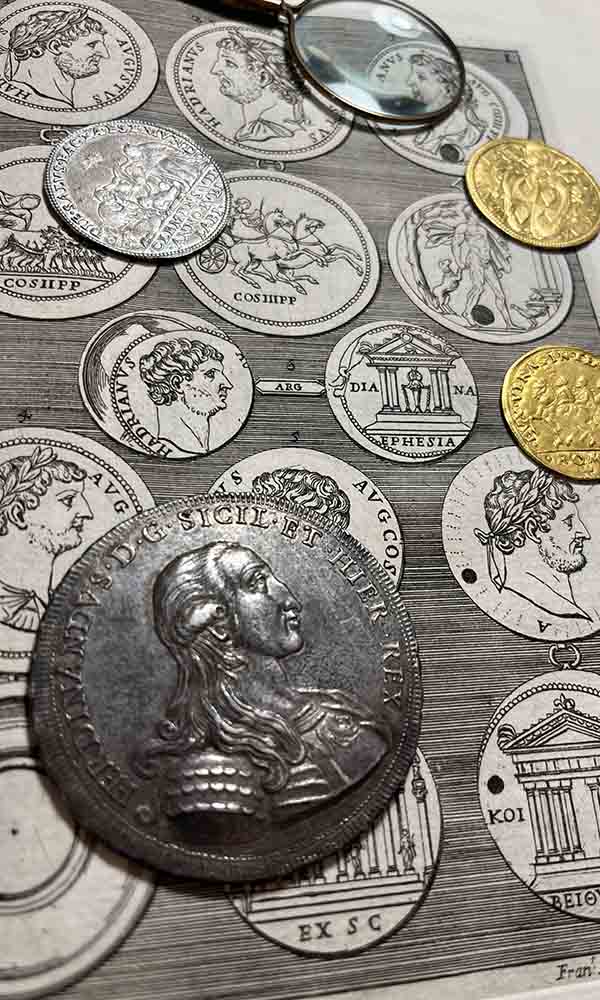
However, a good rule is to carefully examine the sample that we offer, preferably with the aid of a lens. Often asks the experts how to can, who begins to collect, recognize the false or counterfeit products. You can recognize a fake only if you had the chance to examine repeatedly many original. It is therefore obvious that a similar experience is mature with the years, and certainly not in a short time.
If not, what is the meaning would have the figure of the expert? Hence, the importance of the figure of the merchant is to be understood not only as a seller but as a serious professional, capable of distinguishing the true from the false, and, if unhappily ever admit, even their own errors. In the event of a dispute regarding the authenticity of a coin, please contact an expert; with the expenditure is proportionate to the importance of the copy, you can drop its expertise, even better if it's of type of photography.
Riconii in numismatics
The riconii belong to a category of its own as it does not arise in order to defraud someone. It is, instead, a coinage made by the official Mint of the State (and not private), but in the era following that of the first issuance and use of die axis or coin rotation of the original, bearing and then a year prior to the actual typing. They are a clear example of the specimens from 8 florins, and 4 ducats from Austria, bearing the thousandth 1915, or 20 francs, Switzerland 1935. In this latter case, in order to make possible the differentiation between the’ original ‘era, and the riconio, the Mint of switzerland he added after the date on which a symbol (LB).
Conclusions
Hoping to have offered some interesting indication as to the differences between fake, imitation, counterfeiting and riconii, we are waiting for your valuable comments. We also invite you to write us for any information or further details. The official email address is: info@numismaticaranieri.it