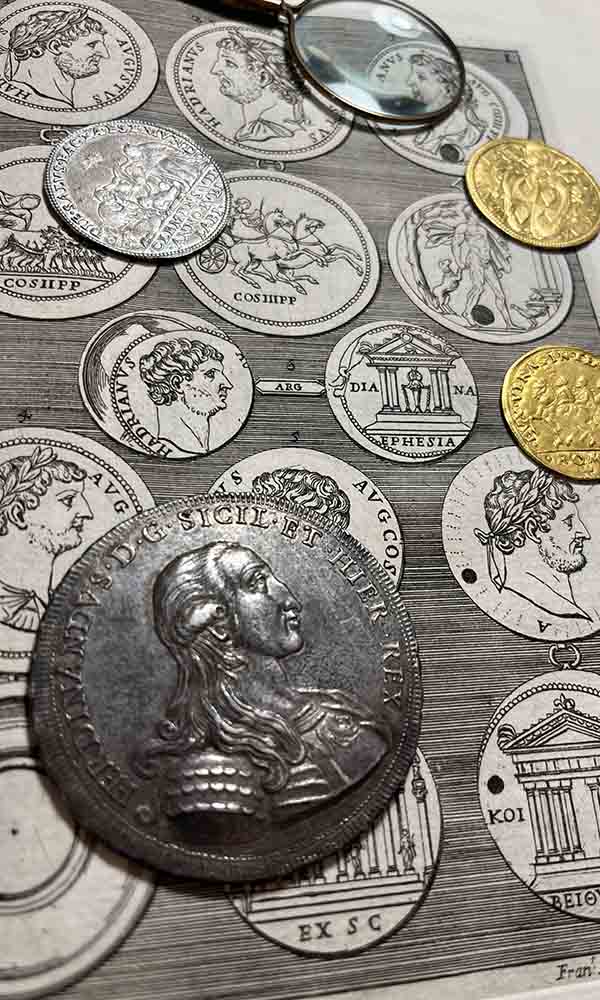


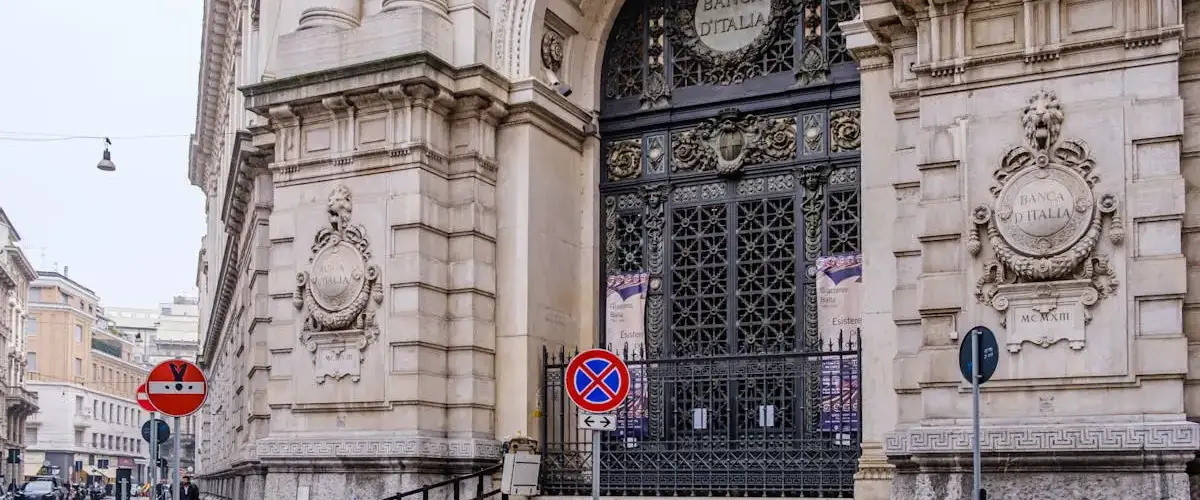
Dear readers Numismatica Ranieri, in the article today is dedicated to discover interesting information on the gold of the bank of Italy. We revisit the adventurous story of the national gold reserves, its concealment, transfers abroad and returned to our Country after the second world war, trying to provide a historical reconstruction inherent in the gold reserves held by the bank of Italy, including relevant historical details. To find out news on the world numismatic we recommend you follow the official blog.
The gold of the Bank of Italy
An Italian treasury and its history
What is courage? It is a state of mind the prerogative only of the heroes young and strong, or it can even be a prerogative of the people who are quite normal, maybe awkward and with glasses, who usually wear dark, and who are working at the desk in the rooms where the street noise coming muffled, but that when they feel they are on your shoulders, burdening the responsibility of the decisions, arm themselves with courage and act as true heroes?
This story is considered “a minor history” with respect to the so-called “history evenemenziale” studied the text books, is a record of heroism, among many others, of simple people that being in dramatic situations have been able to give the best of themselves to resist the violence and the abuse of power, armed with courage and adopting, when it was not possible to another, a strategic line of resistance flexible, while fighting to defend their values. Are past 55 years, from 1943 to 1998, before the story of the gold of the Bank of Italy, orvvero of the appropriation of gold reserves by the National from the part of the naziscome to a conclusion with the recovery of approximately 66% of the gold was stolen by the Germans.
It all began with the abduction of gold took place in the frenzied days following the armistice of 8 September 1943, and was completed in 1998 with the return of the so-called Pool of gold or Gold Pot of the last tranche (of about 764 kg of gold) returned to Italy.
Gold is the central element of this story that unfolds, the intricate and complex, from the glowing atmosphere of Italy, the post-armistice that of a nation, post-industrial and wealthy, but without great social tensions and moral: the Italy of the last years of the TWENTIETH century.
II golden metal has attracted since time immemorial, the human race and has always been, in the imagination of the individual and the collective, one of the most intrinsic and striking power, own it and be able to exhibit it was and remains a status symbol among the most sought-after of all time.
But if gold is the central element of this story, are the values and the human feelings which give thickness to the plot; in fact, the fear, cunning, double game, but also selflessness, sacrifice, and courage are the ingredients that makes this story charming, challenging, and worthy to be remembered.
II looting of Italian gold was part of a large series of raids and retrieval undue carried out by the nazis in the nations occupied during the Second world war, the victims of these depredations were in a particular way, the citizens of the jewish religion.
With regard to the the gold reserves of the Bank of Italy (hereinafter Bdl), already before the outbreak of war, having regard to the aggravation of the international situation, Mussolini himself had felt the need to move from Rome to a safer place from the attacks of the enemies.
The area around The Eagle was the place chosen, as it is considered a most defend-bile from air attacks. For this reason, it was transformed and adapted a set of pavilions in the concrete near The Eagle of 34,000 square metres of covered area used, at the time, for a tannery in the military, then by Snia Viscosa and finally left in a state of state of semi-neglect.
The Officina carte valori de L'aquila, production facility of the Bdl, went into operation in 1941, but the transfer of gold from the vaults of via Nazionale to the establishment of The l'aquila never happened for a variety of reasons: the fall of Mussolini on 25 July 1943, the lack of gold to transfer looted by the Germans from September 22, 1943, and finally the allied bombing of the factory in abruzzo on 8 December 1943.
Already before the occurrence of these events, however, exactly in the spring of 1943, having regard to the unfavourable developments in war, he planned to move the gold bars from via Nazionale to a site more secure in the Veneto region, or in the Alto Adige and Poligrafico dello stato prepared for the occasion of the barrels metal essential to the transport of precious metal, but the fall of Mussolini, had run aground in the project.
In August of the same year, the Badoglio government suggested a transfer of the gold to the North, which, however, was never implemented. In Italy, following the collapse of fascism were were 10 new divisions from Germany, who, in fact, controlled the system of communications in Northern Italy; in addition, the Badoglio government, with his flight to Brindisi, he had delivered Rome from the Germans already from the 10th of September, and with it control of all of the northern and Central Italy.
Occurring in this way, the chance to steal the gold of the Bdl was to lead to a sort of internal competition between some of the authorities of the Third Reich to determine which of these should manage the affair of the Italian gold.
The four were the suitors who, without exclusion of blows, fought for and won the coveted prey, the more a player outside that influenced in a decisive way on the outcome of the same game, and supported one of the parties and reserving for itself about 7 tons of gold, then what will be called “The treasure of the Ribbentrop”.
The four contenders were: Herbert Kappler, Hermann Goering, Walter Funk and Rudolf Rahn, and among them, there was a fight not too underground is made of the quirks, of hypocrisy and of low blows.
But who were the competitors who are competing for the valuable prey?
Herbert Kappler, an expert in criminology and specialized in counterintelligence, was part of the Ss of Heinrich Himmel (and, in the representation of these, on 20 September, and stood in the Bdl to take the gold along with the console Moellhausen. Later, as commander of the Gestapo in Rome, was responsible for the massacre of the Fosse Ardeatine, where they were killed 335 people, including 78 of the jewish religion.
Hermann Göring, the first commander-in-chief of the Luftwaffe, the air force, German war, was responsible for the four-year Plan for the economic revival and then the coordinator of the economic exploitation of the occupied Countries (even if most of exploitation, it was a real sack, a term that would have been more appropriate, as the same Goering had the opportunity to declare).
At THE Nuremberg trials he was sentenced to death by hanging along with ten other nazi leaders, but as far mockery to the jury and to the whole world circumvented the condemnation of them taking their own lives with cyanide the day before the execution. Walter Funk, the minister of economy of the nazi and the president of the Deutsche Reichsbank, the German central Bank, for the acquisition of the Italian gold sent in its representation Maximilian Bernhuber, an executive militarized of the Reichsbank, who played an important role in the story of the gold. The Nuremberg trials convicted and sentenced to life imprisonment. Rudolph Rahn, a career diplomat, cultured, intelligent, and versatile, the ambassador of the Reich at Mussolini, had intervened with Hitler to get his consent to the escape of Cyan, the son-in-law of Mussolini from prison. Aware from the Italian concept of the family, he was convinced that his execution would not be beneficial to the image of the ally, Mussolini.
For the management of the gold reserves of the Bdl, the hypothesis on the field were mainly two: Goering wanted to bring the gold of the Bdl in Germany, considering it as the spoils of war, path, this is hardly practical, especially after the establishment of the Italian social Republic (Rsi) announced on 23 September; while the diplomatic Rahn preferred that the ingots were transferred to Milan and delivered directly to Mussolini, since, he said, “Italian gold must have only the Leader” which, as an ally of the Germans, would have been able to contribute to the war effort shared by the gold reserves of italy; following this second way, the gold remaining in the formal competence of the Italian authorities, while also being done under German control.
At the end the diplomatic Rahn managed to acquire a certain degree of supremacy over all the other general German companies operating in Italy, both for the affair of gold, both for the aspects of the political and military regarding the northern and Central Italy.
On the other side of the fence, to defend the gold reserves Italian, there were only employees and executives of the Bdl, which, being in a desperate situation, did everything counteract the malicious intentions of the germans, and the first among these was undoubtedly Vincenzo Azzolini.
Coming from a middle-class family in naples, Azzolini had entered the Ministry of the treasury in 1905 through the competition in the role of administrative secretary, and, running all the stages of the hierarchical scale, 22 years old, had become the director-general. After only one year of the appointment, went in the same role in Bdl.
In this delicate task is made particularly appreciated by Bonaldo Stringher, that shortly before his death designated him as his successor to the office of governor, a position that Azzolini cover from 1931 to 1944.
Vincenzo Azzolini was a great worker, from the wide-ranging skills from not ordinary ability, was able to extricate himself and solve many of the problems and the crisis of the world, the Italian bank, also at the international level, is distinguished for skill and balance. His misfortune was to be to be the governor of the Bdl in the worst period of the fascist dictatorship, namely, that of the decay and fall. While the Germans are disputing the management of the Italian gold, the vertices of the Bdl warning of what was growing, thought of as a cover-up, in the eyes of the germans, the gold deposited in the vault, the so-called “limelight” of the Bdl.
The idea was inspired by Fabio Urbini, the cashier of the central Bdl, who made a sharer Nicholas Introna, deputy director general of the Italian central Bank, which, in turn, suggested to Vincenzo Azzolini; the governor, though with some hesitation approved. The amount concealed from the Germans would have been a little less than half, about 52 tonnes of gold up of 119 truly present.
In the night between 19 and 20 September, after having transferred the gold to hide from the germans, was walled up in a hurry, the door which admitted from the sacristy to the cavity, a local built for security reasons, and adjacent to each of the vaults of the Bdl; it then passed to the drying of the wall, still fresh lime, by fans and electric lamps.
From the point of view of the administrative and accounting procedures, was simulated delivery of the same amount of hidden gold, backdated to 19 December 1942, to the branch of Power the next to fall under the control of the Allies landed in Sicily, the I July 1943; the aim was to avoid, with this move, the possibility of control on the part of the Germans about the real amount of gold.
On the morning of 20 September, he received an official request from the German embassy by the government commissioner for finance Ettore Changes, Azzolini this request had to make a decision of this kind must, in accordance with the articles of association, refer to the directory.
The steering committee, a body of the summit Bdl, was composed of the governor, the director general and deputy director-general, but in the specific case was extended to the secretary-general Gaetano Giacomelli, to the cashier of the central Fabio Urbini and Rocco Quattrone.
From memorial Azzolini is that he had learned informally by Giovanni Acanfora, director-general of the Bdl and also minister for trade and currencies in the Badoglio government, which the Germans having taken possession of the archive of the staff were aware of the real amount of gold stored.
Acanfora, during the process Azzolini love this episode, said he “can't exclude to have reported to Azzolini on that particular in a previous meeting, picking up an item that is not certain, nor the subsidiary that ran in different environments.”
The executive board approved unanimously the request of the Germans, the transfer of the gold to Milan, and is also seen that the nazis were able to see the true texture of the gold reserves, and gave a favourable opinion to move again in the “sacristy” the gold hidden in the cavity.
The transfer of the stock of gold from Rome to Milan it came to pass via train in two loads, the first on September 22 to about 25 tons of gold, and the second on the 28th of September to about 94 tonnes of the precious metal.
Once transferred, the gold was placed in the Milan branch of the Bdl and the director Francesco Sforza, he asked and obtained that, in exchange for the delivery of one of the three keys needed to open the “sacristy” , the Germans sospemdessero the armed guard of the vault.
After Goering, who had not given up his idea of appropriation tout court, of the gold of the Bdl, and sent an order for the transfer of gold from Milan to Fortezza (Bolzano), a village in the Isarco valley in south Tyrol, including in an area subject to German control.
Rahn initially opposed the transfer, but sold it because the design of Goering was supported by Ribbentrop, and in exchange, he had the assurance that would have man taking full control on gold.
Maximilian Bernhuber, of the Deutsche Reichsbank, communicated to Azzolini the decision, with whom Domenico Pellegrini Giampietro, minister of finance of Csr, in which it urged the implementation of the transfer of the gold to the Fortress at the top of the Bdl. That was a representative of the Deutsche Reichsbank to do as a conduit for communication between the minister and Azzolini says a lot about the power relationships existing at that time between the ministers of the Republic of Salò, the germans and the vertices of the Bdl.
The gold arrived at the Fortress on December 16, escorted by the Ss and was accompanied by the officials of the Bdl, was placed in a cave inside the military area, and the entrance of the cave wall, then it was prepared a cell door instead of the wall.
The gold and then it was still owned by the Bdl, but in a strong German military, which was under the jurisdiction of the Alpenvorland, the German protectorate, which included the provinces of Trento, Bolzano and Belluno, become after The 8th of September, to all effects an integral part of the Reich, and of whose government he was appointed Gauleiter (regional governor) Franz Hofer.
In January 1944 Goering returned back to the office, asking to move in Germany the equivalent in gold of at least 50 million marks. This time his request was advocated by Ribbentrop, and, after a series of negotiations between the Germans and the representatives of the government of the Rsi, on the 5th of February it came to the so-called Agreement of Fasano, a town on lake Garda headquarters of the German embassy, according to which Italy would contribute to the expenses of the war by the gold of the Bdl. From the point of view of the formal and legal agreement constituted as a free transfer from the Csr, in exchange for a service of defending the territory of the Italian from the common enemy. On the 29th of February, by rail, it came to pass in the first shipment of gold from a Fortress in Berlin at the Deutsche Reichsbank, to about 50 t of up equivalent to a total of 141 million marks in gold. Also for the second tranche of the shipment of gold in Germany, Berhuber delivered to Azzolini a letter in which the Minister Pellegrini Giampietro gave the approval for the operation.
In the meantime, in December 1943, 1'amministrazione of Bdl in accordance with government directives and to the equal of other state bodies and major public bodies, it was moved to the north.
Azzolini, it managed to transfer in Moltrasio, on Como lake, 105 employees on 1,200, limiting it to a maximum of the discomfort of all those who worked in the Bdl, and he himself, after a few months of coming and going, who came on a mission to Rome, he stayed there waiting for the liberation of the capital on the part of the Allies.
The minister had then appoint a commissioner in the person of John Orgera, but even these do not run immediately to the order for the second shipment of gold in Germany, and wrote a letter to the minister to highlight the risks that would lead to the Country, the complete delivery of the gold that there was a residual in the Fortress.
The ministry confirmed his order, but Orgera managed to procrastinate until the month of October 1944 by reducing the quantity to be delivered to 21 tons of gold, equal to about 60 million marks in gold. The gold reserves be transferred to Berlin after the second tranche amounted then to 50 t +21 t = 71 t about.
During 1944, the men of the Bdl, in spite of the imbalance of power relations with the Germans, they did everything to maintain the faith of the loan agreement with Switzerland and, after a long negotiation, obtained the consent of the German operation. Then, on 20 April 1944 he was transferred from the castle to the Swiss gold relative to the matches of the swiss national Bank (Snb) and the Bank of International Settlements (Bis), for a total of about 23 tons of gold.
Azzolini also in this episode, he played an important role, that shows how he was the heart of the international credibility of Italy and of the Italian central Bank, in fact, Bruno Kininger delegate business in Switzerland of the Csr, and then a direct witness of the affair, wrote in this regard: “a Useful, valid, and valuable it was then the daily intervention of the governor Azzolini”.
The governor, in addition to direct actions, when he could not openly to the orders of the government, he implemented a strategy of resistance, flexible, defer, procrastinating and pretending not to understand, every move request of the gold of the Bdl defending and then with each half of the gold reserves of italy. A valuable work that has often been underestimated compared to the clamors of the firstborn of the love stories of the proceedings which saw him involved, and that would finally be recognized for the purposes of a judgment clear, and overall about his work.
Azzolini returning at the end of April, in Rome, as it had done for Italy, you would certainly be expected as it was waiting. After a vigorous press campaign against him, he was interrogated by the military police of the british, removed from office of the governor of the Bdl and put under house arrest, while the routine management of the Bdl remained Niccolò Introna, and on 29 July he was appointed extraordinary commissioner of the Bdl.
Following the decree-law issued by the government Bonomi for the repression of crimes committed during the fascism, August 1, Azzolini was arrested “for the rear to 8 September 1943, Rome, collaborated with the German invader, by the same delivery of the gold reserve of the Bank of Italy”.
The process took place in October and Azzolini was sentenced by the High court of justice for sanctions against fascism, to 30 years of imprisonment, most of the damages. The ruling was the result of natural climate fiery of those days, and the former governor, became the head of the sin-offering for every wickedness perpetrated by the nazis in italy.
He was then imprisoned until September 1946, when the Court of appeal of Rome declared extinct for amnesty for the crime he accused the High court. Finally, in 1948, in an atmosphere more relaxed and balanced the supreme Court nullified the judgment of the High court on the ground that “the act does not constitute a crime”.
But where was going to end the Italian gold after the transfer in Berlin? The main sources to examine the events of the gold in Germany are represented by two memorials, one of Paul Carlo Della Torre, head of the agency of the Bdl created in the Fortress, and that of a citizen of the austrian by the name of Herbert Herzog.
The interesting thing is that the two sources, completely independent of one another, do not contradict ever, reinforcing each other and their trust.
Herzog was a very special character: born in Vienna in 1922 and interned in Buchenwald as a “mixed blood of the first degree”, below, was able to obtain the documents of particular importance regarding the game gold Italian moved to Austria after being passed in Germany.
In 1950 he proposed to the legation of the Italian Bern this documentation, for the purpose of facilitating, in return for remuneration, the recovery of the gold stolen. II Ministry of foreign affairs informed of this opportunity, the Bdl who, having invited Herzog to Rome to assess the reliability, signed a letter-agreement with the austrian citizen, which provided that, if the documents in his had allowed actually to Italy to regain the gold, he would receive a fee equal to 10% of the retrieved value.
In 1951, Herzog gave it to the Bank of Italy report on the lot that had been a part of the gold that arrived in Germany from the Fortress.
On the basis of this report, the Bdl prepared a dossier with which he undertook the complete restoration of this game is gold, which, however, had not a positive outcome. For an agreement between the three nations are the members of the jury (England, France, and the United States), this game gold was first considered as an anticipation of the share of Austria in the redistribution of gold, nazi, but thanks to the revelations of Herzog, the gold was entered in the Gold Pot.
In the end, Italy was restored, only 0.58 and t of the so-called “Treasure of Salzburg” and Herzog, as agreed, he received the dollar equivalent of 10% of the gold recovered only in 1958.
In 1957 Herzog sent a second memorial to the Bdl, which was about the whole story of the gold stolen from him, not only on the match found in Austria, accompanied by copies of several documents mainly coming from the Reichsbank, and in which the austrian national foreshadowed the possibility of a full refund of the gold of Italian origin, found in a mine of potassium in Thuringia.
After receiving an unfavourable opinion by the Ministry of foreign affairs, about lereali possibility of a full recovery, the Bdl rejected the second proposal for a collaboration of Herzog.
But as was the case of the transfer of gold from the Fortress in Germany?
The 50 tonnes of gold matches from the Fortress on the 29th of February to first enter in Berlin arrived at the destination after an adventurous trip lasted 3 days. A part of this gold, amounting to about 8 t up, she was taken directly to the German foreign Ministry, while the remaining 42 tons, together with 21 tons of the second sending of the 21st of October, were forfeited by the Deutsche Reichsbank.
The Italian gold, for about 62 t held by the German central Bank, was the equivalent of two dispatches from the Fortress towards Berlin: 71 t deducted from the levy made by the German foreign Ministry about 8 t, the game, the Cei (Italian national Institute for foreign exchange) of around 2 t, which the Reichsbank considered as a credit in the gold granted at the time) at the same institution and, as such, had forfeited, more about 1 t of gold encased in following a verification of the German central Bank gold diverted to the Ministry of foreign affairs; while the fund for the Italian Embassy in Berlin about 1 t provided for in the Agreement of Fasano never had a practical application.
In February 1945, in view of the evolution of the military situation, the germans decided to transfer all of the gold held in the vaults of the Reichsbank, in a most safe, a mine of potassium in Iocalità Merkers-Rohn in Thuringia.
The Allies occupied the area less than a month later, blew up the door of the gallery of the mine, potassium, finding gold for about 213 t that was handed over to the tripartite Commission to send it back to the countries plundered by the Germans. II “treasure of the Ribbentrop”, about 8 t, which is a part of the Italian gold from the Fortress in Germany and diverted directly to the German foreign Ministry, was divided into three parts, the first of about 2 t was buried in three crates near the city of Plun and at the end returned to the Allies, the second part of about 5 t, known as the “Treasure of the Salzburg, was transported in Austria at the castle of Fuschl near Salzburg and there, for security reasons, buried in the cellar of the abandoned farmer's Alois Zeller, located in the Salzkammergut, while about 1 t of gold, as already mentioned, was forfeited by the Reichsbank, following an audit.
The gold remained in the Fortress, a total of about 25 t up, it was completely recovered by the Allies in may 1945 and returned to the Bdl for its preservation, without cedergliene the title, in fact, the keys of the vaults were held by the command of the anglo-american.
After the war, he began a long and laborious process to recover the gold stolen by the Italian government and the Bdl at the tripartite Commission.
The commission of the american State Department was to combine the gold recovered to that the nations neutral, that had the gold transactions with Germany would have been able to make available, and divide it among the allied nations in proportion to the losses claimed. The idea was to create a single Gold Pot and then make a distribution of the gold, in the form proportional to the various demands of the Countries attacked.
This, even though it was not expressly stated, in fact exclude Italy from the recovery of stolen goods, not having our country the status of “ally”.
Russia, during the Potsdam Conference, had renounced any claim on gold recovered by the Allies in exchange for significant concessions of territory, France declared itself in agreement with the setting of the u.s. Department of State, while the Uk was initially for a return to the rightful owners of the gold, with an additional refund, on a pro rata for the amount not assigned.
In view of the difficulty of ascertaining with certainty the origin of the different items for gold and the failure of the gold recovered to fully meet the demands of the Countries that had endured undue appropriations, an agreement was reached among the allies reflected the american position.
Italy, despite not having been invited to the next Conference for the repair of Paris in 1945, he obtained along with Austria a discreet opening in the final document of the Conference itself, with respect to the possibility of the recovery of gold, “in the above mentioned distribution shall be reserved, and the equivalent of the total shares Which country would receive, if they were eventually admitted to participate in, [...] as may be decided by the Allied Governments concerned”, that is, “in the abovementioned distribution will be kept suspended and the equivalent of the shares [of gold], that those Countries could receive, if these were eventually allowed to participate as it will be decided by the allied governments concerned.”
II 27 September 1946 and was formally established the tripartite Commission, composed of Great Britain, France, and the United States with headquarters in Brussels, the distribution of the monetary gold.
The task of the Commission, called the Pool of gold, was to receive and examine the claims by the nations, looted, and have them deemed eligible, to establish the portion of gold for each applicant State.
The gold of the PooI was composed, then, both from the one found in Germany, is the one of the deposits of neutral Countries during the course of the war had had with nazi Germany gold transactions.
Switzerland is the first country for the transactions between all the neutral countries, after a year of negotiations agreed to pour into the coffers of the Pool 52 tonnes of gold, up from about 257 t-evaluated, as the amount of transactions carried out by the experts Allies.
This provision followed those of Sweden, Spain and Portugal, a total of 10 t of gold.
Italy pointed both to a full refund of the 71 t, stolen and shipped to Berlin, is about the most realistic entry in the breakdown of the gold Pool, this is confirmed by the successful cobelligeranza with the Allies began on 13 October 1943, cost a lot both in terms of human lives and financial resources.
After the signing of the Treaty of peace, which took place on 10 February 1947, the three States, the Commission signed an agreement in which in addition to agreeing to the submission of the questionnaire to our Country, they recognized the ownership of the 25 tonnes of gold found in the Fortress, which was already deposited in the vaults of the Bdl.
And then came the questionnaire which admitted implicitly Italy to return the gold stolen from him; it was a complex document, composed of a general part, in which, among other things, it called exactly the monetary gold, that is the one admitted to the claims, and a series of attachments to be filled out for a precise and detailed description of the gold stolen, and all evidence of ownership of the same.
On the 16th of December was formalized the entry of Italy in the gold Pool, through the signing of a protocol of admission which included in addition to on the return pro rata share of the gold stolen, the full satisfaction of the claims of italy to Germany, and, last but not least, the commitment to carving out by the quota, an amount of gold equal to the complaints pending against France and Yugoslavia.
The admission and the recognition of the claim were a first step that would lead to the repayment true consisting of two phases: the assignment, the theoretical with the provision of the quantities of gold that is assigned and the effective return, which provided for the transfer material of gold in the country, the assignee, and the subsequent entry to the reserve.
The amount of the gold is distributed in the total amount from the Pool was about 337 tons. Due to successive acquisitions by the Pool, the assignments for the Italy were more than one, for a total of about 47 tons of gold of about 71 t claimed, then approximately 66% of the gold stolen.
The quota were deducted, of course, the quantities in favour of France (about 14 t) and Yugoslavia (about 8 t), wrongly held by Italy since forfeited the spoils of war.
From the first allocation of the Pool of gold to Italy, which took place in 1947, the last assignment, 1998, has spent over half a century and the time through which you will get justice (partial or total) inevitably affects the quality of justice itself.
The gold reserve of the Bdl, as at 31 December amounted to about 2.452 t gold, with a mass much larger than the 119 tonnes of gold have been stolen by the Germans in 1943; the rest, in addition to differences in the value of the accumulated gold and all the reference parameters that are changed in 62 years, it must be considered that the gold reserve of the time was minimal, having undergone numerous leeches due to the defense of the exchange, security this abandoned as a result of the devaluation of the lira in 1936.
We arrive then at the end of the complex and engaging story of the gold of the Bank of Italy, a sort of treasure hunt dramatically alive and real, where you were in the game the feelings, values, affections, and, not least, also the very life of the participants.
A story played in the first person by the so-called “white collar”, attached to the family and to the office, people measured, and a little flashy, but that, when the situation is dramatic, and the great leaders because for the overthrow of the lot, without hesitation and with a strong inner awareness, take upon himself the responsibility and the decisions that the historical moment requires.
Conclusions
Hoping that this article is dedicated to discover the historical events of the gold of the Bank of Italy has been of interest to you, waiting for your opinions.
You can let us know what you think or send us other tips through the space, and comments confidential, or through the contact page. Also for any doubts or queries please visit the contact us section of our website.
For any information or further details of our e-mail address is the following: info@numismaticaranieri.it
To the next one with the best news related to the world of numismatics.