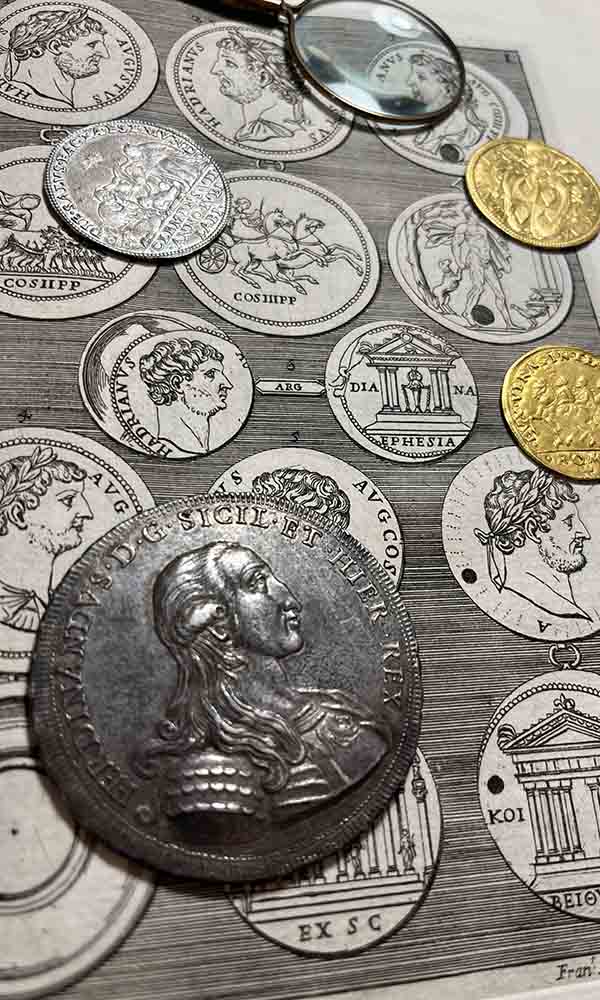


Dear readers Numismatica Ranieri, in this article of our blog numismatic we will talk about the opposition between art and antipathy in the two medals twins. Are those depicting the port and the aqueduct of Civitavecchia bulinate by Ferdinand de Saint Urbain and by Giovanni Hamerani. Two artists, greet rivals, in the service of the pontifical mint.
Art and antipathy in the two medals twin
At the beginning of the Eighteenth century, Rome had a few more than a hundred thousand inhabitants, a population that is fairly contained, and that in the cultural circles – few, to be honest, we knew a little about each and every one you knew the virtues and vices, as you knew dislikes that divided the engraver of the chamber of commerce Giovanni Hamerani by his deputy, Ferdinand of Saint Urbain. Ferdinand de Saint Urbain was obliged to flee from his native Lorraine occupied by enemies, and had taken refuge in the house of a nobleman in Bologna, where he obtained the post of page.
His propensity for the fine arts had convinced the landlord to make him study and, at the end of the EIGHTEENTH century, the lorraine had become the engraver, head of the mint of that city. From here, seeing his talent, the treasurer of the apostolic Chamber, Ferdinand de Saint Urbain monsignor Lorenzo Corsini, the future pope Clement XII, had called him to Rome, at first only as “above alli needle”, that is, as the second engraver cones coin; then, as vice-engraver of the chamber of commerce, that is, a substitute for the artist, who had the task to affect only the cones for the medals of the official papal.
Since 1676, this prestigious office was covered by Giovanni Martino Hamerani, belonging to the third generation of a family of engravers, who about a century had established on the square in Rome. Giovanni Hamerani, among other things, he was a profitable private business in his workshop In the sign of the she-wolf (so called because his trademark was formed from the lupa capitolina) in via dei Coronari, where they minted medals of all types and all genres, including reusing the old cones of papal medals official.
The antipathy between the Hamerani and Saint Urbain was immediately palpable, the roman already enjoyed a great international prestige to the point that even from the far-off London, sir Isaac Newton, the then director of the mint of the English, had commissioned some studies for the invoice of new models of pounds; however, he was afraid of the ability of lorraine, certainly superior to him for art and creativity. From here, the hostility, personal as well as professional, that the Hamerani immediately showed to the other engraver, to the point that twice voted against the admission of Saint-Urbain in the Accademia di San Luca.
However, the Hamerani, although holding for 25 years, the office of the engraver, of the chamber of commerce and was a personal friend of the pope Clement XI, and since the latter was still a cardinal, he had to accept, considerable arm twistingin 1701, the appointment of his deputy of Saint-Urbain.
Unfortunately, the misfortune – as they say – are not never be alone. So, in the spring of 1702, Giovanni Hamerani was seized by a stroke, or, according to the documents of that period, from an attack of “apoplexy”. Therefore, the medal of The year of the pontificate of Clement XI, 1702, who was preparing, the celebrant of the mission entrusted to monsignor Tournon to go to China to place the friction between the local authorities and the catholic missionaries, had to be completed, in a hurry, children, Beatrice and Ermenegildo Hamerani.
Meanwhile, the time was drawing near of the minting of the annual gold medal of the year III of the pontificate of Clement XI, 1703, which was to celebrate the opening of the new aqueduct of rome, and was designed by the architect Carlo Fontana in a dozen years before, under Innocent XII (1691-1700).
The Hamerani, from the time she was still very ill and lay in your bed who was partly paralyzed, it would not be able to engrave this medal, which esecuzlone, therefore, was given to his deputy, Saint Urbain, in fact.
He developed a beautiful medal. II straight shows a realistic picture of the pope; but even more beautiful is the reverse: the square where stood the “show” of the aqueduct, the view from the sea, from the port, where, at the bottom, you can see the wall, wanted by pope Clement X (1670 - 1676). Higher up, between the hills overlooking Civitavecchia, is a representation of some of the arches of the aqueduct itself. The legend is more than ever relevant, is from Isaiah (12, 3).
However, the Saint Urbain received compensation for his work, praised and admired by all, only 13 September 1703! And there is a reason, indeed, at least two, of so much delay in payment.
To begin with, in the meantime, the Corsini had been replaced, and so the Saint Urbain had lost its protector in the Curia. But the main reason was, once again, the Hamerani. These, for malignancy, using all of their outstanding support, meant that the administrative offices of the apostolic Chamber ritardassero the payment to the Saint-Urbain, convinced as he was that the lorraine, because of the poverty in which he was, would have been forced to leave early from Rome. And he was right! Ferdinand of Saint Urbain, in fact, accompanied by his wife and two sons, went out from the Door of the People in a morning of march 1704, and if he returned to Lorraine, where it was restored to the throne as the legitimate duke who had been recalled to fill the role of head of brand of Nancy and the ducal architect.
Giovanni Hameraniinstead, when he recovered well or ill from the stroke, it started to work, and his first opera was just a larger version of the medal for the aqueduct of Civitavecchia. He, however, he copied down to the smallest detail, the representation of the reverse of the medal the annual Saint Urbain he had only a few months before!
But the Hamerani not there, he never fully; indeed, his health after a temporary improvement, began to get worse, so much so that at a certain point he no longer had even the strength to hold the graver. Reduced to a life that is practically vegetative, Giovanni Martino Hamerani moors at his home on 28 June 1705, on the eve of the feast of saints Peter and Paul, in that occasion, for 29 years, was recorded in the annual gold medal of the roman pontiffs.
Conclusions
Hoping that this article is dedicated to discovering the contrast between art and antipathy in the two medals twins have been of interest to you, waiting for your opinions.
You can let us know what you think or send us other tips through the space, and comments confidential, or through the contact page. Also for any doubts or queries please visit the contact us section of our website.
For any information or further details of our e-mail address is the following: info@numismaticaranieri.it
To the next one with the best news related to the world of numismatics.