

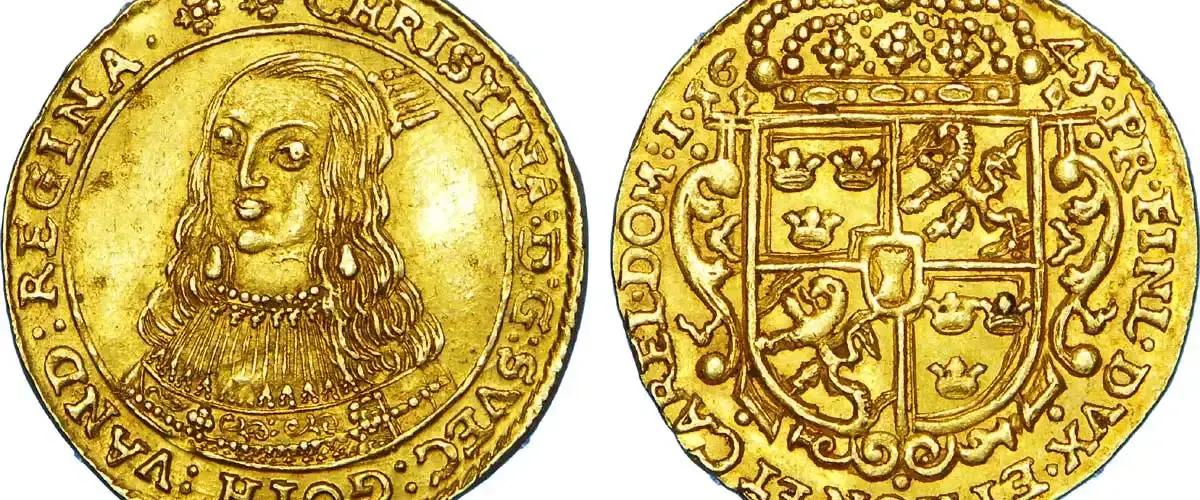
Dear readers Numismatica Ranieri, inside this blog article, we will talk about the money created to celebrate the abdication of queen Christina of Sweden, offering you the history contained in it. Good read.
The abdication of queen Christina of Sweden
The renunciation to the throne of Christina of Sweden after the conversion to Catholicism was not a defeat, but the maximum win for the woman, who settled in the City, it nobilitò the life artistic and cultural debate
If it is true that the art of the medal had the maximum brightness, especially between the late Fifteenth and the first half of the Sixteenth century, even by the mid-SIXTEENTH century and throughout the SEVENTEENTH great, sometimes even great, medallists such as, just to name a few:
- Alessandro Cesati
- the brothers Bonzagni
- Leone Leoni
- Jean Charles François Cheron
- the Hamerani
- Girolamo Lucenti
- Massimiliano Soldani
- Gaspare Mola
- Gaspare Morone Mola
Artists, these and many others, who made the great medal of the baroque and made it the great in a particular way to Rome, putting their art at the service not only of the successors of Peter, but also of the highest prelates, members of the roman nobility of the characters more or less illustrious, all keen to use the small round metal, cast or minted, to spread among his contemporaries and to hand down to posterity their appearance and their businesses.
And it was one of the most lively and the most extravagant of environments cultural and socialites of Rome in the second half of the XVII century it was certainly the queen Christina of Sweden.
The story of queen Christina of Sweden
The daughter of Gustavo Adolfo Wasa, the protestant king of Sweden, was found to be the queen, of course, under the protection of, just six years for the death of his father in the battle of Lutzen. Just reached the age of majority, had begun to show sympathy for Catholicism, so much so that a few years later, in 1654, he abdicated in favour of his cousin Charles Gustav, and began the long march towards Rome, both in the spiritual sense is in a real sense. He had embraced, then, is the catholic faith, first privately in Brussels, in 1654, then publicly, in 1655, in Innsbruck, where he had made the decision to settle in the City.
Here was arrived in December of that same 1655, which was received in triumph by pope Alexander VII and the occasion was renovated by Bernini the Door of the People, as noted by the annual gold medal of The year of the pontificate, 1656, made by Morone, grinding Wheel, which was mimicked by another medal similar to Alberto Hamerani, which seemed to want to compete in skill with the Morone Wheel, then the engraver of the chamber of commerce.
Woman with a bizarre character, extrovert, but of profound culture, tied his fame mainly to the meeting place of artists and men of letters, of which he surrounded himself in his palace in Rome, in via della Lungara, furnished, according to the new taste of the late-baroque style, both with “strange things”, such as, for example, the Bosco Parrasio, a beautiful park at the foot of the Janiculum hill, in which the taste of the classic Italian garden, mingled with the rarity of the botanical garden; both with “rare things” can collect and, above all, to “investigate,” according to the new spirit of critical-scientific: not for nothing that the Seventeenth century was the century of Galileo, Newton, Copernicus.
But she was also a passionate numismatics, who has managed to put together a famous collection of roman coins, and not only. But the medals are dedicated to her, the best expression of the art of medals, roman, form a real corpus; for she modeled, in fact, Massimiliano Soldani, Gasparo Morone Mola, Gioacchino Francesco Travani, John the Baptist Guglielmada, Cheron, and many others.
Just Massimiliano Soldani should be a medal of Cristina that celebrates both the victories of Sweden on his enemies, and, above all, the victory of the Queen on itself, on its ambition; the victory, that is, obtained with the abdication: the victoria maxima, as indicated by the legend.
The obverse shows the bust to the right of Christina of Sweden with her hair and entwined with strands of pearls, wears a low-cut with a cloak edged with ermine, stopped on the right shoulder with a clasp to diamond: beautiful straight, this, that served as the model for a whole series of medals named Gloria Deo, and ordered by the queen herself be his “history of metal”, that is, a series of medals commissioned by a character, to exalt their own companies.
On the other hand the “stories metal” were typical of this period: it is enough to think of that of the Sun King, to that of the medici, or even in the series of the return of papal that make everlasting in the metal, not a single pontiff, but the whole series of popes, offering – for the first successors of Peter – even portraits and coats of arms of the imagination.
The reverse depicts, surrounded by the legend VICTORIA MAXIMA, the winged Victory going to the left on globe, holding in the right hand raised high, a crown of laurel, and in the left a palm branch; below, in the field, to the left and to the right of the picture, G[loria] D[eo].
“This reverse – writes de Bildt, in his essay Les médailles romaines de Christine de Suède – this is the glory of a reign victorious victories obtained [from Sweden] over all his enemies by land and sea, but like glory force has given way to the glory of the abdication, where she [Cristina] triumphs over herself in this great opportunity, the most striking of victories, who prostrate themselves, and the world at his feet, and this is the victory that deserves to be called the greatest: VICTORIA MAXIMA”
Conclusions
Hoping that this article dedicated to discover more about coin depicting the abdication of queen Christina of Sweden is of interest to you, waiting for your opinions.
You can let us know what you think or send us other tips through the space, and comments confidential, or through the contact page. Also for any doubts or queries please visit the contact us section of our website.
For any information or further details of our e-mail address is the following: info@numismaticaranieri.it
To the next one with the best news related to the world of numismatics.