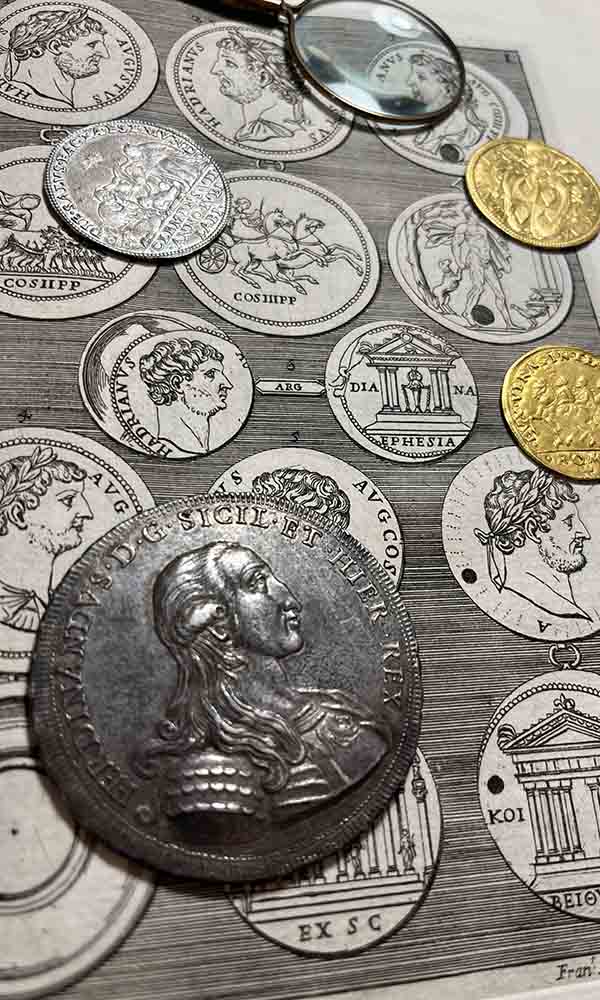



Dear readers Numismatica Ranieri, inside this blog article, we will talk about the time in which the banknotes were worth gold. After having spoken of the story about the gold of the Bank of Italy, we continue the analysis of the value of gold and coins, investment gold. To discover the listing of the actual coins, gold investment managed by Numismatica Ranieri, we recommend that you check the ratings, updated daily. Good read.
When the banknotes were worth gold
The troubled life of the gold standard Italian. The “gold clause”, a coupling that today would not be feasible.
A question that is often posed, especially in the moment of passage from the Lira to the Euro in the period, therefore, of settling economic characterized by the depreciation of the new paper money and cons from the increase in the price of gold was if the solution to the inflation were to be found in the payment of wages and pensions in notes convertible into gold.
In general the coupling of income to gold, either through the indexing of the value of the contract to one of the metal yellow (“gold clause”), and with the circulation of banknotes convertible, does not protect from inflation. This is because the value of gold increases or decreases over time as the one of any other goods. However, in the early stages of inflation and prices of the metal to high, the coupling allows for protection, even if it is limited.
Between 1900 and 1914, for example, a family of the middle class could live modestly with 3,500 lire annual income, which then amounted, in fact, 1.016,50 grams of gold. At market prices today would correspond to about 19.100 euro.
In Italy, the gold standard, in the form used by the player, when 100 lire paper were obtained by five marenghi containing 29,03 grams of gold, had a limited existence, and troubled. It was in force from the first of January, 1862 to April 30, 1866, and from 8 April 1881-10 August 1893. From December 21, 1927-October 4, 1935, banknotes could be converted at the exchange rate of 1 lira g 0,07919 only in rods of the minimum weight of 5 kg. However, the fascist regime considered “antinazionali” conversion requests.
In fact, after this date, the gold standard was abolished. In the most important european Countries, it was allowed, except for temporary exceptions, throughout the Nineteenth century, and until a few days before the world war began in August 1914.
It was resumed in the second half of the twenties, but was overwhelmed by the The great depression began in 1929. Only the United States in the second world war, and permitted the foreign central banks to change your dollars at the rate of 35 per ounce (g 31,1) gold. From the first of August, 1971 the vaIuta american is inconvertible.
Today, no economist laments the gold standard. However, given that ideas such as those of the reader recur frequently, especially in the presence of inflationary pressure, it is useful to know, albeit in a nutshell, as operated on the gold standard.
It provides that the State:
- establish and maintain a stable monetary unit of the Country (lira, dollar, pound sterling, etc.,) in terms of the amount of metal (e.g., from 1814 to 1913, the pound continued to be equivalent to g 7,32);
- to allow the exchange of paper money at par and gold sight;
- to allow the free export and import of the yellow metal. In this situation, the exchange rates between the different currencies has not diverged much from the relationship of the respective content of gold.
For example, given that a dollar contained g 1,50, it took 4,88 dollars for 1 pound. Economists had spread to the thesis that States had to maintain at any cost the convertibility, and then the exchange of the national currency. Not only for reasons of prestige, but also because, then as now, the fixed exchange rates encouraged international trade. In addition, when the external accounts of a country had a surplus or a deficit, in a short time, the gold standard re-establishes “automatically” the balance.
In tune with the liberal ideas and liberal then in vogue, which condemned the intervention of governments in the economic field, this automatism limited strongly of their discretionary powers.
To understand these “virtues” of the gold standard it is necessary to remember that there existed and still exists, a direct relationship between the quantity of Money (in this case, simplifying, gold and banknotes) in circulation, and the general level of prices. In particular, an excessive circulation of gold and/or banknotes convertible caused inflation, while blood circulation is insufficient produced deflation.
If the annual value of imports and exports was the same, the inflow and outflow of gold and abroad are compensated for the gold reserve of the bank of issue remained unchanged. If, however, the value of imports exceeded that of exports, i.e. in the event of a deficit in the balance of payments, and the gold flowed from the bank to pay foreign suppliers (who did not accept the paper money, foreign).
Given the obligation to ensure the convertibility of banknotes, the contraction of reserves forced the bank to reduce the movement of the cards. This would decrease the prices of domestic goods; exports had so reduced, while imports become more expensive, were hampered. Then, in a more or less short, the external accounts, they tended to come back into balance. However, to avoid a deficit continued prosciugasse the reserves, the authorities usually increased the discount rate and the interest rates.
These measures were pouring in liquid funds from foreign operators. In addition, the increase in the cost of money, made more costly bank loans for which the operators of the national reduced investment and employment. This led to a reduction in employment.
II automatic balancing operated in a manner diametrically opposed when the annual value of the imports was lower than that of exports. Ultimately, the burden of the maintenance of convertibility and the gold parity had a negative impact mainly on the workers. This was possible in times of weak unions and political regimes with little or no democratic, while today, the social costs for them would be unbearable.
Conclusions
Hoping that this dedicated article to find out when the banknotes were worth gold has been of interest to you, waiting for your opinions.
You can let us know what you think or send us other tips through the space, and comments confidential, or through the contact page. Also for any doubts or queries please visit the contact us section of our website.
For any information or further details of our e-mail address is the following: info@numismaticaranieri.it
To the next one with the best news related to the world of numismatics.