

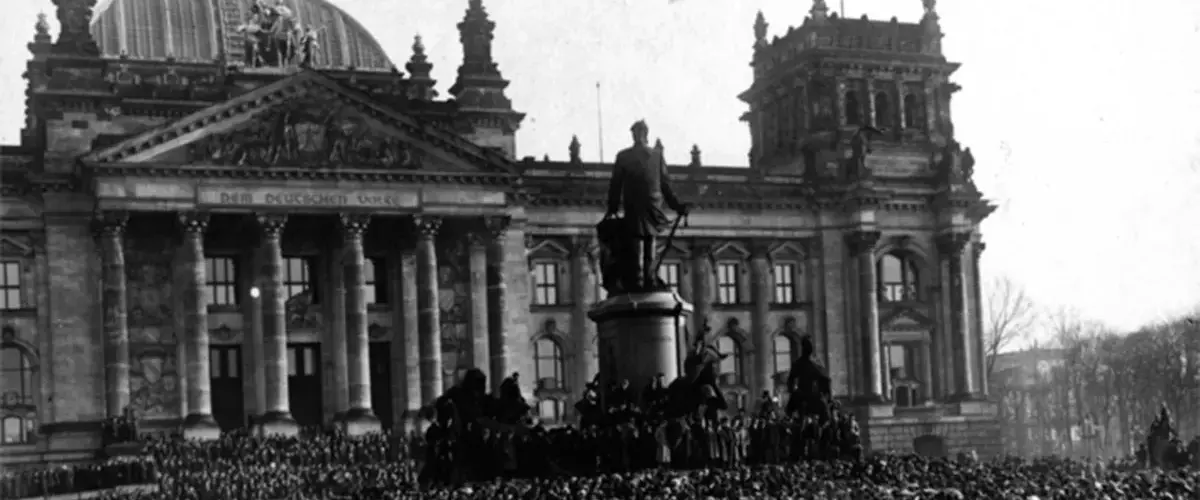
Dear readers Numismatica Ranieri, in this article of our blog numismatic we will tell you about the history of the currency devaluation of the Weimar Republic, dating back to the first world war, a historical time periods darkest of Germany.
Weimar currency devaluation
The currency devaluation of germany in the first world war, a phenomenon known to anyone who knows a little of the history of the TWENTIETH century, is marked by the abnormal emission of paper money, government bonds, and values in the post nominal in the order of billions and billions of marks and leads us to reflect on the serious reasons of domestic economic policy and international finance, which were contributing causes of the disaster without precedent.
In this context, it is still important to keep in view, as he watched the Kindlegerger, that “when the devaluation and inflation rates, accelerating lead to hyperinflation, after a certain period of time the brand of the central Bank is no longer able to keep up. Then, the money supply in real terms decreases and the monetary system in the previous disintegrates. People spend as quickly as possible, not being willing to hold assets that lose value”.
For sure, the German mark had begun to show signs of depreciation since the first year of the Great war, when the collapse in the exchange rate of the currency made illusory income tax to ensure the Treasury the revenue needed to meet the necessary expenses, including the payment of interest on the good patriotic, which had increased the Treasury of over 100 billion marks. Consequently, a significant part of the necessary and urgent expenses grew in exact proportion to the increase of the exchange rate and that of the abnormal monetary circulation, so that the inflation became virtually the only resource of the State to deal with the crisis: from here the myriad of issues of paper money!
Aggravating the situation was the matter of the compensation of the damages of the war in favor of the victorious powers, to which the defeat of Germany was obliged to Austria, which in the meantime had been built in Germany. So, the impossibility of the Treasury of the German honor the repayment of the interest and the loans accrued in favour of the citizens, it was added to the amount that the Commission for repairs, in April 1921, he fixed at 132 billion marks-and-gold, in addition to a tax on exports of 26% to 42 years old.
To adjust the debt of Germany is committed, then, to issue bonds, which were bought by Americans, while the proceeds of the sale were to be turned over to the recipients of the repairs with the refund (hypothetical) of the bonds.
We examine, at this point, the emission of paper money while making it clear that, from 5 August 1914 to September 15, 1922, the German government bonds intervened with their own issues (similar to our Good cash and paper Tickets of State) in the denominations of 1, 2, 5, 10, 20 and 50 marks, by the Darlehnskassenschein, i.e. Cash loans (that is, the same one that issued the tickets of occupation in the Veneto region invaded, with the dating of 1 January 1918).
THE REICHSBANKNOTE
The latest issue of the war period, dated October 20, 1918, has a nominal value of 50 marks; in the following, the cuts paper reached a numeraire 7 digits, emittenze 10 series (a To K) printed on two types of watermarked paper; the numeraire indicates that each of the ten series was taking every 9.999.999 specimens, for which the amount of broadcasting (also with the cash of six digits) is considered to be about 60 million tickets, made with the intervention of private printing houses the execution of the numeraire (of different types); these printers will be used for future emissions of reichsbanknote.
This issue is very sought-after by collectors.
Follow after the abdication of Wilhelm II (9 November 1918, and the armistice with Italy (November 11, 1918), another broadcasting of tickets of 50 marks, dated 30 November 1918: the case of the new type (series Al-K400) to the high-volume listing numismatics less than the previous one.
From here, starting from the 24th of June 1919, the nominal value of paper money began to be galloping with cuts, intercalandosi between different dates, reached quickly the value of 1 million marks, after the proclamation of the Weimar Republic (August 11, 1919).
Until the month of December, 1922 1'inflazione seemed to be contained, then the question is deteriorated further when, on 11 January 1923, troops from the French and belgian crossed the German border, occupying the territory of the Ruhr to sequester all the carbon and the wood from that territory had never been shipped to France and Belgium in the repair of war damage. As a result, the workers of the Ruhr caused work: to assist the strikers, the German government took recourse to the printing of banknotes exacerbating monetary inflation, whose assets reached unsustainable levels.
Accordingly, on 1 June 1923, there appeared the first cards from the 5 million mark, followed by cuts of 2 million with dating 23 July 1923: the inflation was exaggerating.
Among minor cuts 50,000 and 200,000 marks (in cash private) you put in the denominations of 20 and 50 million with the dating of July 25, 1923. However, it is only from the day on August 22, 1923 the first leap in quality with samples from 100 million, made on paper in a variety of watermarks and issued also by printers private, that have reached a series of 8 digits, resulting in a broadcasting over 500 million marks.
Followed emittenze cuts lower, but still in the order of millions of marks to lead to inflation culminating in a long series of emittenze which reached the numeraire to 8 digits, and, with dating from the 10th September, up to 500 million marks. From September 5 appeared first cut by The billion, below the 10th of September cut from 10 billion. Then you had to use all of the series are not circulated to the issuance of 1,000 marks of 15 February 1922, which were soprastampate 1 billion. Still 10 billion on 15 September, followed by another type of the same nominal value dated October 1923.
But, after 25 days, exactly on the 26th of October, did the appearance of the first cuts in the order of billions of marks, starting from 1 billion to 1 November, up to 100 billions of 15 February 1923, followed by the cut from 2 billion (march 15, 1924 (the last broadcast).
For sure, all the German capital available was consumed in the cost of the war, and repairs to the winners. In this climate of uncertainty and political crisis matured the putsch, Hitler (8 and 9 November 1923).
NOTENBANK AND NOTGELD
To intervene in the working cartamonetario were called and the large regional banks: the Badische, the Bayererische, the Sachsische and the Wuttembergische that they had suspended their emissions in 1911, filming during the first world war, with cuts of modest nominal value until 1922, but reaching digits hyperinflationary in the next year. But that's not all, because a further host of emittenze that reached billion, then the billions of marks was made to the ministries of railways, for example, the Reichsbank issued denominations of 1 in 200 million), and federal offices located in all regions of the Reich (for all issues, please refer to the Catalog Pick, vol. l, no. S/1.001 no.380: it is well-380 types of specimens, in addition to the variants, from which the collector specialist will be able to draw more news).
However, at the end of 1922, the movement of the currency in circulation was already 10% compared to that of the Reichsbank, and, towards the end of 1923, circulated as much circulation as money of the Reichsbank.
Of course, these emittenze relate to the requirements of the working processes, for coins, small change (that is, the small working-metallic -), the several ticks German had been with coins of aluminum in cuts of 50 pfenning (from 1919 to 1922), 3-marks (1922), the other 3 marks the anniversary of the constitution (August 11, 1922), issued with dating 1922 and 1923; and then, in 1923, to be added to the high cuts in aluminium, 200 and 500 brands.
The insufficiency of said assets induced, then, several commercial firms in germany to be minted on its own coin-the coin of aluminium; subsequently, other companies, they encapsulate stamps germans who determined the value (and the related costs were offset by advertising).
Subsequently, in order to bypass this commercial production, the government began to allow other institutions, i.e. banks, municipalities and counties to issue locally, for transactions in the local scope, the notgeld, i.e. tickets of necessity; the first notgeld have the only indication of the value, date and details of the issuer, while in 1918 the notgeld took on the characteristics of polychromy, enhancing natural landscapes, but also the characters (as Froben, Frederick, Goethe, etc.) as well as highlighting local monuments.
But it is only since 1921, after the war, the notgeld took on connotations of artistic relevance, like the series, city of Altenburg, with the broadcasting of the three types of cutting 50 pfenning in which exalt the commanders of ancient times (1455).
For the city of Hamburg is interesting cut by 1 mark in which the irony of a water carrier in a period of scarcity of water, while cutting by 50 pfenning hassles of a man who defends a woman attacked by a monkey in the zoo: the city of Altona, in a series of four values (two 25 pfenning and one 75) joking about the magicians and local scenes; the town of Eisenach, in the four specimens from 50 pfenning, recalls the characters of the time including J. S. Bach, playing their signatures; the other four characters are represented in four denominations of 25 pfenning by the city of Stotel.
Still on 1 July 1921, the town of Bad Harzburg, we give representations of the dance “tribal” and in the cut by 10 pfenning reads (in translation): “Where a long time ago in the jungle dancing to the ghosts and drank the fresh water in the source, it flows today, the holy source of the God krobo land. Makes glad the heart, and the eyes clear.”
In the cut by 20 pfenning: “a long time ago danced the ghosts in the light of the moon circle above the lawn of the Donar. Now there lies like a bouquet of flowers coloato, a distinguished nursing home”.
In the cutting of 50 pfenning: “Under the oaks of Harzburg you can find the linden trees of Berlin, the sweetness of all the countries where you get the lady, the music, the beautiful woman, conservative; there kissing the ghost of the forest with the wild boar”.
A series of 21 December 1921 in the city of Gultig enhances, finally, the game of chess.
The emissions of 1922, they have different characteristics, both in the nominal value that reach the 10,000 marks, but also on the type of construction of the print on the fabric (the City of Bielefeld) and leather (the same city in 1623); but you know notgeld made of wood, which are very sought after by collectors, forming a true curiosity in fact, for this type of printing, but also for the reliability of the emittenze, that, to the previous, merely highlight the nominal value assumed on the eve of hyperinflation.
It is, however, a myriad of notgeld, which, for their conservation is often in the fine print, it is assumed that, in practice, they are seldom crossed because of the nominal value was, at that time, insufficient to buy even a piece of candy, given that the payment of wages and salaries were to insert the paper into the baskets (there are valid period photos).
In 1923, when inflation was well determined, the municipalities had to resort to broadcasting more suited to the needs of the moment, so she had notgeld issued by Kassenskein of the municipalities, to which were added to the city of Gdansk and the region of Rhineland-Palatinate, with emittenze 1-billion mark. These notgeld are to be considered true paper money emergency and constitute, with the emissions of the reichsbanknote and notenbank, the actual documentation of the hyperinflation, German in the years 1923-1924. At the end of the 1923 hyperinflation had touched the abyss: they are well known to the collectors of the large quantity of stamps issued (with suitable overprint), who have reached the nominal value of 50 billion marks.
Fatally, in the disaster, there were people who grew rich: those who had debts became rich because in 1923 returned the deutsche mark devalued to pay money which, at the time of the loan, had premium on gold.
THE RENTENMARK AND THE REICHSBANK
In between the floors of a possible deflation proposed to the government was met with the need to create a new bank to be put under the administration of experts; the capital was to be guaranteed indirectly, by a general mortgage privileged and directly constituted by securities representing half on agriculture and, for the other half, on industrial and commercial.
He was then created the rentenmark (the unit was equivalent to g 0,358422 of gold), who formed a bridge of luck thrown to regain the gold coin. The exchange rate with the dollar was brought to 4.2 rentenmark, that is, eliminating all the zeros of the billions in the period of devaluation. The mark and gold was also adopted by a large part of the industrial apparatus German, including the ElektrizitatsWerk Laupheim that she made good by marco-gold, in consideration of the payment of the consumption of 2 kilowatts, with dating, on 15 November 1923.
Obviously, it was a currency of transition, the movement of which (the tickets are all dated 1 November 1923 in the cuts of the rentenmark 1, 2, 5, 10, 50, 500, and 1000) entered into force on 15 November, and until the 11th of October 1924, even if the new president of the Reichsbankonote, Hjalmar Schacht, had ordered that the rentenmark would not have been in the crates from November 22, 1923.
However, together with the notes, the ticks of the Reich issued coins of copper from 1 rentenpfenning (dated 1923, 1924, 1925, and 1929), as well as from 2 rentenpfenning copper (dated 1923 and 1924), 5 rentenpfenning always copper (dated 1923, 1924 and 1925), 10 rentenpfenning aluminium (dated 1923, 1924 and 1925), followed by silver coins of 1 and 3 rentenmark (dated 1924 and 1925).
The introduction of the rentenmark was also extended, of course, the values in the mail. The creation of the rentenmark was attributed to the Schacht incorrectly, whereas it is the himself who, in his memorial, the Magic of the Geldes (in Italian translation: the Magic of money, p. 95) pointed out that “from the theoretical point of view, the new marco (rentenmark) was nothing more than an abortion”, to the point of inhibiting the spread. Of course, this currency was replaced by the new markka, of the Reichsbank, with a production of banknotes dated II November 1924 (cuts by I, 20, 50, 100, and 1,000), production suspended the restoration of the rentenmark (50 rentenmark dated march 20, 1925, 10 rentenmark dated July 3, 1925 and 5 rentenmark dated January 2, 1926). Only for the history of the currency, the reichsmark will resume on January 22, 1929 (denominations of 10 and 20), then on march 30, 1933, while living with the new cuts of the rentenmark from 6 July 1934, by the will of the Fuhrer, who, in 1939, got rid of Schacht, stating contrary to the dual circulation of the mark; Schacht was replaced by Funk that he signed the only denominations of 5 reichsmark dated August 10, 1942 (ultimaemittenza nazi).
But, in the meantime, such as events in the field of politics and international financial had more influence for the creation of the Reichsbank, which the new institute of broadcasting in the replacement of the rentenmark? It was returned again to the fore the question of the payment of war damages from Germany, now that the new marco-gold issued the rentenmark was re-established, indeed, re-evaluated, the old German mark. Evidently, they claimed that the French and the Belgians, Germany could now pay for the damages, which they pretended to have a voice. Accordingly, it was prepared a plan for the payment of repairs, also to facilitate the evacuation of the French from the Ruhr.
To this end, were established two international committees that welcomed the proposal of the plan Dawes, plan, made public in April 1924, the economist Kindleberger thus exhibited: “The Dawes loan provided for a payment plan for the repairs, which began with 1 billion mark-and-gold for the first year and reached 2.5 billion in the fifth, leaving a certain margin of variation, if the price of gold was increased or decreased by 10%. In Berlin it was established as an Agency for repairs, check the public finance of germany, collection of resulting in marks and their conversion into currency, with powers of intervention in case of difficulty. The Reichsbank was reorganized to support the new German currency, the reichsmark, which had replaced the rentenmark, with a mandatory limit of coverage of the liabilities of 40%, with three-quarters gold and one-quarter in the currency. He had finally planned a first recycling operation, a loan of 800 million reichsmark, to be placed on different markets (...).
The flow of foreign loans from New York to Germany for a certain period gave the latter the currency needed to pay for the reparations to France and Great Britain”.
Stabilised the mark, the gold reserve and foreign currency, the currency of the Reichsbank, at the beginning of April 1924, which amounted to 600 million marks, peaked in 1925, a figure more than double.
THE PAPER money Of EMERGENCY ISSUED BY the BANKS OF the FORMER STATES of the GERMANIC peoples DURING THE PERIOD OF HYPERINFLATION
• Badische Bank: by the cuts than 10,000 brands (1/4/1923) you came to the cuts of 500,000 marks (1/8/1923); 1.000.000 brands (7/8/1923); 2 billion of 20 million marks (25/9/1923); 100 billion marks (30/10/1923).
• Bayerische Bank: by the cuts of 20,000 marks (1/3/1923) you came to the cuts of 20,000 marks (1/3/1923) you came to the cuts of 50,000 marks (15/3/1923), rm 100,000 (15/6/1923), 1 million trademarks (15/9/1923), 500,000 marks (18/8/1923), then the range of 1 million, 5 million, 25 million and 50 million marks (all with date 20/8/1923); 10 million marks (1 / 9/1923); 1-billion mark (1/10/1923); 5 billion marks (18/10/1923); 50 billion marks (24/10/1923); 500 billion to 100 million of the 1/8/1923.
• Sachsische Bank: 10. 000 marks (1/3/1923); 5.000 brands (12/3/1923); rm 100,000 (2/7/1923);50.000 brands (25/7/1923); 5 million marks (12/8/1923); 500,000 marks (15/8/1923); 1 million trademarks (18/8/ 1923); 2 million marks (1/9/1923); 100 million marks (1/10/1923); 20 billion and 100 billion marks (20/10/1923); 1 billion and 10 billion marks (15/11/1923).
• Wurttembergische Bank: 10.000 marks (20/2/1923); 500,000 marks (10/6/1923) of 20,000, 100,000 and 1 million trademarks (15/6/1923); 1 million, 5 million and 100 million marks (1/8/1923); 10 billion marks (15/10/1923); 50 billion over a 100 brands in the 15/12/1918, 500 billion (20/11/1923).
THE PAPER MONEY OF THE REICHBANKONOTE DURING THE PERIOD OF HYPERINFLATION, MONETARY UNION IN 1923 AND 1924
•1 February 1923: RM 100,000 (the effigy of H. Holbein). We know three issues of the government (with double-numeraire green, with a T black in double and a single numeraire), there is also an issue of private without the T.
•February 3: RM 10.000 (printing a private little circulated).
• 20 February: RM 20,000 (you print of the State and the private sector built on seven types of watermarked paper). Issued a total of 10.996.000 specimens; RM 1 million (printing a private, on watermarked paper with hooks scattered and print of the state sucarta watermarked transverse waves). Issued a total of 2.820.000 specimens.
• March 15: RM 5,000 (the effigy of H. Holbein). Printing has Been a little circulated.
• May 1: RM 500.000 (print of the State and private).
• June 1: RM 5 million (printing Status).
• July 23: RM 2 million (printing private). You know specimens with error: Zwei Mulionen instead of Zwei Millionen.
•July 25: RM 100.0000 (printing private); RM 500.000 (print of the State and private); RM 1 million (the press of the State and private); RM 1 million (the type of the RM 20,000 in the 20 February 1923, print private); RM 5 million (emission Status); RM 10 million (emission Status); RM 20 million (the issue of the State and private); RM 50 million (the issue of the State and private).
• 9 August: RM 50 000 million) (issuing private) ;RM 200,000 for the issuance of a private (with and without the initials of the printer); RM 1 million (the press of the State and private); RM 2 million (the press of the State and the private, the latter even without the series and printed on five different types of watermarked paper). Issued a total of 12.114.000 specimens.
• 20 August: RM 5 million (printing of the State and private).
• 22 August: RM 10 million (printing a private, four types of watermarked paper). Issued 21.457.000 specimens; RM 100 million (printing Status on two types of watermarked paper; printing locations on five types of watermarked paper with variants of colour in the initials of printers). Issued a total of 5.262.000 specimens.
• 1 September: RM 20 million (printing locations on six types of watermarked paper). To Be Issued .370.000 copies; RM 50 million (printing locations on six types of watermarked paper, and with variations in the colors of the abbreviations). Issued 8.690.000 specimens; RM 500 million (printing Status; print locations On six types of watermarked paper with variations in the colors of the abbreviations). Issued a total of 6.960.000) specimens.
• September 5: RM 1 billion (print of the State and private).
• September 10: A. M 5 billion (print Was a private). RM 1 billion to RM 1000's of February 15, 1922 (overprint of the State and private, with variations in abbreviations of the printers private).
• 15 September: RM 10 billion (print of the State and private).
• October 1: RM 10 billion (another type of print only of a private five types of watermarked paper). Issued 7.812.000 specimens; RM 20 (print locations on five types of watermarked paper). Emessi6.982.500 copies on two different types, one with the written value on the vertical side right, the other on the left.
• 10 October: RM billion (print Status and the print of a private, the latter with variations in abbreviations of the printers).
• 15 October: RM 200 billion (print locations on five types of watermarked paper with variations in abbreviations). Issued 6.018.000 specimens.
• 20 October: RM 1 billion (printing private); RM 5 billion (printing private with variants); RM 500 billion on tickets from RM 5,000 of 15 march 1923 (print of the State and private).
• 26 October: RM 50 billion (printing private with variants); RM 100 billion (printing private); RM 500 billion (print of the State and private): RM 100 billion (print of the State and private).
• 1 November: RM THE fourteen (print of the State and private); RM 5 billion (print of the State and private); RM 10 billion (print of the State and the private, the latter with variations in the colors of the abbreviations); RM 10 billion (another type of private). Issued in total in the two types 2.144.000 specimens.
• November 5: RM billion (printing private); RM 1 billion (print of the State and private); RM 2 billion (print private, with variations).
•November 7: RM 5 billion (print of the State and private, with variations).
• January 1, 1924: RM 10 billion (print State series A-Q).
•5 February: RM 20 billion (Print State series A-C).
• 10 February: RM 50 billion (print State series).
• 15 February: RM billion (print State series).
• March 15: RM 5 million (print State series A-F),
Prints are identified by the same type of series of alphanumeric. Prints private have the series of alphanumeric or only of the alphabet made with different types of printing that are different from those of the state.
THE SVOTAZIONE MONETARY AUSTRIAN
It is to be noted that, at the end of 1917, riots against the government to put an end to the war had upset the higher levels of the state hierarchy.
So write down G. Horstenau of the press and of political service to the Supreme Command of the armed forces of the austro-Hungarian army):
“The misery was increased unbearable.
Already at the beginning of 1918 the population of mountainous areas and industrial in Austria, he had to settle for a ration weekly flour 110 grams to the head. When the emperor visited at the end of march, the Czech-German, he saw a misery so frightening that exceeded all imagination; the hunger and typhus, which was the consequence, desolavano the Country. The sovereign had to do the terrible realisation that he could not bear them, not even the relief of a single wagon of supplies.
The army was severely impacted by the battle of June in the Veneto region and suffered no less political and economic decline of the country, which not only denied to its armed forces, each for moral support, but also not fulfilling his obligations in regard to materials, because it was not able to provide it.
July and August were in the states for the troops on the front two months of real hunger. For many days, they saw a piece of meat, not a gram of fat. After the harvest there was a slight improvement, at least a little more bread; however, it gave the case that entire departments in full trim disertassero to the first line, because it was here that the ration is increased by a few grams.
In the trenches of the glorious 82nd infantry he was a morning this note left by some deserters: ‘so Far, none of us is passed to the enemy; but, now, we cannot resist the hunger'”.
You came so 25 October 1918, when Charles of Habsburg wired to William II of Germany: “how ungrateful, my duty is to let you know that my people, neither wants to nor can no longer continue the war. I have no right to oppose to his will (...). Therefore I announce that I have irrevocably decided to ask within 24 hours of a separate peace and an immediate armistice. Other things I can; and my conscience of the sovereign commandeth me that I should act this way”.
Thus the yield of the 4 November 1918, although William II, so said to Charles: “your intention to give our opponents a separate peace to me, has painfully hit. Carrying out this idea, you faciliteresti the plan of our enemies, that is to subdue the more easily our Countries to their will, by means of I, the dissolution of our alliance, and reach for this via their purposes, anti-monarchists (...). I pray you, therefore, strongly advised to desist from each step, which give the impression of a disagreement between us.” Follow the surrender of Austria-Hungary on 11 November 1918.
From the above it is noted that Austria already suffered economically. In the monetary sector, the production of the coins issued by the mints of the empire, had proved, however, insufficient to the needs of the working capital, being so constituted:
• from 1heller (copper-zinc) dating from 1914 to 1916.
• 2 heller (copper-zinc) dating from 1914 to 1918.
• 10 heller (copper-zinc-nickel) dated 1915 and 1916.
• 20 heller (nickel), dated 1914, as well as from 20 heller (iron), dated from 1916 to 1918.
• 1 crown (silver) dating from 1914 to 1916.
For Hungary, there were other coins expressed in filler and crowns:
• I and 2 filler (copper-zinc), dated 1914 and 1914, as well as from 2 filler (iron) dating dal1916 to 1918.
• 10 filler (nickel), dated 1914, followed by the coinage of the reformed (copper-zinc-nickel) with dating from 1915 to 1920, as well as in the league reformed (iron) from 1914 to 1916.
• 20 filler (nickel), dated 1914, and by (iron), dated from 1916 to 1921.
• 1 and 2 crowns (silver 835/ ) dating from 1914 to 1916.
From the above, we see that the economic crisis has affected the entire apparatostatale resorting to the use of alloys poor to ensure the nickel necessary to the war machine.
In the field of paper money, only from November 18, 1918, that is, in the days that followed the surrender, there was a broadcast of a million crowns from the central Bank of the austro-Hungarian monarchy: the case of the good cash made on white paper continued to be issued, in denominations lower, until December 31, 1921.
But, when, with the collapse of the German economy in Austria was the Anschluss of Germany voted by the constituent Assembly, the austrian on February 16, 1919, and the paper money of the former central Bank of the Austro - Hungarian monarchy was soprastampata with the legend Deutschosterreich, the economic crisis and monetary became untenable.
From here, the State could not ensure the small circulating monetary, authorized municipalities to issue a myriad of notgeld, in the German manner, however, less polychrome and more realistic to the economic reality of that period.
As the cartamonetazione, the new national Bank, in the climate of inflation, issued, on January 2, 1924 in denominations of 10,000 crowns, while the denominations of 1 million crowns, dated 1 July 1924 were not placed in circulation since, in the meantime, the government decreed the reform, monetary, for 10,000 crowns corresponded to the new currency austrian shilling.
Accordingly, on 2 January 1925, was the first issue printed from one shilling (divided into groschen and equated to 10,000 crowns-down), emission followed by cuts from 5 to 1,000 shillings.
Hungary underwent a lot different. With the peace of Trianon (1919) lost large territories , but remained formally a kingdom under the regency of N. Horthy, albeit of short duration. Because of the political issue was added to the economic one, is represented by the surplus of the population employed in agriculture, the government passed for a short period in the hands of the communism, then return to an address of the conservative politician expressed by the Party of the union magyar.
In working cartamonetario, the first symptoms of impairment is identified in a draft broadcasting, on the part of the banking service postal (Hungarian post office saving bank), cut by 10 million with the dating of 1 may 1921, the issue has not been the end for the intervention of the Ministry of finance, which, after a series of paper money issued by the 1920's, came from the may 1, 1923, to the broadcasting of 50,000 crowns, to implement, on the 1st of July next, a series of 5000, 10.000, 25.000, e500.000 and 1,000,000 crowns.
Only in 1925, the currency reform replaced the Hungarian crown with pengo, divided into 100 filler, compared to 12,500 crowns, for which he was issued a series of banknotes that soprastampò in filler and pengo emissions written down already issued in the crowns.
So you obtained the following cuts:
- 8. the filler of 1,000 crowns,
- 40 filler over 5,000 crowns,
- 80 filler 10,000 crowns,
- 2 pengo over 25,000 crowns,
- 4 pengo on an area of 50.000 crowns,
- 8 pengo out of 100,000 crowns,
- 40 pengo out of 500,000 crowns
- 80 pengo over 1,000,000 crowns (Pick 81/88).
In 1926, will be the new bank of issue, the Magyar nemzeti bank.
Conclusions
Hoping that this article is dedicated to discover the history of the currency devaluation of the Weimar Republic has been of interest to you, waiting for your opinions.
You can let us know what you think or send us other tips through the space, and comments confidential, or through the contact page. Also for any doubts or queries please visit the contact us section of our website.
For any information or further details of our e-mail address is the following: info@numismaticaranieri.it
To the next one with the best news related to the world of numismatics.