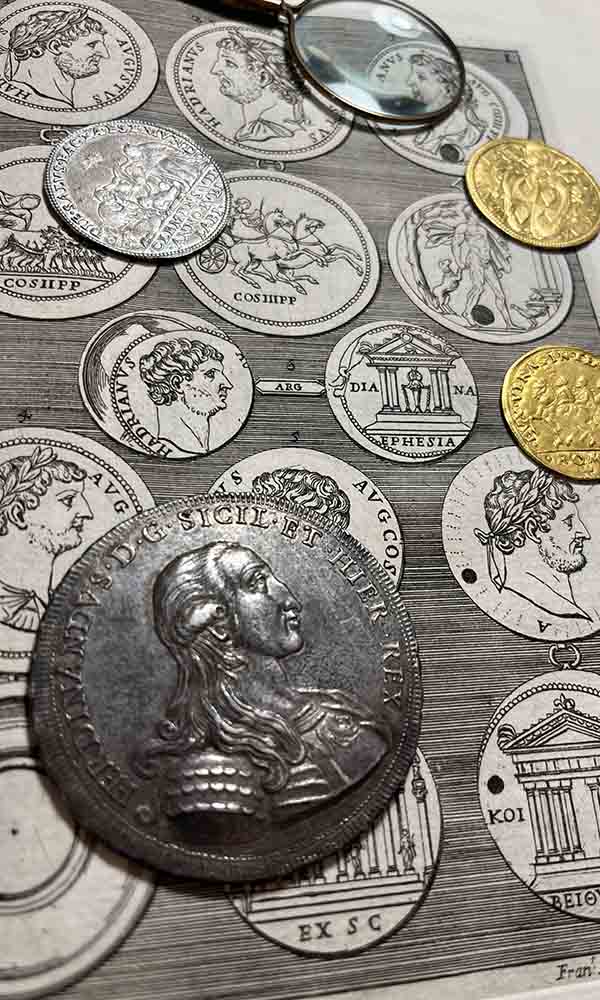



Dear readers Numismatica Ranieri, in this article of our blog numismatic cercehremo discover more details related to the topic of inflation, which is a concept that periodically comes back into fashion within the debate financial and economic world. In the post, we'll tackle the topic of inflation in the story, trying to emphasize that there is inflation and inflation, depending on a number of variables, including the historical period, the economic development of a country, etc, etc. To learn more, there is continue reading and find out more information.
There is Inflation and inflation
It can appear out of place to speak of inflation today, when the law and if you listen to a thousand, when each person is willing acquired sufficient knowledge and experience to not judge a sacred mystery reserved for the initiates to economic science; however, the fill of the words around that phenomenon and the confidence that he was born at the common people can justify the entertain of it; consequently, it is provided by the fact that here he speaks among lovers of paper money. That is, among people who, without the claim of the doctrine, practice to delight in the study of the adventures of the monetary sbirciandovi in through the cracks of the evidence and taking advantage of the friendly help of their companions of life, the tickets monetary note.
In that capacity, cannot ignore or rebuff of the inflation. why is paper money and inflation are the two items of the same theme in the relationship of the derivation given by the order in which they are quoted here, are interwoven to the point of becoming inseparable To summarize the mechanism of inflation, holding on the surface, that is, without going into difficult, it is enough to remember the function of money as a measure of the value of the real assets. That measure remains true and stable until it is a proper balance between the value of the goods and the amount of currency that intends to represent it. If the value of the goods increases, as would normally happen with the continued growth and improvement of the production and development of services that accompany it, it is right that increases the amount of currency in circulation; but that balance can get lost, so starting from the field of business where price increases more or less justified in any portfolio can easily drag many others to the rise and generalize. As for the initiative of the State to meet their financial needs can indulge to excess emission in the paper. Seems fitting to the definition of the most basic is:
inflation is a glut of paper money compared to the mass of the goods and services that they contrast in terms of the exchange.
Means an overabundance marked, it cannot be absorbed through the further production of goods, remains, therefore, an imbalance between the two items you are comparing. There is a spontaneous tendency towards such an imbalance that follows different rhythms depending on the economic circumstances and also of the effectiveness of interventions on the part of the supervisory bodies.
A rhythm inflation moderate, kept under control is the estimated beneficial because by creating the expectation of earnings represents a stimulus for business initiatives, facilitates employment, promotes The burning, ignites and keeps aspirations to well-being, a pace too fast disrupts the calm in the markets while tickling in some environments, dangerous desires of speculation reminiscent of prudence, or even afraid operators noticed withholding them from challenging programmes of the long-term. All of this is part of life of each country, and therefore also of our own, and have many examples, not always-ready reading and interpretation for the plot with the other phenomena of political and social non-national.
But, to remain faithful to the role of curiosanti in the history of monetary, we will continue to follow the facts. it will not be difficult to recognize in more recent years, those that have preceded and accompanied the entry of Italy in the circuit of the euro, the construction of dikes stringent in the course of inflation, and then the onset of a phase of benign kept under control by government authorities, while tracking down an example of a behavior much more raw and pushed, rather than to return to the experiences of ten or twenty years ago, it is convenient to go back to a time already far away, though still of the reach of memory, for many, the last years of the second world War and immediately subsequent to which you can give an account, from the point of view of the eminently practical, and informed of the slip in which incurred the money in those times.
It is clear that the state of War is for each country that will remain involved with an event so groundbreaking bring havoc in the economic models followed, in time of peace, both from the state apparatus, both from the private. We mention just the steering stamped violently on the industry to step up war production, the assumption of generalized initiatives unusual and time-consuming to scoi defensive, in the most extended sense, the movement that is created in the working world from the subtraction of staff to be employed in military activities, and the resulting effect on the economy of families, the increase in sudden and unbridled public spending, and, in private, the search for liquidity by hoarding money, as well as the transformation of investment in the pursuit of shelters, hypothetically, reliable: these are examples of the most trivial of rimestio social, economic, produced by war and dominated by the phenomenon of inflation means a rise in prices , the need to the most amount of money. We must add that the phenomenon that undergoes influences aggravating the psychological climate of a general fear that affects a population in a period of war, which determines which behaviors are confusing, even contradictory. capable of altering the canons economic, that is powered via pessimistic forecasts as much as that period lasts. For our superficial observation will be sufficient to go to find verification of this disorder in some of the data commonly used to measure The state of the economy.
The official indexes of the Italian built on equality 1913=1, and be referred to the years between 1943 and 1947, express the increase of the following items through the respective multipliers:
- the price of gold x 15,5;
- wholesale price x 22.5;
- cost-of-living x 16.7.
The purchasing power of the lira was decreased less than twenty times. In these indexes, it is difficult to find placement for the wages of employment, remain under-developed in terms of contractual but side-by-side street away from the remuneration accessories improvised under the title of allowance from the various denominations.
By the same indices is far away, another piece of information, the volume of currency in circulation (x 3.3) that had accused instead of t (x 5.1) in the early years of the war, 1941-43. It is, however, summary indicators which blend the diversity of conduct arising from the dual position from Italy in the course of the war.
Two aspects of the circulation can be put in evidence: the first is represented from the fact that the increase in the driving force not just the imposition of the occupants: the German side with the uncontrolled use of banknotes Italian obtained with ease from the government Printing office for the official defense of Italy, but also gone into the hands of little official of the troops; on the american side, all the more so, with the profusion of the am-lire and the wide availability could be made to look rich and spendthrift any allied soldier who had occasion to familiarize themselves with the population. The second aspect regarding the scale of the values of our paper money, which underwent changes over the period of the war: in fact, were not introduced banknotes of more than 1,000 lire until after the middle of the year 1945.
The preeminence of the 1000 lire held from the time prior to the Italian unit (remember the colorful variety of connotations of the highest card in the production of the departed banks of issue).
Born in August of '45, the cuts 5,000 and 10,000 lire, whose definition of "provisional titles... the equivalent of bank notes", and the shape is very similar to that of the already known promissory notes of the Bank of Italy served to dampen a bit of the psychological effect of their appearance. Many years shall pass before opening to the forefront of the movement cuts the most high. This fact leads us to consider how, as occurred later, and in a soft bland climbing the cuts paper is high, tickets on existing were able to maintain their role in the exchange current, while bending the extent of their purchasing power. At the decrease of value made to front only the increase of the amount of means of payment, which we describe as the first phase of the unfolding of the global inflation process.
Don't forget the tickets and low-cut 1, 2, 5 and 10 lire, that is, the tickets of the State, were still deployed in the early Fifties, and that the corresponding coins were minted until the Seventies (only coins expressed in cents perished with the war), a sign that these monetary instruments bought something, certainly not as much as before the war, but still something. The difficulties of businesses and at certain times in their absolute suspension rested from the contingencies of war – we are referring specifically to transform progressive every region of our Country in the area of military operations – and not from inadequacy of the coin.
The direct appeal of the citizen to the manufacturer of agricultural holder of food resources essential address (one-way) as well as the establishment of a black market, commonly called nero, were a necessity of practical consequence of the absence of the usual commercial channels, but may not be enrolled in (as is sometimes done) in the type of bartering that despite its primitiveness, contains a System pluridirezionale of trade and excludes the principle of monetary intermediation.
In certain cases it would be appropriate to speak of a fallback to abbreviated forms of supply adjusted normally and only in critical moments transformed in the early sale of assets assisted by fiduciary arrangements for the regulation of monetary delayed.
Everything belongs to adaptation that is necessary everywhere in the difficult moments for the survival, resource varies of shapes capable of finding paths of exit in the united states and difficulties without falling in the impossible, without resulting in chaos.
We could conclude by saying that the inflation suffered by Italy to the effect of the war, if it was of undeniable heaviness, and rightly complained, not touched the limits of gravity extreme, as happened elsewhere, the appropriate comparison cite the case of Hungary, that almost at the same period and to the same circumstances (the end of the war can be dated to the 13th of February 1945, the day of the surrender of Budapest, he suffered a fall in inflationary that completely destroyed the national currency, the pengo. That fall, as he was through it's paces and sensational reflections spectacular on paper-currency.
Conclusions
Hoping that this article dedicated to the topic of inflation has been of interest to you, waiting for your opinions.
You can let us know what you think or send us other tips through the space, and comments confidential, or through the contact page. Also for any doubts or queries please visit the contact us section of our website.
For any information or further details of our e-mail address is the following: info@numismaticaranieri.it
To the next one with the best news related to the world of numismatics.