

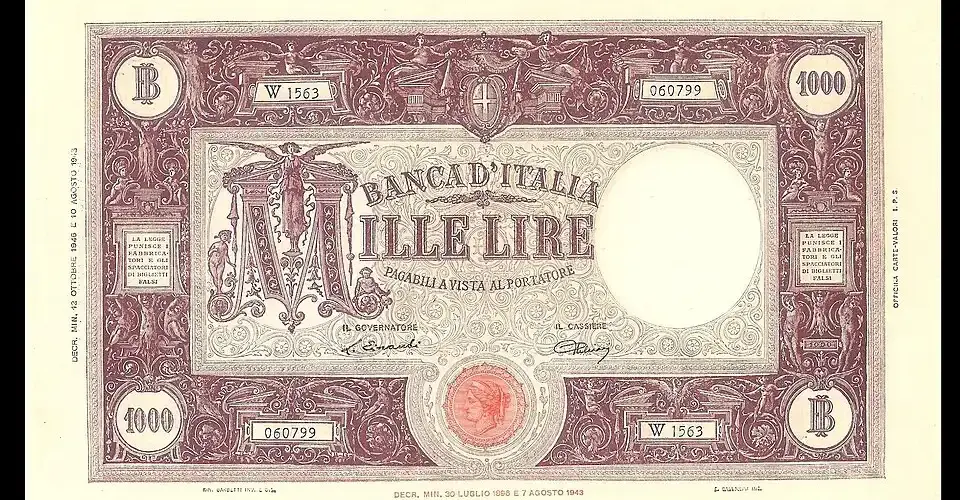
Dear readers Numismatica Ranieri, in this article of our blog numismatic we propose an article, the historical background to the banknotes of the Italian miracle, i.e. to the period of the great revival of economic of the Italian Republic after the end of the war.
The banknotes of the Italian miracle
Who has gray hair, and he sees their children, after long studies, maybe even brilliant, work hard to find a modest occupation, at the mercy of insecurity, insecurity, and humiliation of all kinds, can't remember with nostalgia the time of the youth, those of the period 1953-1962, the years of the "economic miracle".
In that decade came to an end our industrial revolution, we entered permanently in the small group of the most developed states of the world, they spread mass consumption. Cars, televisions, refrigerators, goods, until then reserved for the more affluent, and they became within everyone's reach. Unemployment disappeared in 1951 was still 10 per cent of the labour force, in 1963 it was reduced to 2, historic low of the last half of the century. It was the era in which companies were competing for the university students and those in high schools, even before the end of the studies.
Milestones in the history of the Italian miracle
In 1958, the lira gained the oscar for money is more stable; the exchange with the us dollar, set in 1949 in 625 lire, was nailed to this level until 1971. Also in 1958, the italians came back to hear the pleasant clink of the silver coins, after that by 1937, the brand had ceased minting and the war had made it disappear. What happened in that decade, it has nothing of supernatural: in 1947, it was the defeat of inflation were then rebuilt the apparatus of production and infrastructure destroyed by the war.
This first phase ended in 1950 when the average income of the Italian returned to the level of 1938.
The so-called miracle, which was characterized by an increase in per capita income at the average annual rate of 5 percent, a pace that even today is amazing, all the more so that it came to pass at prices substantially stable.
In lire, 1975, the Gdp, that is, the value of the goods and services produced in a year, went from 36.220 billion in 1951 to 71.342 1963, with a peak in the period 1959-62, the product per capita rose from 764.000 lire 1.393.000.
After the west made with the elections of 18 April 1948, governments tightened on the integration of our economy in international markets: the most important milestones were the liberalisation of imports, the accession to the European Payments Union (1950) and the european Community of coal and steel community (Ecsc), the participation in the foundation of the European Economic Community (Eec) in 1957, which resulted in the European Union. Since 1953, the industrial sector experienced a strong increase in productivity occurred especially in the more advanced sectors are open to foreign competition.
This required a massive exodus of labour from the agricultural sector to the secondary and a great international migration (5.810.000 drive from 1950 to 1962, addressed in the first place to the countries of the Mec) and internal (particularly intense between the 1958 and 1962) from the regions of central-southern regions to the North, in particular towards the triangle of Milan. The Turin-Genoa. In 1951, about 100 occupied 41, working in agriculture, 32 in the industry and 27 in the services; in 1963, the percentages were passed to 28, 40, 32.
At the base of the increased productivity were especially low wages, which, in Italy, was influenced by about 20 percent less than its european partners. In these conditions our industrial products both finished and semi-finished products, due to their competitiveness and good quality, invaded the international market. Companies could count on a prolonged period of high profits that reinvestirono in new equipment, expanding production and jobs. An important role played the expense of the state, public investment (remember, for all, the Motorway of the Sun) and, in particular, raw materials and energy sources at a good price, a fact that is critical to an economic system such as ours, essentially, a transformer. There were, however, the shadows: the development took only the northern regions, for which, despite massive public interventions, expanded the already considerable gap of income and employment with those of the south.
The rural exodus messy congestionò the great cities of the north, led to the ghettoization of the emigrants, the reckless, the rapid increase in the price of real estate and leases. You took advantage of the boom in order to rationalise the production system, which continued to be constituted by a large number of companies undersized and inefficient.
To compensate for the exodus from the countryside, and for political reasons, was favoured by the small peasant ownership, family-run, which caused the proliferation of traditional farms and uneconomic. Missed a radical redistribution of income, so that a great part of the wealth of the Country was concentrated in a few large families. Little was done to ensure widespread and adequate social services:
- schools,
- university,
- hospitals,
- nurseries,
- homes for the elderly
they were largely empty promises.
Conclusions
Hoping that this article dedicated to find out what are statele banknotes of the Italian miracle was of interest to you, waiting for your opinions.
You can let us know what you think or send us other tips through the space, and comments confidential, or through the contact page. Also for any doubts or queries please visit the contact us section of our website.
For any information or further details of our e-mail address is the following: info@numismaticaranieri.it
To the next one with the best news related to the world of numismatics.