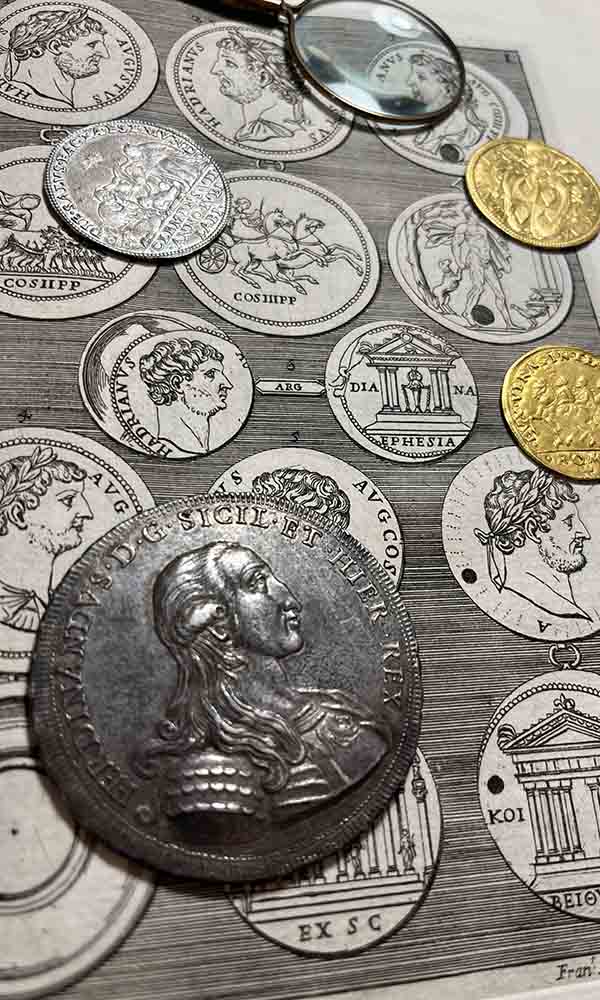


Dear readers Numismatica Ranieri today I we will talk about one of the greatest finds of roman coins of the story, which took place in 1992 by Eric Lawes in the county of Suffolk in England. This story turned the pages of all the magazines specialized in numismatics in the world because it was really incredible.
The discovery of roman coins of Hoxne
In November of 1992 in the near Hoxne (Suffolk) is it came to pass on the incredible discovery of roman coins to the work of a quiet, retired English with the hobby of searches with a metal detector has unearthed more than 500 solid gold and more than fourteen thousand siliques silver.
It is not everyday you find a treasure trove of 14.780 roman coins, almost all in the golden and silver, to a value between 10 and 25 billion: at least this will be the fact that the money which the English crown, in order to acquire the treasure, will have to pay the fortunate discoverer. The news – it could not be otherwise given its importance – held tour on a daily, weekly, and television around the world in the first week of September, after which the 14.780 coins, finally catalogued (with the exception of certain coins of silver, and of brass, on which the studies of deepening continued and completed the excavations in the last few weeks) have been placed in the British Museum and presented to the scholars of the print.
Eric Lawes is a quiet, retired English with the hobby of searching for hidden objects with metal detector, 16 November 1992, in a field near Hoxne, in Suffolk, was looking for a hammer lost a friend when suddenly his tool revealed the presence of what, at first remove the earth, he had to be a large quantity of items, gold and silver. With a great sense of civic duty, Mr. Lawes and put immediately in contact with the Unit for Archaeological heritage of the County of Suffolk began the excavations, thus saving the treasure from a possible dispersion.
Of 14.780 roman coins of the late empire, 565 are gold, 14.191 silver and 24 bronze. The gold coins are all solid coined in a majority during the reigns of Arcadius and Honorius, between the 383 and the 424d. C.; even if the total emissions of the eight emperors different: the silver coins have emissions of the other seven emperors.
All the solids belong to the period following the monetary reform of Valentinian I, 365-68, who brought this coin to the weight of 4.4 grams and with a content of up to about 99%. 124 small bronzes, unfortunately, are very ruined, and their identification is almost impossible; the particular oxidation of the bronze has been shown that the container of the coins had to be a basket of wood, whose measurements are approximate, and they were cm. 60x45x30. The great mass of the coin, however, is constituted by more than 14,000 coins of silver, almost all of siliques, among which there are 60 miliarensi.
The miliarense is a coin silver rather rare, first introduced by Diocletian in 301, as a result of the reform wanted to put an end to the monetary chaos of that era, miliarense means that 1000 of these coins were worth a pound of gold. Among those found at Hoxne, two are variety and unpublished. The coin is old, it is a miliarense diCostantino II (337-340), somewhat corroded, the most recent are two siliques of Constantine III of years 407-408. The more than 14,000 siliques are almost all following the weight reduction sets in 358 and is around 2 grams; only two of Constantius II belong to the original series from the weight of about 3 grams.
All the coins are minted by 15 the emperors in 50 years, from 358 to 408, in 16 ticks different from Trier, in the west, eventually to Antioch, to the east; the majority of the coins comes from the workshops of Lyon, Trier, Arles, Milan, Ravenna and Rome. Ticks british at the time were not active, except for a short period of reign of the usurper Magnus Maximus, but no money from these workshops is present between the 1033 Magno Maximum contained in the treasury.
It is not known precisely when this has been buried: you can, however, make assumptions rather accurate.
In 407-408 the roman empire lost the effective control of the Britannia; the fact that the Hoxne have not been found coins back to the 408 is not necessarily prove that the coins may have been buried in that year. But after not entered more roman coins between the circulating british, is therefore likely to assume the burial is not more than 15-20 years later.
The siliques found present, 80%, one peculiarity of the whole of the uk may be cut at the edges; sometimes these cuts reduced the currency by almost half, and still today the reason is not well understood. If it was a toasting to recover the metal, there is no reason why the same treatment was not reserved to the solids, which are all of excellent quality. Maybe it was the lack of money petty bronze to push to chop up the siliques to make it smaller coins. But even in this case it would be enough to divide into two or more parts with cuts precise and not cut the edges. Among the other oddities are to report 178-counterfeits of the period. Even if, after completing his studies – the number will rise for sure. Treasures of coins of the late empire of this kind are relatively common and “normal”in Britain; the peculiarity of Hoxne are without a doubt the quantity of pieces:normally, the findings do not exceed the 200-300esemplari; of this kind and of this age have come to light, nearly 90 tesoretti. To Cleeve Pior, in 1811, came to light 3000 coins of the late empire, including 500 solids.
Another finding is that more than 650 gold coins of the emperors between Valentinian I and Honorius took place near the village of Eye, in 1780. Given the imprecise and vague news about both of these tesoretti, it is difficult to imagine the connection with the discovery of Hoxne, even if it seems a remarkable coincidence that the number of solid transcends always 500 units.
Other historical finds of roman coins
The greatest discovery English roman coins of gold of which we have a certain and documented news is one of Northumberland: 160 gold. The quantitative difference highlights even more the importance of Hoxne. More than Hoxne, but only by number, is the treasure of Cunetio discovered in 1978 in the vicinity of Marlborough, format 56,000 roman coins.
The biggest treasure of roman coins ever gold was found in our parts, in Brescello, in the province of Reggio Emilia, at the beginning of the Eighteenth century was composed of approximately 80,000 gold of The century.C., the great majority went to cast or dispersed.
Together with the coins have been found in Hoxne, chains, bracelets, rings, items, toilet female, cutlery and other small parts in majority of gold and silver.
In all of the treasure you found 52 inscriptions, including many christian symbols: 22 symbols are personal names that refer to the likely owner of the treasure, that Aurelio Ursicino. Who was he? The name was not very common at the time, in fact, through the engravings on jewelry and tableware you know just 24 Ursicinus who lived between 300 and 500 d.C. In any case, our man had to be part of a very rich family, in which the real estate totalizzava the equivalent today of £ 10 million.
Through the discoveries you have come to the conclusion that only three characters of the name Ursicinus may have been the owners of the treasure of Hoxne' a commander of the roman army delRhine, stationed in Britannia in the 350, which later seems to have been a candidate for the imperial throne; a "Vicarius" (administrative officer of Rome; one of the lords of the patricians who administered the territories of the imperial during the first part of the fifth century.
Both the Ursicino military that the Vicarius were deprived of their charge and will be sent from Rome in exile in Britain: the Ursicino military had criticized the attitude too accommodating of the emperor against the eunuchs, while the Ursicino mayor was simply incapable. The owners of the treasure were without any doubt the christians, and, among other things, rather observant.
Conclusions
Hoping that this article dedicated to the discovery of roman coins of Hoxne has been of interest to you, waiting for your opinions or comments.
You can let us know what you think via the contact page. Also for any doubts or queries please visit the contact us section of our website.
For any information or further details of our e-mail address is the following: info@numismaticaranieri.it
To the next one with the best news related to the world of numismatics