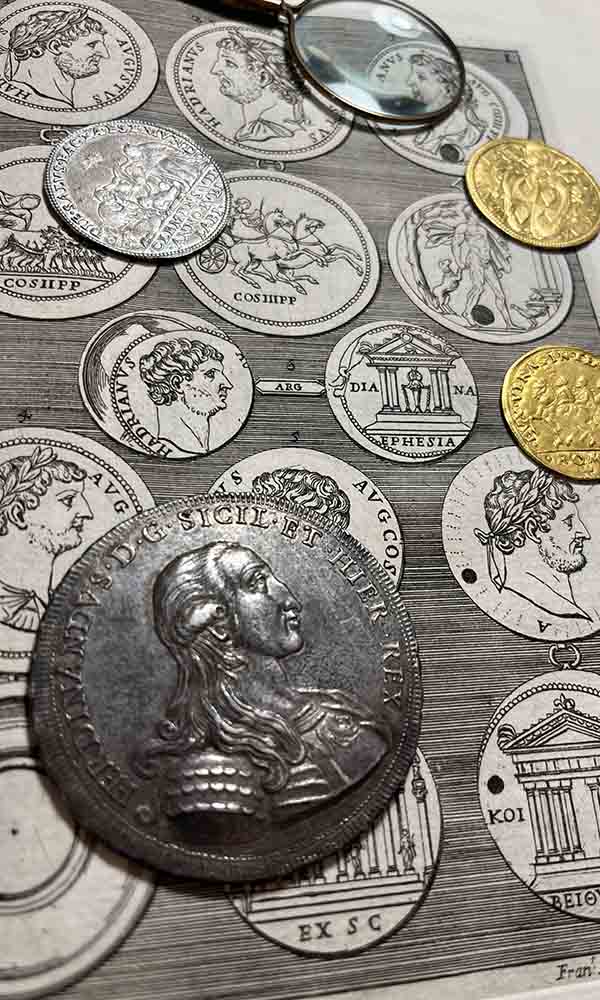



It has been over 140 long years since the proclamation of the kingdom of Italy, during which our currency has the path, and between events, sometimes stormy, his long journey, while always managing to perform the function of a meter of the economic values and, at the same time, of a medium of exchange in the context of those needs business cycle, which they characterized our national life.
The purpose of these Records is, however, addressed to the events of the monetary of the first forty years of the kingdom, Vittorio Emanuele, The Umberto I, arriving at the dawn of the 1900's.
The treatment, then, follows and refers to the period of the Risorgimento, which has seen, with the coinage of the King-Elect, and those nostalgic patriotic uprising that led to the unification of Italy.
So, in essence, the Annals analyze, year after year, from 1861 to 1900, the whole of the coinage as a whole is, metallic paper, an indissoluble combination of continuity.
After the 17 march 1861, proclaimed the kingdom of Italy, when you had to take the first steps to organize the State, imposed "in the ante omnia res" the monetary matter relating to the unification of the currency decimal places, throughout the national territory, in which there were different species of monetary united outbuildings, the value of which was able to evaluate a billion lire in piedmont, in addition to half a billion lire in euro banknotes, the circulation of which was founded explains the De Mattia — in principle and in fact, on the private nature of the agreement between the issuer and the bearer, who was taking place mainly in the possibility to obtain a view of the barter cash tickets.
The annals of the brand-1861
To him, therefore, to issue a series of decretazioni to adjust the flow of the coinage of pre-unification, in expectation of measures consequential damages related to the minting of coins for the kingdom of Italy.
At first they were used, even some of the decrees of the former Government of Tuscany to fulfill the first minting by the Mint of Florence, then it is declared on the monetary system to be adopted, that is, if on the basis of monometallica (which he attributed to the gold coins, the function of measurement of the values of economic and commercial), or on the bimetallic (which gave the silver coin, the function of money notes fractional notes paper gold). Prevailed in the System of the bimetallismo and gave the start to the production of money. And since, in 1861, there were 5 ticks, in addition to those of the refining and foreign, will provide a close two (Bologna and Florence), while five banks of broadcasting on paper-monetary accentravano most of the banking operations as if the unification of the country had never occurred, because it is the fruit of a lively regionalism which sought to protect the interests, real or supposed.
In 1862, other events of the monetary accavallarono when we noticed that the gold and silver monetary hadn't been in that legal relationship, which dates back to the beginning of the last century.
As a consequence, – to say it with the Onion - instead of adjust this ratio to that of the market, coined the lira silver in the intrinsic slightly less than the par for that with effect from 1 863, was reformed in the intrinsic slightly less than the par for that, with effect from 1863, and was reformed in the intrinsic 900 835 milliseconds. It was then changed the minting of coins from the line to be able to distinguish the coins of the series coat of arms (900 to 1,000), from the series value (835/1000).But when, for technical reasons we had to postpone the coniazioni1863, were made minting in the two types.
In 1866, when it was decided to take the 3rd war of independence for the liberation of the Veneto region, the issue moved into the field of money to finance the costs of war with a coin, which, aside from the matter composing, to perform its tasks.
It was, therefore, to the Law 2872 (may 1, 1866, which authorized the government to adopt the consequential financial measures. It followed then, the R. D. no. 2873 of the same date, which economists called it a "of the circulation of paper money," to which the National Bank in the United Sardinian (which was renamed the "Kingdom of Italy") was authorised to issue 250 million lire in banknotes inconvertible in metallic currency, which took on the role of specific "paper money" to finance the State.
For certain the forced circulation dramatically reduced the circulation of coins to the advantage of the coin-card, even if the Treasury continued to be minted gold coins representing in very limited quantity from 1868 onwards. that although they were regularly hoarded to consolidate forms of saving, safe from inflation.
It is estimated that from 1861 to 1868 were minted gold coins for L. 205.584.000. While we continued to mint coins silver L. 5 with the title of 900 thousandths for the account of private individuals, who paid the charge to ticks (by circulating these shields at the L. By 5.05), the shortage of coins caused, as a result, another monetary circulation is replaced, the so-called"tickets trustees paper, variously coloured, ranging from the cutting of cents.5 lire 10, issued by banks, companies, associations, municipalities and private companies of the Italiacentro-north (with the exception of the municipalities of Trapani and Palermo (the amounts are irrelevant).
It should be noted that the trustees resolved not just the lack of small, working with the tacit consent of the authorities that although they were aware of both the strong expansion of the System, both the absence of any authorisation decree.
Established the kingdom of paper, the evolution of the banking system, supported by the bourgeoisie, the capitalist caused an abnormal increase in banknotes. generating an enormous euphoria in the business world, especially when, after Rome, the capital, gave rise to speculation.
To overcome this expansion bank intervened in the Law no. 1920 April 30, 1874, which established an interbank Consortium for the production of cards syndicated as forced, as guaranteed by the capitals of the six institutes of broadcasting was merged with the Roman Bank, for the transformation of the Bank in the Pontifical);but since, with tickets syndicated, were authorised emittenze extraconsorziali on the part of the six banks, you had come to create a dual circulation cartamonetaria: the one for the account of the State that was in charge of hiring the service of the tickets syndicated, the other on behalf of the banks, legal and tramutabile in syndicated State... as forced!
It was necessary, in 1881, to abolish this movement and laying the foundations for the recovery of the legal tender of paper money. what will happen in 1883, but we are under the reign of Umberto I.
Meanwhile, in 1875, the government had taken a decision relating to the silver coins of L. 5 that you didn't with the intrinsic 900/ 100 for the account of private individuals, in conformity other "shields" of the countries participating in the League Monetary Latin: from 1876, this production came under the management of the ministry of Agriculture of the (at the time in charge of the security services to companies and banking institutions), until, in 1878, after the split of the ministry of Finance (December 25, 1877) in the Treasury, the Treasury was transferred to the latter the dicastery (and suppressed that of Agriculture, subsequently reconstituted with other institutional duties).
With the death of Vittorio Emanuele II is the conclusion of the first part of the Record.
THE ANNALS
1861
On 18 February 1861, the met, the first Parliament of the Kingdom of Italy, which she recorded in her diary the Massari – "immediately had to deal with ent examination of the proposal of the law which proclaimed the kingdom of Italy, and entative was the natural corollary, the header of the official acts and the legend to sculpt on the coins. The King declared, then, will absolutely be said Vittorio Emanuele Second and not First, since parevagli, if he had taken this second title, making ingratitude towards The glorious his ancestors, which they certainly in retrospect, and with the sword, laid him long hand to the crown, that surrounded the head." In fact, the King wanted to keep enta title of the Second, already taken when he was King of Sardinia, as can be seen from the coinage of the sardinian: Victorius Emanuel The.
On march 22, he formed the first government. With Cavour to the Presidency, Vegezzi to Finance (at the time there was the department of the Treasury), Natoli Agriculture (under the dicastery depended on the banks). To commemorate the event, of the constitution of the kingdom was entrusted to the Mint of Florence commissioned to produce no. 21.472 silver coins in execution of the decree 223 of the Government of Tuscany, 29 November 1859sulle emissions of the King-Elect, with the appropriate changes, and dating Florence, 1861: this is the first coin of the kingdom of Italy.
In the monetary field, the first important problem, and not presence was to establish the represented to be taken, in the same way as the other european States, that is, if you rely on the monometallismo (the gold had the function of a measure of commercial values) or if projected onto the bimetallismo, consisting in the minting of coins of gold and silver, the nominal value of which corresponded to the intrinsic value of the precious metal contained in them. It was decided for the bimetallismo, already in use in the kingdom of Sardinia and the Duchy of Parma (gold gr. 0,322 – silver gr. 5 ,00), determining the intrinsic 900 thousandths, the title adopted for The two types of coins in the represented legal 1: 15,5 given that the lira silver was equal metal fixed in gr. 4,5 (a gram was the equivalent of the title of 3.3 of gold coined). In regard to the coinage of work it was reviewed favourably a represented 5 January by the chemical Taddei, of the Mint of Florence, which had provided The results of the oxidation of the alloys, copper-nickel and copper-tin. So the Mint of Milan, made
the technical tests of the two alloys and proposed the adoption of the second type, consists of 960 copper and 40 of the pond.
To provide you with the Treasure of adequate coinage, and in the more that you decretasse on new impressions of coins, you will finish The entative of coins that have already been authorised by the former Government of Tuscany, so that they were minted in the Mint of Florence, the first coins of the kingdom, dated 1861, in cuttings of L. 1 and Cent. 50 (letters F and mountain), respectively, of the n. 431.534 and n. 1.222.099 specimens, after which the Mint was closed on ministerial, on the 31st of may. However, the staff dellaZecca remained in office because it already faced the possibility of the transfer of the capital of the kingdom in that city, where the brand could be rehabilitated for any minting.
The first measures entative in monetary matters were The royal decrees no. 16 and 17 on 2 may, established, respectively, the prints of the new coins of gold and silver, and the bronze for the recording of Giuseppe Ferraris, former chief engraver of the mint in coins sardinian-piedmontese. Forms and weights recalled the Law of n. 1773 20 November 1859 of the kingdom of Sardinia.
The sudden death of Cavour (6 June) created a crisis for the government, but now he was succeeded by Bettino Ricasoli, the former head of the government of Tuscany, with Bastogi of Finance and Cordova to Agriculture.
For the replacement of the coins eroded of Emilia, the Marche, Umbria and Lombardy, with the Law no. 73, June 30, was enshrined in the exchange of the same with the national ones, to be made by 30 June; but since the coins of the Italian circulating were, in enta time, only those issued by the Mint of Florence, furinviato the withdrawal of the eroded before the unification of December 31, 1961, by virtue of the royal decree no. 391 of December 12.
Finally on the 17th of July, with the royal decree no. 114 was established enta legal, with effect from 1 August, the new coins dibronzo cent. 5, 2 and 1’, and the withdrawal diquelle austrian already circulating in Lombardy, while R. D. no. 123 of the same date was provided for the comparison of the various species of coins before the unification: the lira increased = L. 0,84; the florin entative in Lombardia = L. 2,47; the duchy neapolitan L. 4,24; the duchy sicilian = L. 2,12; the shield of Romagna = L. 5,375;
In the modenese continued to refer to the old lira = L. 0,3838.
Consequently, they were activated, the three existing ticks:
— MILAN, who uttered the well-n. 210 million coins cent. 5, n. 37.500.000 cent. 2 and n. 26.720.000 cent. I (the latter cut there are rare specimens with the sign of the mint M turned upside down);
— NAPLES ,which issued no. 103.706.743 coins cent. 5, n. 23.055.000 cent. 2 and n. 48.280.000 cent. L. But the inclusion in the neapolitan of the national currency on the basis of the decimal had raised concerns of the refusal on the part of some sections of the population who could not inform the currency of the bourbons with the decimal (already in 1813 similar refusal had occurred when king Joachim Murat had done to mint coins with the increased decimal napoleonic). It was therefore necessary for the government to intervene with the provisional restoration of the coinage of the bourbons, so as to replace, for in the postal service, a series of stamps printed in Naples in the currency of italy, with a ‘other series, printed in Turin with currency bourbon, issued between the 14 and 15 October 1861, and circulated until 1862, after the introduction of coins, cent. 1 with the inscription "the experiment";
— BOLOGNA, which issued no. 3.808.922 coins cent. 5, with the letter "B"; there are, however, rare specimens without engraver's name Ferraris. Even if the Mint was closed down on 31 dicembre1861 (R. D. n. 39, may 23, 1861),in fact continued to mint. What emerges from official data that do not report, in 1861, the minting of bronze, but indicate in 1862 minting of bronze coins for L. 28.190.000 (rounded), the amount that corresponds exactly to those dated 1861 (to L. 17.836.881) in addition to the production dated 1862 (to L. 10.353.558).
On the circulation of the coins, gold, L. 20, and 10 have already been issued for the kingdom of Sardinia, the R. D. no. 287 of October 20, authorized the National Bank in the United Sardinian to use, in exchange for their notes, these coins taking into account that The Institute had opened new offices and branches in many cities in italy, extending in the national territory, especially in the area of northern Italy, the circulation of coins of the kingdom of sardinia.
On the date of the royal decree no. 288 established that the manufacture of new coins of gold and silver had to be done on the contract as a result of public enchantments, the specification was approved by the M. D. October 21, 1861, with the result that, with the Convention of 21 December of the same year, the National Bank in StatiSardi obtained the temporary exercise of all the ticks for the entat January 1, 1862 – December 31, 1873, tacitly extended until 31 December 1875; the Mint of Turin was assigned to the same National Bank, one of Naples to the Stock Estivant of Paris, of the Milan Stock Talanger & C. Paris. On the government of the ticks was established a Commission from the entativ of Agriculture (R. D. n. 326: November 9, 1861), in which the regulation was approved with the subsequent R. D. no. 327 of the same date. The decree 326 ordered also that the manufacture of gold coins and silver(art. 4) it had to be in ticks of Milan, Turin and Naples, while the contractor (art. 9) had to make a paste gold, and d0argento in the cities of Bologna, Genoa, italy. Livorno and Palermo, under the direct supervision of a government official (costs of minting: L. 7,44 per kilogram of gold, and l’72.00 per pound silver); art. 6 provided: “The types, arrays, punches, not that the die axis or coin rotation and bearing of the coins will be provided by the Engravers of the Cabinet of engraving officer in the mint of Turin”.
"In the case of manufacturing an extraordinary brand that is far from the seat of the Government, the Ministry of Agriculture, Industry and Commerce, is authorized to allow the formation of' die axis or coin rotation and bearings from any brand with the faculty and the precautions that will be established for the regulation".
As to the Regulation of coinage, in particular, for the art. 87 "the beauty and The perfection of the fingerprint is entrusted to the special supervision of the Director of the mint and of the verifier of the coinage"; for art. 87 "The die axis or coin rotation must have a characteristic sign or the initial letter of the brand to which they were destined, and they also have one of the contractor. In addition to these signs, they have another secret that is determined by the Ministry, and will be indicated in the minutes to be kept sugello at the Mint of Turin"; for art. 88 "l die axis or coin rotation must have a number of orders in order of manufacture for each year and for each species of coins , so much pel right as pel reverse". As the coins of The art. 32 prescribed that "if you have the Office of the Exchange coins (the Verifier) must difformarle to the presenter, if these do not prefer to deliver in their value of the field".
With regard to the manufacture of the coins of L. 5 (shields silver) R. D. no. 370 12 December 1861 he established that the emissions had to be made for the account of the represented. With regard to the issue of the gold coin of L. 20 Simonetti cites a report of the Convicts for which it would be authorized the minting of a private in the September 1 861 performed in the Mint of Florence for a concession to Count Kervèguen: it was a quota for the amount of approximately seven million lira with the punches provided
from the same Brand. The execution, initially postponed for the non-delivery of the gold to be a part of Great Britain, suffered a further postponement despite ministerial to melt a stock of gold coins pontifical order to allow the minting of a first amount of ten thousand coins. The project was, in the end, inattuato.
For the minting of coins, silver, gold, and referred to in the aforementioned royal decree no. 16, it had to wait for its decision that determines the fingerprints. That were established by the royal decree no. 368 8 December 1861 .
Thus, only at the end of the year, the Mint of Turin could be limited to the coinage of the following quantities of coins:
- L. 20 (gold) for n. 3.267 specimens.
- L. 10 (gold) for n. 1.916 specimens.
- L. 5 (silver) for n. 160.410 specimens.
- L. 2 (silver) for n. 9.871 specimens.
- L. I (silver) for n. 19.399 specimens.
- Cent. 50 (silver) for n. 4.910 specimens.
The series has the sign of the mint of the T, and the symbol B in the title (i.e. Battilana, the director of the Mint) in a character leading article classic, abbreviations that will be modified in the subsequent years. The currency of L. 10 was withdrawn from circulation in 1865 to its diameter mm 18 is not found to comply with the decrees n. 788 and 871 of 1862, and art. 2 a Monetary Agreement Latina 1865 (from the point of view of the numismatist the case of the coin is rare). Regards. Instead , marengo, there are specimens with the T that would seem to be the rebound on F: but it is likely to be due to a defect punch that brought a tiny cuff horizontal to the right of T.
As for a hypothetical coinage of cents. 50 silver from the Mint of Milan, although reported by some authors (in C. N .l. no. 10, the coin is actually shown, but it is not in the collection of the Author), is never coined in 1861; this could be an infringement of the date 1863 or 1866 as the coin bears the symbol BN in the rectangle that appears in the coins of the Mint of Milan only since 1863.
On the continuation of the legal entity of "maurizi piedmont", the R. D. no. 391 of December 22, 1861 sanctioned the referral, while the R. D. no. 407 29 December approved the Regulation of the essays In monetary matters.
The contribution in the monetary circulation of banknotes was not very relevant because they continued to circulate those issued by the National Bank in the United Sardis, in the regional, the National Bank of Tuscany, issued tickets during the trustee; the Tuscan Bank Credit to Industries and Commerce of Italy, established on march 12, 1860, will begin its activities in broadcasting after 1865; the Tour of Naples and Sicily was emitting faiths credit, insurance, and polizzini. That is, the so-called paper apossidaria (from the Latin: apoxa, receipt) that circulated on the shot being registered under a law of August 18, 1861, which had given to the two banks the obligation of the movement of said card like cash.
The circulation of paper money tuscany and of the benches in the sicilian was generally widespread only in areas being heavily penalized at the time of the exchange with the notes of the National Bank in the United Sardis in the ratio of 250% (led al7,81%, in 1866, and the 14,30 in 1873).
At the end of the year the working paper was evaluated as soon as L. 88.864.000, while the metal was L. 956.052.000, including the pre-unification.With regard to the Mint of Palermo, inactive, after the landing of Garibaldi, the Law no. 128 of 28 July 1861, he extended them to sine die the provisions of the decree prodittatoriale n. 159 of the 17 August 1860, signed by Depretis, which provided for the recovery of the Mint to mint coins with the legend VITTORIO EMANUELE RE D'ITALIA.
A consideration of the economy of the State, at the end of the first year of his reign, it is necessary to do it. 1861 ended with a budget deficit di505 million lire, a figure apparently high when you consider that, at the time of the constitution of the kingdom, was $ 268 million, which must be added the well-2.444 million arising from public debt inherited from the former outbuildings: this shows that the kingdom was born between issues including economic-finaziari, inherited dale 59 provinces that constituted and which boasted the local traditions and cultures.
It has also been ascertained that it was not squandered the public money, even if it was not verified accounting of the costs incurred by Garibaldi, during the dictatorship in Sicily. Indeed, such an accounting was finished under investigation and was never examined as it was not returned to the State coffers the money holdover because every thing is lost during the sinking of the boat Ercules, which took place in the waters of the Tyrrhenian sea near Ustica, in the night of January 3, 1861, in which perished the same as the Intendant of Finance of Garibaldi, Ippolito
Nievo, who had embarked at Palermo, direct to Naples for delivery to the homes of the State of the above. We follow what he wrote Stanislao Nievo, the grandson of Hippolytus, in the book: "The meadow at the bottom of the sea" (premio Campiello 1975), in the entative of full light on this event that had shaken public opinion: "The administration of a Thousand had been difficult. Clean, for how messy it was under investigation, with slander of every kind, designed to discredit the more liberal and fortunate adventure of the Risorgimento.
Under investigation, it was clear that a political maneuver of the right wing conservatives. The cards embark on Ercules had to be proof against these maneuvers". Therefore, it was suspected of the massacre, to liquidate the left exploits, but of the money entrusted to Garibaldi for the adventure of Sicily, it was not possible to find the account. Write Ernesto Pazzaglia (Giornale di Sicilia 9 settembre1893): "Had taken the flight to Piedmont 443 million lire in gold, including 5 million ducats, the dictator Garibaldi has the requisite Tour of Palermo and that will be the same as the end of the gold of Dongo". But why Cavour wanted Garibaldi to give account of the accounting-related funding at the time received from the government of the piedmont region? In fact, contrary to the will of Cavour and the King, Garibaldi had passed the straits diMessina and occupied Naples in the name of Victor Emmanuel the King of Italy. In Naples. Proclaimed dictator, had been set up only for just 62 days, from 7 September to 8 November 1860; then he had to leave Naples, and from there the farewell to the population and its red shirts with the following message: "The Providence he made a gift to Italy, Vittorio Emanuele. Every Italian must rannodarsi to Him, bolting around Him. Next to the King Gentleman, each race must disappear, every resentment dissipate!". Naples was part of the kingdom of Italy after a plebiscite on 21 October 1860 and Naples had been started a fund to "Rescue Garibaldi, for the redemption of Rome and Venice" was just a collection of money-using folders expressed in currency of the bourbons (still working in neapolitan), which consists of receipts "Pugs Six", that is to L. 2.50.
However, before the dawn of November 9, 1860. Garibaldi was forced to leave Naples at the time of Caprera with steam, and Washington fleet entative. While the steam was coming out from the port, the ships of the English team fired in unison a save of greeting; not so did the Italian ships!
It was obvious that you wanted to remove Garibaldi any chance of getting hold of money to avoid the need to focus on Rome and free the Veneto, provocandouna serious complications political and diplomatic with the allied French. Then Garibaldi he remembered his English friends rather high places: that is, of the british prime minister Palmerston, the secretary for foreign affairs Lord Russel, and of the Chancellor of the Exchequer Gladstone, who had provided financial support for the expedition to Sicily: "And if there is any truth – precise Ridley – in the affirmation of the duke Ernesto (of Habsburg), namely, that the mystery of the success of Garibaldi in Sicily is wrapped in the paper of the british banknotes, documents of The state and the match represented the statesmen british clearly show that the banknotes were delivered without either Palmerston or Russell in the know... Everyone knew that the allusion to the gift was a trick, and that, in reality, the subscription would be served to finance the expedition exploits against the kingdom of Naples against a State that is, with which England was at peace." Indeed, the british supported him once again openly by establishing a
"The fund in aid of Garibaldi". How much money resulted in the subscription to the fund? Undoubtedly so. We follow, from the text of the biographer Ridley, those events: "The government, however, continued to allow England to collect money for Garibaldi, preventing at the same time to the catholics of ireland to send money to the pope and to the irish volunteers who had enlisted in the army, the pontifical".
The bids for the Fund in aid diGaribaldi it rained. The second duke of Wellington, the son of the great duke – mandò50 pounds, intended, however, that the offer is anonymous; the Florence Nightingale sent 10 pounds, and Dickens 5. They were collected 300, in a single ent, at the Athenaeum Club, Gladstone , chancellor of the Exchequer, came to refer to Panizzi that the government could give a contribution to the secret, pulling it from public funds, but withdrew the offer, fearing the opposition of Palmerston. In the north, where Cowen organizes a collection, the response was particularly enthusiastic; in Berwick was disappointing in the beginning, but even here, in the end, the money was.In Darlington, The posters announcing "the biggest event of the year, laSoirée to the Bottom of Garibaldi", the ticket cost a shilling "with The profits donated to the Fund Garibaldi, which is collecting in England, with the purpose of assisting him in his heroic attempt to liberate Italy from the yoke of tyranny". In Newcastle, the shipping Company Red Star Line, of which he was a member of the exiled Polish Lekawski, put at the disposal of the Fund, for a whole day, his ship passengers Garibaldi: the proceeds would be allocated to the fund. In Glasgow, John MacAdam, secretary of the "Friends glasgowiani of Italy", and organised a special "Fund worker to Garibaldi," and held a meeting at the Bell's Coffee House "to consider how best you can help the friends of the bourgeois of the Cause, who have already submitted bids to Italy, and in preparation for a larger one, which every true patriot should, without delay, to contribute."For many brits, Garibaldi mattered even more than the Italian cause. A fan wrote Cowen: "Garibaldi, remember, is the man of action in the present moment and deserves all I aid that we collect from you. Garibaldi, disappointed in his hopes of freeing Rome and Venice in march 1861 , immediately after the proclamation of the kingdom of Italy, however, was determined not to let another spring, another summer without acting. Not lost heart, and, for self, from the exile of Caprera, in August of 1861 , had printed by Lithography Armanino Genova Subscriptions (engraver M. Jules), collected in 50 sheets of shares of cents 25 lira, who had to bring money to the "Association of the Committees of the Measure — Dean Garibaldi" as "Fund sacred to the ransom of Rome, and Venice." On the title page of the subscription, to the point of The law: "The bottom of the sacred is intangible, available for the exclusive use of General Garibaldi, who can use it only for the redemption of the two sister cities".
But will have to stop. In 1866, will be among The first to give her contribution to the military for the liberation of the Veneto region.
Conclusions
Hoping that this article dedicated to discover the annals of 1861 has been of interest to you, waiting for your opinions.
You can let us know what you think or send us other tips through the space, and comments confidential, or through the contact page. Also for any doubts or queries please visit the contact us section of our website.
For any information or further details of our e-mail address is the following: info@numismaticaranieri.it
To the next one with the best news related to the world of numismatics