

Dear readers Numismatica Ranieri in the article today, we are going to talk about the annals of the Brand-1867 continuing our analyses began with the previous 2 articles on: annals of 1861 and the annals of 1866.
The annals of the brand-1867
The annexation of the Veneto had determined the need to extend throughout the region, the circulating money in the national estimated at 225 million lire, was the increase in the 224,3% compared to the previous year, bringing the whole mass monetary 696.552 lire of the national bank, as well as by 107.7 from that of other institutions.
Of this, the King had already anticipated events in the sermon on the Crown of the 15 December 1866: "my government has taken steps in advance to what is necessary for the expenses of the next year and payments extraordinary in every way. It will ask you in 1867, the continuation of the measures approved in 1866... Italy is now left to itself". Meaning. with this last phrase, the Italia loose from the constraints of the treaty of Plombières in 1858 and by the signing of the treaty of peace with Austria of October 3, 1866.
On the 25th of January, a draft law for the emission of a billion paper money to cover the emergency measures. he was rejected for the 4 next because the request was deemed detrimental to the national economy. But in march of the same year, serious questions about the financial liquidation of the axis and ecclesial deficit of well-741 million) led to the dissolution of the Room even with the knowledge to leave behind that the minister of Finance. during the conflict, he had shown his determination in taking the decision on the circulation of paper money. Not for nothing is the Boccardo he stated in his written: "Who has known the poor Scialoja and saw him crying in the fatal may 1, 1866, who knew how much was the nobility of the soul and the height of his mind, never could doubt for an instant that. if the course forced could be avoided at the price of any sacrifice that was not the ruin of the country, the great jurisconsult, and the distinguished economist, not decreed it to latch. But the circulation was unfortunately become an inevitable necessity, economic, financial and political".
The new legislature (march 22) led to the Presidency of the Council (10 April) Urbano Rattazzi, with F. Ferrara to Finance. on the 9th of may of the following year he introduced a ‘financial exposure to achieve the balance of the balance sheet with the sale of the goods of the church, but also, by imposing economies in military expenditure in time of peace, in addition to the review of taxes and fees.
At the same time, the draft law no. 93 presented on the 4th of June for the suppression of the circulation, remained fulfils your every belief that the coinage metal divisional would not have been able to replace, sic et faciliter paper that has already been issued in great quantities and now well accepted by the population and trade.
While this was going on in the field of political and financial. The increase of the circulating money was determined by the minting of the following cuts with dating 1867 as the prospectus:
- The mint of Turin: L. 20 (gold), L. 1 (silver, series a coat of arms), cent. 50 (silver, series value), cent. 20 (silver , series value).
- Mint of Milan: L. 1 (silver, series a coat of arms), cent. 50 (silver, series, value – emission completed in 1868).
- The mint of Naples:Cent. 50 (silver, series value).
All for a total of diL. 5.526,000 gold, and L. 16.530.000 silver. But since the official data do not match, at this point you detect a persistent error on the indication of broadcasting of n only. 33.465 specimens of the coin of L. 1 minted by the mint of Turin (series a coat of arms). The issue is instead of n. 334.650 specimens, as by official data that shows the broadcasting global annual silver L. 16.350.000 (perfectly corresponding to the emissions of the year); however, if you consider the 33.465 specimens, the total would have been inferior to L. 301.000 how much (for rounding) and the 301 .190 specimens declared less!
The error which is always incurred, probably derives from an erroneous transcription in which you omitted the last zero. In this same vintage were also issued coins, cent. I, and 2 for the amount of L. 1.987 .000 against that reported so far in L. with a difference of L. 175.000, corresponding to well-17.500.000 cents! And because these minting occurred in 1867/68, and from 1883 to 1892 (after recovery of course legal), I found "the drowned" in the years 1868, 1888, and 1892, as will be better exposed in the respective vintages, ben 17.500.000 cents!
To complete the minting dates to the earlier, were issued:
- The mint of Turin: n. 105 specimens diL. 100 (gold) of 1864, no. 103 specimens of L. 50 (gold) of the same vintage.
Evidently such minting did not give a contribution to the monetary circulation, which, instead, was supported by the issues paper by the B. N. S. S. with "the Creation of the may 23, 1867".
As far as the cut of L. 2, already ordered by the National Bank with"the Creation of a 25-July 1 866", were issued , respectively. on 26 April next, the D. M. n. 3654 which were certain "characteristics".
In particular, the decree no. 3654 stared at the limit of broadcasting in the 50 million lire (art. 1), while the next art. 2 dictated the following provision: "No one is obliged to accept payment cards lire two if not for the hamlets of lire cent. The B. N. A. I. will change request tickets from two liras in those of L. 50, - and higher value". With the next R. D. no. 3902 August 22, the contingent was authorized 25 million pieces (the first tranche).
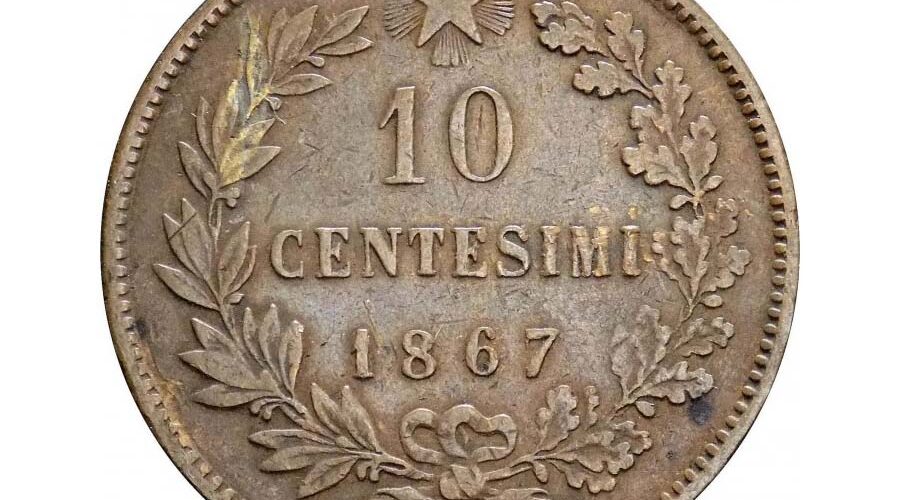
The intervention of the government to reduce the circulation of the trustees, which was highlighted in a wave of speculation was that the launching of the R. D. no. 3969 date of 17 October and which was authorized the issuance of bronze coins in denominations of cents. 10, 5, 2 and 1, in the total amount of 20 million lire, contingent, halved by the R. D. no. 3970 of the same date, which will be reconstituted by the decree no. 4204 30 January 1868 to the issuance of 10 million lire coin cents 10 (the cosiddeto "palancone"), which will lead to the issuance of 15 million lire, which will add 5 million of the cuts of cents.
5, 2, and l, as already expected from the above-mentioned decree. 3969, converted into Law n. 4474 July 7, 1868.
Therefore, the emissions were performed, as in L. 41.000 in 1867, and to L. 19.959.000 in 1868, as follows:
- Cent. I x liras (Turin, Naples, Birmingham, Strasbourg and Brussels);
- Cent. 5 x 3.5 million lire (Milan and Naples);
- Cent. 2 x The million lire (Milan and Turin);
- Cent. The x-500 thousand lira (Milan and Turin);
as in the prospectus.
With these minting ending the emission of coins in bronze, under the reign of Vittorio Emanuele II. The effect of the forced circulation is adversely affected until al1883, when under the reign of Umberto I, will be for the recovery of the circulation of coin made by the new divisionarie silver, as well as an abnormal amount of bronze coins (cent. 2 and (l) made by riconiazioni with the year 1 867 on the part of the sole mint of Milan (see prospectus), which lasted from 1883 to 1892, the reigning Umberto I, in the amount of L. 487.000 and that, in addition to the actual product in the 67-68, L. 1.500.000, give a total of broadcasting L. 1.987.000, that is a198.700.000 cents (figures rounded), against the 181.182.000 cents so far known. This difference in the "black" was found in L. 150,000 in 1867-68, L. 18,000 in 1888, and the. 7.000 in 1892, which correspond to the lack of 17.500.000 of cents.
In the meantime, the need to replace the ticket of the B. N. A. I. L. 5 already widely spoofed, the Superior Council of the Institute, with the Creation of the October 30, 1867, he called for the production of ten million units of the new type, which will be issued with the characteristics of the D. M. n. 4543, September 4, 1868.
Messina "as a public establishment with quality as a moral Authority standalone", ceased to belong to the Administration of the Finances to be placed under the supervision of the Office of the union on commercial companies and credit institutions at the Ministry of Agriculture, Industry and Trade.
The law followed the R. D. no. 4083 of 5 December, which found the tour "as a public establishment of credit": in other words, the Tour of Sicily was recognized as a "de jure" the institution of broadcasting of paper apossidaria.
Among these events is that economic and monetary union, they joined the political events that led to the fall of the government. Indeed, since the summer of 1867 were visible symptoms of serious political unrest resulting from the Convention of 15 September 1866, owing to the dreaded period of a war, this time with France, when it had been boarding in Toulon, a French expedition to ripresidiare Rome-and to protect the Pope: the consequence was that the political crisis after the news that a battle of Mentana between the Italian volunteers and regular French had caused serious losses to Italy. On the 27th of October, the President of the Council Rattazzi resigned and took over the general Menabrea (Finance Cambray-Digny).
The last measure in the field of money is the R. D. no. 4123 15 December ordered that the withdrawal of the coins of the coinage of the austrian in the territory of the Veneto freed.At the end of the year, the monetary circulation was assessed in L. 761.984.000 of the paper, in addition to the misuse of L. 1.821.000; moreover, the metal L. gold coins, as well as L. 16.530 silver, and only the L. 41.000 bronze.
As to the two desks in the south, and interesting are the emissions of different Faiths and Policies:for the Banco di Napoli and the last two productions of the old type in the cuts of L. I and 5 (dated April 10, 1867), which was followed by, from the 1st of January to the 1st of December, emissions new types of cuts, from L. L. 250 (see prospectus).
For the Tour of Sicily, in the Case of Palermo riprodussePolizze L. 2, 3, and 5 in the "silver and gold", as well as faiths L. 2, 3, 5, 6, 7, 8, 9 and 10 (type (1866) pending new legislative measures.
The relaunch of Garibaldi. In the margin of the report, for the year 1867, we also highlighted the activities carried out by Garibaldi, not only in political-militaresca, but also in monetary terms. Remember that in the summer of that year, the bodies of volunteers organized by Garibaldi had approached the border of the papal states, with the evident intention of return, while the French troops flocked to Rome to defend it.
For some, the activity of Garibaldi had to be financed. Because the funds in london in 1864 (as we will see below) were already sold out, it formed a committee for Relief to the relief of the romanesque they wanted to join Garibaldi in a bike insurgency and antipapale: organized, then, a collection of funds by the Centre of Migration Rome, which was established in Florence, issued on April 30, 1867 of money patriotic, that they were no more than a sort of folder-loan in denominations of L. 5, 25 and 100, signed by such A. Bompiani, E. Agnoni and R. Carafe (the two cuts above were also countersigned by Garibaldi). Purpose of the release is contained in one of Our long sentence is written in the line of money, and in the following text:
We intend to valerci of the cost of the law that came from the same Diplomacy recognized, by accepting the principle that Rome belongs to the Romans.
While we await glue the energy of despair, and with the wisdom of our ancient fathers, to hasten the moment, we feel the duty to bring relief to the painful conditions in which the bad government of the priest, it still maintains the unhappy our populations.
We have, therefore, determined to unanimity on the issue of money orders Five, Twenty-five and a Hundred Lire, so that each may, according to its own forces, contribute to this pitiful work...
Which and how much of the spread we had the money order is not given to know, but is it confirmed that, following the action of the volunteers to occupy Rome, had also failed, the need to obtain money for the rescue and relief of the romans". Then the situation came to a head when, on the French side, with a telegram to the State, they asked that "the king's government to give proof of his will, suppressing the enlistment offices dissolving committees of relief and sent a proclamation threatening all of the volunteers to stop, disarmament and internment! Talk with Rattazzi and respond immediately".
Garibaldi , who was arrested on 30 September , was brought back to Caprera and soon after disavowed by the King, with the proclamation of the 27th of October: "the Italian armies of volunteers, horny and seduced by the work of the party, without authorization, my, nor my government, they have violated the borders of the State". But Garibaldi, after an escape from his exile, he reached Florence, in piazza Santa Maria Maggiore, harangued the people with a sentence remained in the story: "We shall Rome, and I thank the people of Florence. A fleet of foreign annunziata; not temetela, will vanish with the powerful breath of the people". For Garibaldi, it was almost certainly not a new arrest, but Rattazzi chose to resign, then he accepted the reincarico the same 27 October.
But on 3 November Garibaldi attacked the French Mentana being overwhelmed; the 1 the French minister of Rouher, in a speech to the Room, assured, "We declare that Italy will never have Rome...never"
It was the very famous and left "jamais" history! Rouher was wrong not to believe in the ability of the Italians.
But, to the honour of the true – according to An annotation Massari (op. cit., page 377) – shipping of Rome, ended with the defeat at Mentana, was Garibaldi was prepared with the connivance of the Government, which granted him free passage on the railroads to the volunteers who flocked to the frontier of the papal provided the food, weapons and ammunition.Sconfessò the company when he saw thicken the risk of complications foreign. Garibaldi was not going to Rome to destroy the spiritual authority of the Pope, that even the Roman Republic, had, in 1849, respected".
Indeed, already in April 1864, Garibaldi went to London, where he was received with the military band. Precise, his biographer Ridley: "Dined at the home of Palmerston at the Cambridge House in Piccadilly, and, with Palermston, had a private conversation for an hour (...) he also Had a private conversation with the Foreign Minister, Lord Russell, as Palmerston, asked him not to start a war in Europe (...) A delegation of italians residing in London, who were, in reality, mazzini gave him a flag that she had written Rome and Venice Before Garibaldi left the England of his admirers aristocrats organized a collection of money, as a tribute to his feats and relief to his poverty.
In duke of Sutherland he presided over a meeting at Stafford House for the launch of a subscription and the money rained down. The duke and (the liberal mep) Seely gave £ 200 each, and Palmerston cent. The mazzini's thought that it was a tip of Garibaldi why he went away, or maybe of a kind of the sum paid to appease a remorse. Already the 22nd of April, Garibaldi had said to the prince of Wales, who would not have accepted any gift; and on 6 may it was announced that all the money would be returned to the donors, after deduction of the expenses for the organization (...).
And a real provocation -wrote the lady's Chambers (friend of Garibaldi), a Cowen (patriot thread Italian): Manchester (President of the Society of Temperance) had promised the 6,000 pounds; I know that we could have 5,000 from Liverpool, and so on. "He thought that Garibaldi had lost the opportunity to collect and 140,000 pounds, which you would be able to use it to buy weapons for his next campaign." With the visit of Garibaldi in London, Mazzini on march 22, he had written at Cowen: "I urged you to come here two months ago. Came in late, but now we have to try to exploit it. Should not stay in England over the 20th of April: for the time we will need him in Italy, and if possible, he shall bring from England, 2,000 or 3,000 pounds".
On April 28, Garibaldi set off from London at a time of Caprera.
Conclusions
Hoping that this article dedicated to discover the annals of the brand-1867 has been of interest to you, waiting for your opinions.
You can let us know what you think or send us other tips through the space, and comments confidential, or through the contact page. Also for any doubts or queries please visit the contact us section of our website.
For any information or further details of our e-mail address is the following: info@numismaticaranieri.it
To the next one with the best news related to the world of numismatics