

Dear readers Numismatica Ranieri, in this article of our blog numismatic we will discover the true ABC of the collector that is, the list of names and terms that every expert in the field, or fond of collecting numismatic needs to know.
In fact, anyone who has already had the opportunity to scroll through the pages of a book of coin collecting, you may have noticed the large amount of particular terms that are used. Because nowadays, many purchases are made through sales postal Auctions and price Lists), where the compilers use plenty of these terms, it is obvious the importance of having a clear meaning.
ABC of the collector, numismatic
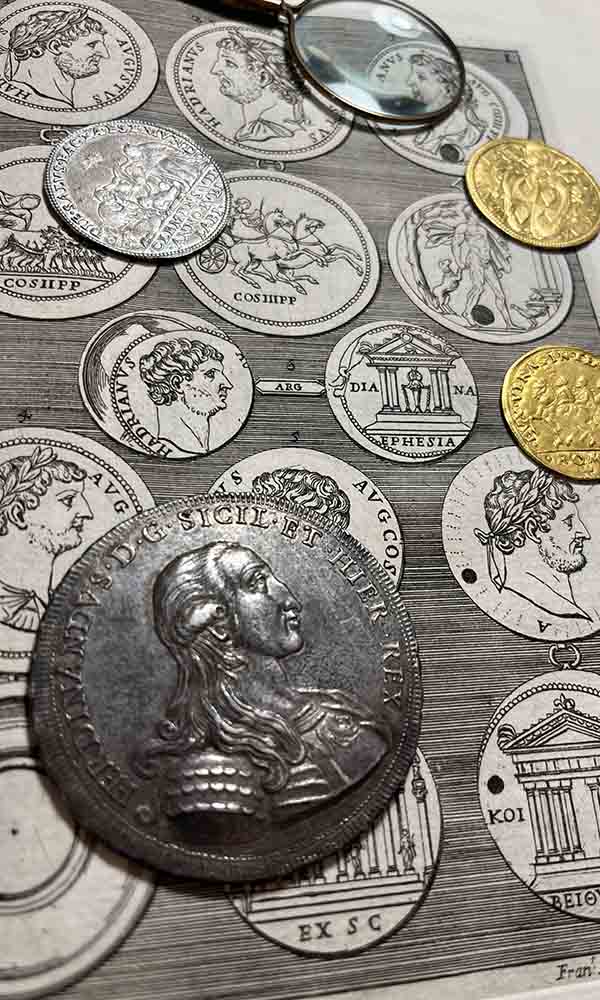
With right (abbreviated D/) is the most important side of the coin, because, here, generally, is imprinted with the name of the issuer, and therefore, there will be depicted a bust (Duke – Emperor -Pope) or a coat of arms with the house or the emblem of the City.
The term reverse (abbreviated R/ ) indicates, of course, the other "face" of the coin, on which we can truly find everything: the deities, animals, Coats of arms, monuments, or more. In this variety is the luck of the collector that has the chance to indulge themselves on the subject to follow.
The smallest of the three sides of which is composed of a coin is the cutting (abbreviated T/), or ring, some confused with the board (see).
The cutting in itself, not just six great interest given the lack of ornamentation (usually it is smooth or knurled) and small size (about 2/3 mm) but it is here that most of the times you nest small and large defects of the coin strokes, filings, traces of the frame to the jewel can sometimes not be very obvious, and, therefore, it is very important to examine a coin under this aspect in order to avoid regrets later.
The edge is that tiny frame, slightly raised, born with the aim to give added protection from wear and tear. The space between the bust, figure or what is represented in both the D/ R/, and the legend, or the board is called field.
Excuse (abbreviated e.g.). The so-called space of the bottom of the field, bounded by a straight line, which stops the legend, and inside of which you can find symbols. letters, mint marks, and, in more recent times, the year of issue.
Note that the specimens belonged to roman republican and imperial are always provided. Legend (or myth). Is a set of words, sometimes abbreviated, on the side of the coin. When this is absent, it is used the term Anepigrafe.
Importance of title in numismatics
Title. From that world and the world of metals, such as gold, silver, and platinum are used to make were always mixed with other metals to easy availability and low cost (copper, iron etc).
To measure the percentage of noble metal present in these alloys, it is used to the end of the title. expressed in thousands of parts (70c). When we find, therefore, an indication of the type "title 800" will mean that the percentage of noble metal present is 800 parts in a thousand.
Generally they are used alloys of 800 to 900 thousandths, but there are cases of alloys with a low content of noble metal, used especially in ancient times.
When gold or silver are present in the form of minimum or lower than 500 milliseconds, using, respectively, the names of Electro and the Mixture.
Pros and cons of a coin: words to use
Then there are the words born to indicate strengths and weaknesses of a coin:
- Appiccagnolo. Outgrowth of the weld metal on the cut in order to transform the object in the pendant.
- Patina. Oxide of the metal formarosi from contact with chemical agents present in the air or in the ground. Given the importance that it rlveste both economically that. especially, under one of the charm of a beautiful (and original) patina, it is able to give. we will return as soon as possible to learn more about this interesting topic.
- Suspension hole. Other practice fortunately fallen into disuse was to produce a small hole at the margin line to use the coin as a pendant. The coins went votive Images (Saints, Madonnas, the Popes), and once transformed, they were used to bring good luck.
- False. Reproduction of the authentic specimen. almost selnpre done for profit.
- Riconio. The term "ambiguous" with whom are also sometimes false. Unlike the latter, the products with systems different from the original, the riconi were performed with the coinage of the original but in a later period
The state of conservation of the coin the words to know
Also the states of preservation they have their own terms:
- Mediocre (abbrev. M) the Currency in a poor state of conservation. of which only a small part remains readable or recognizable.
- Discrete (abbrev. D). Just above Mediocre, one coin in similar conservation is worthy to be collected only if they are of great rarity.
- Beautiful (abbrev. B). Are already so many coins that you can buy in the preservation, although it can certainly define optimal. There are considerable traces of wear and tear, bumps and scratches almost certainly present, but the essential features are recognizable, and the legend is largely readable.
- Very Nice (abbrev. MB). lngiustamente excluded from many collectors and those who publish catalogs, price lists. an exemplary MB merits, appear in any collection.
- Beautiful (abbrev. BB). A coin that has been circulating in for good measure, but not excessive, that it has no serious faults, and as a result are more pleasing to the eye of the coin can be called beautiful. Conservation practically optimal for the ancient (Greek in particular), where they are hardly to be found the best, is the basis of many collectors and catalogues prezzari.
- Beautiful (abbrev. The SPL or Spl). When you recognize the signs of mild wear and only the smallest details and delicate appear "weak" then a coin can be called beautiful. That is rarely found in the coinage of ancient and, especially, in the middle ages, is theoptimum for the modern and contemporary.
- Fior di conio (abbrev. FDC or Fdc). We have reached the maximum storage possible, and many fans praised and ostentatious. The coin has minimal traces of wear and tear, nor blows or scratches; it is, in short, perfect. It is obvious that only the coins, contemporary, or at the most modern ones, can be searched in a similar conservation.
- Funds in the mirror (abbrev. FS) Although it is always below the entry keeps, this definition indicates a characteristic of the coin. That is, to have the funds (or fields) of the coin perfectly shiny to a point where it potercisi myself in the mirror.
Conclusions
Hoping that this article is dedicated to discovering the abc of the collector coin has been of interest to you, waiting for your opinions.
You can let us know what you think or send us other tips through the space, and comments confidential, or through the contact page. Also for any doubts or queries please visit the contact us section of our website.
For any information or further details of our e-mail address is the following: info@numismaticaranieri.it
To the next one with the best news related to the world of numismatics.