

Dear readers of the blog numismatic Numismatics Ranieri, today's post traces the story of a major historical event, or the massacre of the Huguenots.
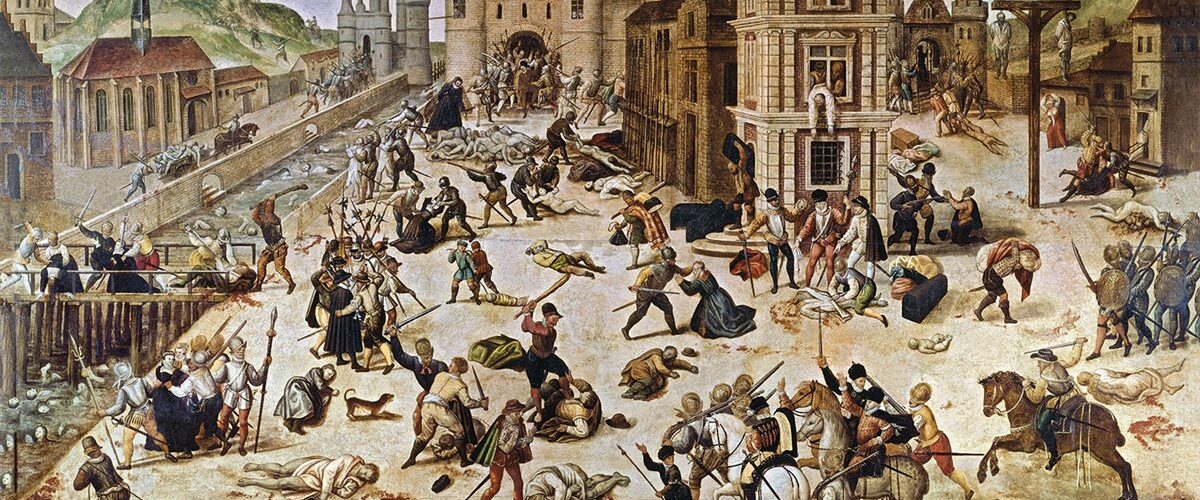
What he thought of that night more than four centuries ago, San Bartolomeo? It was his night, the night of this saint with the name, which means "son of Tolmai", this saint is depicted usually with a book or with a rotulo, but also with a knife, to ostendere his death as a martyr (died scorticamento), almost a sad omen of slaughter made in the night between the 24th and the 25th of August, 1572. The night. In fact, of St. Bartholomew, on the night of the massacre of the huguenots.
Over the past few decades, the French protestants had by now joined to calvinism and had been identified with the name of the Huguenots, corruption fonicadi eidguenot, the end of the swiss co-conspirator. The spread of the reformed religion, had come up to the court of the young Charles IX, manipulated by her mother. Catherine de Medici, but, above all, by the ugonotto Coligny. The confessional differences were more times become, in this second half of the 500 French, real military engagements, the last of which ended with the peace of Saint Germain in 1570he had prepared for the huguenots, also four "places de sureté" , thus creating the basis for a spread that would bring a "state within a state", to use the future words of Richelieu. In an era In which the courts of europe, were a hotbed of conspiracies and den of traitors, an era in which politics were built, both with international treaties, as well as with the dagger, it was an attempt (which was organized by Catherine de’ Medici, with his privy Council and awkwardly failed) to kill the Coligny to unleash one of the most bloody massacres religionis cause in human history. Paris had been a few days invaded by the huguenots for the social event (but not only) of the year: the wedding between Margheficando their declared the head.
But great was their outrage and anger when the Coligny, who had great influence with the king, escaped attack: Catherine de' Medici, was immediately identified as the principal and threatened, but at this moment it emerged his spirit "machiavellian" (not for nothing was the florentine as the author of the Prince), which allowed her to convince the son of a real danger of an impending coup ugonotto. The king tricked him, prepared so the plan for what would have been a real action for him, as the other will be there in the TWENTIETH century: closed the gates of the city, blocked the docks river, Paris became a prison from which there was no exit, so it could begin the rounding-up of the huguenots.
Personal grudges, old hatred, desire of revenge; all shuffled in the night, when it was enough to look wrong to be executed, often beyond the religious. In that night in which he reigned, the hatred and the law is made by hand, between two and three thousand people diedin Paris; many were the victims in other cities, in the days subsequent.
Reaction papal after the massacre of the Huguenots
What was the reaction to the papal to this slaughter? Above all, what was – if there was -the liability of the pope, recalling how, in the years immediately preceding, wars, plots and betrayals had birth, and often developing their own in Rome? In just two years Ugo Boncompagni, a pope from the harsh gaze, perhaps even for the beard, but from the mild character, had started a pontificate that would be a long twelve years; the historiography has not recognized the specific responsibilities of the papal bulls in this massacre. but it certainly is indicative of the celebration of a Te Deum of thanksgiving at St. Mary's basilica and in the church, the French national St. Louis, the news of the massacre: even he was given the task to Giorgio Vasari to paint with some scenes of that night, the Sala Regia in the Vatican! This spirit of satisfaction, and hope for a full return of France in the bosom of orthodoxy. you can also notice in the production of medals, papalas in the model proposed here.
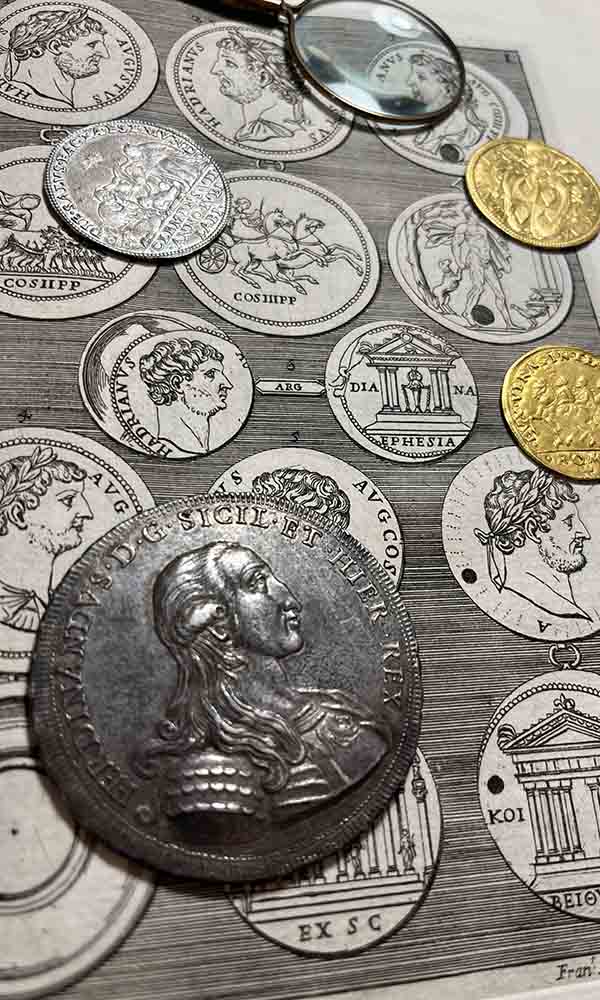
It is a medal made by Federico Bonzagni, said Federico Parma (1510 ca.- 1588), an engraver at the Mint of Rome from 1556 1585. In the obverse features the profile of the Pontiff, almost engaged in a severe warning (against the heresies), or absorbed in a moment of reflection; on the reverse a carpet of huguenots dead or dying, ideally, gives way to the Church, triumphant, and together fustigatrice in the image of the angel that securely grips a sword. This verse of the medal is surmounted by an inscription that leaves no room for doubt, for its brevity, the explicit and terrible together: VGONOTTORVM STRAGES.
Specimens of gold and silver, were distributed to the various cardinals and ambassadors in Rome in early September, 1572. By Protestants instead, the medal was seen as an "insult" and incettata to transform it into a coinage "satirical" and antipapista, so much so that 250 years later, in 1823-1824, when the director of the Pontifical Mint Francesco Mazio made riconiare the entire series of papal medals, Marino V, for a total of 445 pieces, to be put up on sale, for the present medal of pope Gregory XIII could not be purchased alone, it had to buy the entire series! But it was really so creepy, so abominable, in the SIXTEENTH century, a slaughter for religious reasons?
It may seem inconceivable, but in an era that did not yet know the religious tolerance, democracy and liberalism, was perfectly (and sadly) normal suppress those who thought otherwise, when the time was right; the pacification, then, could not, regardless of the uniformity of thought, which can be obtained in any way, at any cost. Let's not forget that in just a few years, the Pacification of Ghent, with whom, in November 1576, Spain would have tamed the Flanders region in revolt, it would have been preceded by the terrible sack of Antwerp, resulting in the destruction of the then thriving economy of the city. This is a prerequisite for those who are going to read the story, then, with the eyes of today, with the eyes of a citizen of the 2000 that you can see how, with respect to the ‘500, today everything is different, or, perhaps.... many things are still the same...
Conclusions
As always waiting for your opinions about this article dedicated to the massacre of the Ugonottti.
You can let us know what you think or send us other tips through the space, and comments confidential, or through the contact page. Also for any doubts or queries please visit the contact us section of our website.
For any information or further details of our e-mail address is the following: info@numismaticaranieri.it
To the next one with the best news related to the world of numismatics.