

Description
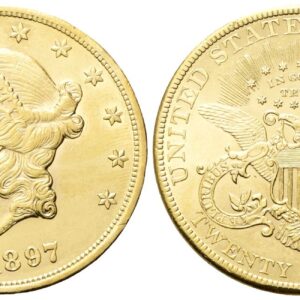
Type: $ 20 Saint Gaudens
- Material: Gold
- Mint: Philadelphia, Denver, San Francisco
- Actual weight: gr. 33,43
- Weight of pure gold content: gr. 30
- Pure gold: 900 % (21,6 carats)
- Diameter: mm 34
- The period of coinage: from the 1907al 1933
A beautiful new series of coins american: this was the result of a dinner at the White House between the president, Theodore Roosevelt (1901-1909) and the famous sculptor Augustus St. Gaudens. In contrast to his predecessors, Roosevelt he was very interested in the aspect of national currencies, much to realize of the coins as beautiful as those of ancient Greece. St. Gaudens accepted the challenge and created a coin 20 dollars.
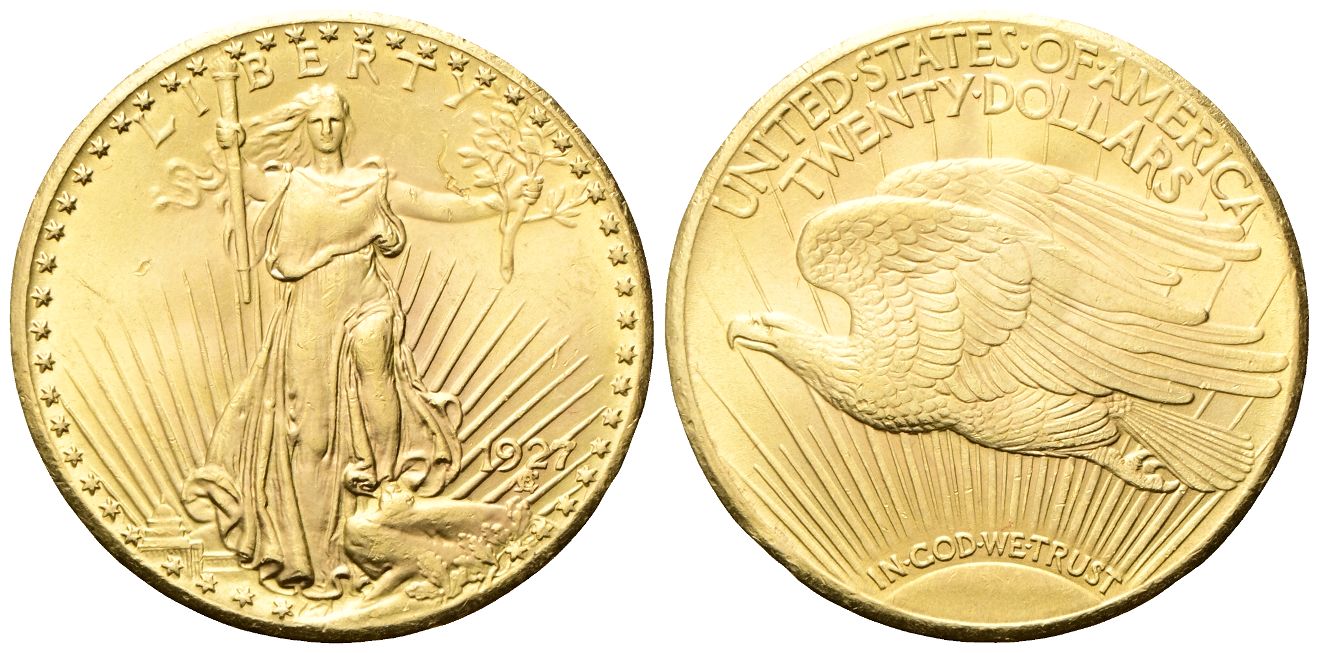
The obverse of this coin there is a figure of Liberty standing against the sun that rises on its back and the Capitol, second floor. Above his head is inscribed with the word LIBERTY. Dressed in a peplos floating, the Liberty holds a torch in her right hand and an olive branch in her left hand. His foot is resting on a rock.
Theodore Roosevelt The edge of the coin is surrounded by 64 star 5 tips.
In the field, to the right, it reads the date in roman numerals (MCMVII) below which are the initials of the engraver, ASG.
For the other dates, just the date is in Arabic numerals.
On the reverse, an eagle flies against the rays of the sun which appears at the bottom of the coin. While in the upper part of the figure, on two lines, the written UNITED STATES OF AMERICA – TWENTY DOLLARS.
Were produced twenty-two test samples in high relief, which has resulted in the use of the coin nine times; two of them were merged. Two of the remaining specimens are kept in the collection of the American Society of Numismatics. The Smithsonian Institution, and the Theodore Roosevelt Museum will have a copy each. Later, in 1907, 11 250 copies were produced with less marked reliefs and were put into circulation. These are the words E PLURIBUS UNUM (the national motto of the american). On the reverse, only 13 of the rays emerging from the sun, while on the test there are 14.
These coins met 5 emissions. They were accepted with enthusiasm, but the bankers and businessmen complained that difficult to stack.
To respond to these criticisms, prepare the new die axis or coin rotation for coins, $ 20 vintage in Arabic numerals and a raised less protruding. These were issued in 1907, and in the course of the following years. President Roosevelt, thought to be written with the name of God on a coin was blasphemous, and so the first issues drawn by St. Gaudens appeared without registration IN GOD WE TRUST that was on all of the gold coins of 5, 10 and 20 dollars manufactured from 1866 until 1907, without exception.
And’ the religious sentiment of the American instilled from the american civil War (1861-1865), which guided the choice of this motto. At the time of Theodore Roosevelt, the public, apparently, he was used to that, to see this written in the coins, because the protests were flocking to the Congress, which decided to enact the law (may 18, 1908), which provided that on all the coins of gold and silver appear to this motto. To comply with the law, Roosevelt decreed that the legend it would have appeared on the new coins: actually, in 1908, the writing appeared on the reverse of the coin, above the sun.
The a $ 20 St Gaudens has a diameter of 34 mm and weighs 33,4370 gr. with a title of 900 to 1,000, and a gold content up to 30,0933 gr.
Collect coins of gold St. Gaudens Double Eagle is an enterprise rather ambitious. When it was coined for the first time in 1907, the original design was engraved in high relief; however, about 11.250 of these coins were minted before the design was modified to allow production of the format a little deep on the press for coinage at high speed. Noticed and recognised by their design, with roman numerals, MCMVII, the pieces in relief, are extremely scarce today, and it is estimated that there are still between 2,000 and 3,000, which makes their demand is quite high.
Between the St. Gaudens Double Eagles prior to 1933, there are a number of rare issues sought by collectors and numismatists, in particular those of the ’20s. For example, the 1927-D is rather difficult to acquire. Although they have been coined the 180,000, there are fewer than a dozen, because all the rest has not been released, and time.
All the St. Gauden issued after the 1928 are considered to be rarity, and, with the last year of issue in 1933, there is a rather controversial. As the version of the 1927-D Double Eagle, 1933 had 445.000 in production; the vast majority of these coins was cast. The United States government has issued a statement according to which the workpiece from $ 20 to 1933, it was officially released, and that all those held by the collectors had been illegally issued.
An exception to this illegal status was a double eagle Saint-Gaudens 1933 what was sold in the collection of king Farouk, who was king of Egypt. This money was to be auctioned in 1953, after which the goods of the king were seized by the egyptian government. In 2002 it was sold for $ 7.590.020. To date, this year, the issue has continued to make prices, auction records, and is currently sold in like new condition for $ 18.872.250.
With a roman numeral up to date, and the other four stars to represent the current fifty states that did not exist in 1907, the Mint of the United States has raised this gold coin Double Eagle in 2009 in a gold coin with a Double Eagle high relief, a coin that could not be realized with the technology, 1907, and which promised to realize the vision of Augustus Saint-Gaudens.