




Description
Type: 20 Francs (Marengo Stranger) – Austria, Belgium, France, Switzerland
- Material: Gold
- Brand: Austria, Belgium, France, Switzerland
- Actual weight: gr. 6,45
- Weight of pure gold content: gr. 5,8
- Pure gold: 900 % (21,6 carats)
- Diameter: mm 21
- The period of coinage: from 1800 forward
On June 14, 1800 Marengo the First Console Napoleon Bonaparte he defeated the austrians, regaining the domain of most of northern Italy: Lombardy, Piedmont, Emilia and Liguria. The austrians, in addition to retire beyond the Mincio, delivered the artillery and food supplies, and keeping the strongholds of Ferrara, Mantua and Peschiera del garda.
With the victory of Marengo, was also born in the Repubblica Subalpinaa republic sister, who stood on the territories of the Kingdom of Sardinia, and in 1801, to celebrate the victory of napoleon in the previous year, he coined a gold coin with a nominal value of 20 francs and was given the name “Marengo”. The Lira in turin, the former official currency in France, he was replacing with the Franco 5 years old at the time of the minting of Marengo, which, therefore, was a reference to the new coinage of the French, the Franc Germinal (established on 18 germinal of 1795, 8 April). Characteristic of the Franc Germinal was, in addition to the division into cents, the bimetallismo of gold and silver, for each of the franco had to have 0,29025 grams of pure gold, and 4.5 grams of pure silver, with a ratio of 1:15.5 in.
The Latin Monetary Union, therefore, was an attempt of the NINETEENTH century to allow free circulation of most european currencies within member states, at a time when the value of the coins was given by the amount of precious metal contained in them. The european agreement was based mainly on the French monetary system. France, following the French Revolution, it was the new monetary system, said of the franc germinal, by the law of 18 germinal of the year III (7 April 1795) and 7 germinal year XI (27 march 1803), which used a decimal system (1 franc = 100 centimes), a monetary system, bi-metal in which they were legal tender in both the gold and the silver. The legal tender of the franc provided for a relationship between the metals gold and silver equal to 15.5 approximately, that is, a franc was worth 4.5 grams of pure silver or 0,29025 grams of gold.
This type of coin was produced from 1803 and 1815, with a weight of 6.45 grams and a title gold 900 thousandths. The coins carry the effigy of Napoleon Bonaparte, the first time as first consul and then as emperor of the French. After the fall of Napoleon, the production of coins of the same type, continued, and the name was extended to all the coins 20 francs gold produced in France in the NINETEENTH century.
During the napoleonic period, France had exported the Franc as the monetary system, even in the other countries of Europe such as the Netherlands (in the sense of Belgium, adopted him when he was born in 1830) , the Duchy of Parma, the Kingdom of Sardinia in 1815) and Switzerland (which adopted the Franc with the federal law on the coins of the 1850s).
This, then, was the situation when they were discovered deposits of gold in California (1848), and Australia (1851), which did lower the price of gold leading to the first crisis of the payments in silver. Phenomenon which is called “bimetallismo lame” this is due to the fact that the discovery of large gold deposits led to the decline in the relative value of gold in relation to silver, but since the coins minted in gold and silver, the issue became a matter of convenience, as it teaches the the law of Gresham. The commercial value of silver increased, but its legal value, such as gold, remained the same, which is why, when the value of the commercial became so high to cover the costs of the recast, the currencies were merged and the silver was sold as the metal making a profit. This led to a first crisis of the bimetallismo.
France, Italy, Belgium and Switzerland, they had already been in several years, a community monetary informal, since the currency of each country had the same content of precious metals. The system had given him a big advantage in terms of trade. It was to go a step further to guarantee the stability and strengthen it.
The coexistence of the two standard monetary, gold, and silver, and set the groundwork for a potential source of instability. The system of the franc germinal is based on the assumption of constant relative prices of gold and silver, and supposed that the volumes, the conditions and cost of production of the two metals will remain stable. Given the premises, a crisis of this system would have been possible at any time. He wanted to create a the single currency by the name “Europe” , tied to gold, and that which would have been the gold standard, but realistically, given that France had large reserves of silver, he decided to keep the bimetallismo.
Chaired by Félix Esquirou de Parieu, the Latin Monetary Union” was signed on 23 December 1865.
He wanted to create a the single currency by the name “Europe” , tied to gold, and that which would have been the gold standard, but realistically, given that France had large reserves of silver, he decided to keep the bimetallismo. After a month of negotiations at the Quai D'orsay, the 23 December 1865 you came to the signing of the Treaty on the Latin Monetary Union on the part of Napoleon III, Leopold II, Vittorio Emanuele II and Konrad Kern, minister plenipotentiary in France, Albert Escher, the director of the Mint, the federal and Carl Feer-Herzog, a member of the national council in the canton (the Swiss Confederation).
The convention was established principles:
– Uniform currency: each signatory state was required to mint coins conform to defined standards, but could continue to name their own currency with the name, which previously had.
– The bimetallismo integral: the minting of gold and silver was free and the liberating power was unlimited. Every citizen was obliged to accept, without limitation, any coins of gold and silver 5 francs coin) in respect of the agreement of the Union; also the coins of each state had a legal tender in the european Union (with a roof for the coins of silver).
The success of the Latin monetary Union, as measured by the number of countries that adopted the system (32), laid the foundations for an international monetary system.
The agreement is then regulated the minting of coins with the title of 900/1000 for the gold coins of the participating Countries. 900 to 1,000, the metal content in gold Marengo, that in some way served as a unit of measurement and a reference to the agreement. The coins became the means of payment in freely circulating and universally accepted within the States of the Union. The coins kept their old name, each country could coniarle, there was not a central bank was not expected to be issued in paper money, but each country was required to inform the other about the number of coins of gold and silver in circulation. Were finally fixed the shapes and weights of the gold coins of 100, 50, 20, 10 and 5 Francs/Lire and the title (835/1000) of the coins in silver 5, 2, 1, 0,5 and 0,2 Francs/Lire.
The signatories were France (1865), Belgium (1865), Italy (1865), Switzerland (1865) and Greece (1868); the associated countries with bilateral agreements in Austria-Hungary, Sweden, Russia, Finland, Romania, Spain, the Papal State, San Marino, Liechtenstein, Monaco, and Clay. The countries aligned unilaterally were Serbia, Bulgaria, Venezuela, Peru, the Dominican Republic, Haiti, the west Indies from denmark, Argentina, Brazil, and Chile. There were also the countries under the statute, colonial, such as Tunisia, Comoros, Congo, puerto Rico, and Eritrea. The United States also thought of joining the Latin Monetary Union in 1873, but the Congress decided in the end to maintain the ratio between gold and silver at 16, against 15.5 of the Union.
The idea was to accept anyone who wanted to conform to the system by signing the agreements. Prussia refusedbecause it was the opinion of Bismarck, who, while was not opposed in principle, especially as a diplomatic instrument of the monetary instrument, that the objectives of geopolitical prussians should be pursued without France, that, with the Union to the guide of the Franc would have created a coin hegemonic. We adapted their work (through bilateral agreements or alignments unilateral), without joining, but other states: Papal States in 1866, the Austro-Hungarian Empire in 1870, the Principality of Romania in 1867, the Kingdom of Spain in 1868, the Principality of Serbia in 1873, the grand Duchy of Finland in 1877, the Principality of Bulgaria in 1880, and the Russian Empire in 1886. Even Albania, who had adopted a system of their own money only in 1925, gave legal tender, in 1912, to the coins of the Latin Monetary Union from France, Italy, Greece, and Austria-Hungary, in the place of the Turkish Lira.
In 1868, followed, instead, officially the Kingdom of Greece led by George I, the latter country that destabilizzò the Union: in fact it was economically more backward, eager to feed rapid economic and in need of resources for industry, infrastructure and the army. The construction of the Corinth canal, the railway between Athens and Piero and acceptance of the organization of the Olympic games of 1896 brought up to the stars the debt with the issuance subsequent paper money discovery. Greece in 1893 declared bankruptcy. This, together with the crisis of the franco-prussian war and the discovery of silver mines in the territory of the II Reich brought him out of all the defects of the Union, which was based on the bimetallismo, that was inexorably the effects of the fluctuation of the commercial value of the metals that made up the coins, leading to the phenomenon of “bimetallismo lame” already seen before.
On the other side with the franco-prussian war, there emerged a strong competitor of the bimetallismo, the so-called Gold-standardin use in Great Britain since 1815 and from its colonies. In that year, in fact, Britain had chosen as the only convertible currency to the gold, leaving the bimetallismo adopted until the napoleonic wars: a currency was convertible with 7,32 grams of gold. The british system will boot to the head when in 1872 the Prussia, following the victory over France, demanded the payment of an allowance monstre 5 billion francs, to be paid entirely in gold coins (as we have already said Prussia refused membership of the Latin Union for hostility to France), formally adhering to the Gold standard, combining with the occasion, the new marco the gold standard and the Reichsmark and giving life to the German central bank, the Reichsbank, only the custodian of the rights issue. The ultimate success of the system will be sanctioned by the accession, in 1900, in USAto the gold standard where 1 dollar had the nominal value of 1,50 grams of gold.
The functioning of the Union was inherently weak for two problems: the fluctuation of the relative ratio of the two metals, which had been initially supposed to be stable, and the fluctuation of exchange rates. The change in relations between the metals had made it impossible to continue to mint money. After the first world war, the situation was no longer sustainable, given that in order to respect the treaty could not be beat coin. At the end of 1925, the Belgium denounced it for the first this situation and the Convention, which had in marengo and in the shield by five francs coins the most representative and now no longer minted, was formally dissolved on January 1, 1927.
The crisis of the Union culminated in 1914, when the full convertibility of money in the gold was abandoned as a result of the devaluation caused by the economic crisis due at the beginning of the First World War. The Union was dissolved permanently in 1926. The Swiss Confederation was the last to leave it, establishing that only the coins of gold and silver, the national would be legal tender in the territory of the confederation from 1/4/1927.
And in all this, Marengo? “Marengo” continued to be the name by which he was called the coin of 20 francs, lire and drams of gold, and that could be exchanged 1:1 in the various countries, and after the failure of the Union it became a gold coin investment and collection.
Italy it was coined by from 1861 to 1923, with the effigy of Vittorio Emanuele II, Umberto I, Victor Emmanuel III. The production of Marengo, Italian ceased with the exit of Italy from the Union as a result of the heavy devaluation of the lira in the first post-war period.
The Marengo French (with the effigy of the sovereign before the Union, and then with the coats of arms of the republicans) continued to be produced by the mint of Paris after the end of the Second Empire with the same characteristics and was the model for the marenghi d'oro products from other european states.
It defines Marengo Belgian the production of 20 francs gold that goes by Leopold I, Albert I. of course, that of Leopold I is pre unionist, one of Leopold II, he was spread wide, having been coined from 1865 to 1909; whereas, by contrast, is limited only to 1914, when the minting of Marenghi of Albert I. Belgium then left the Union in 1925.
George I of Greece, instead, the monarch is depicted on the obverse of the Marengo Greek, coined until 1913 (about 20 drachmas prior to 1865, always aligned to the franc germinal, and then inserted between the “Marenghi” there is depicted The Brass).
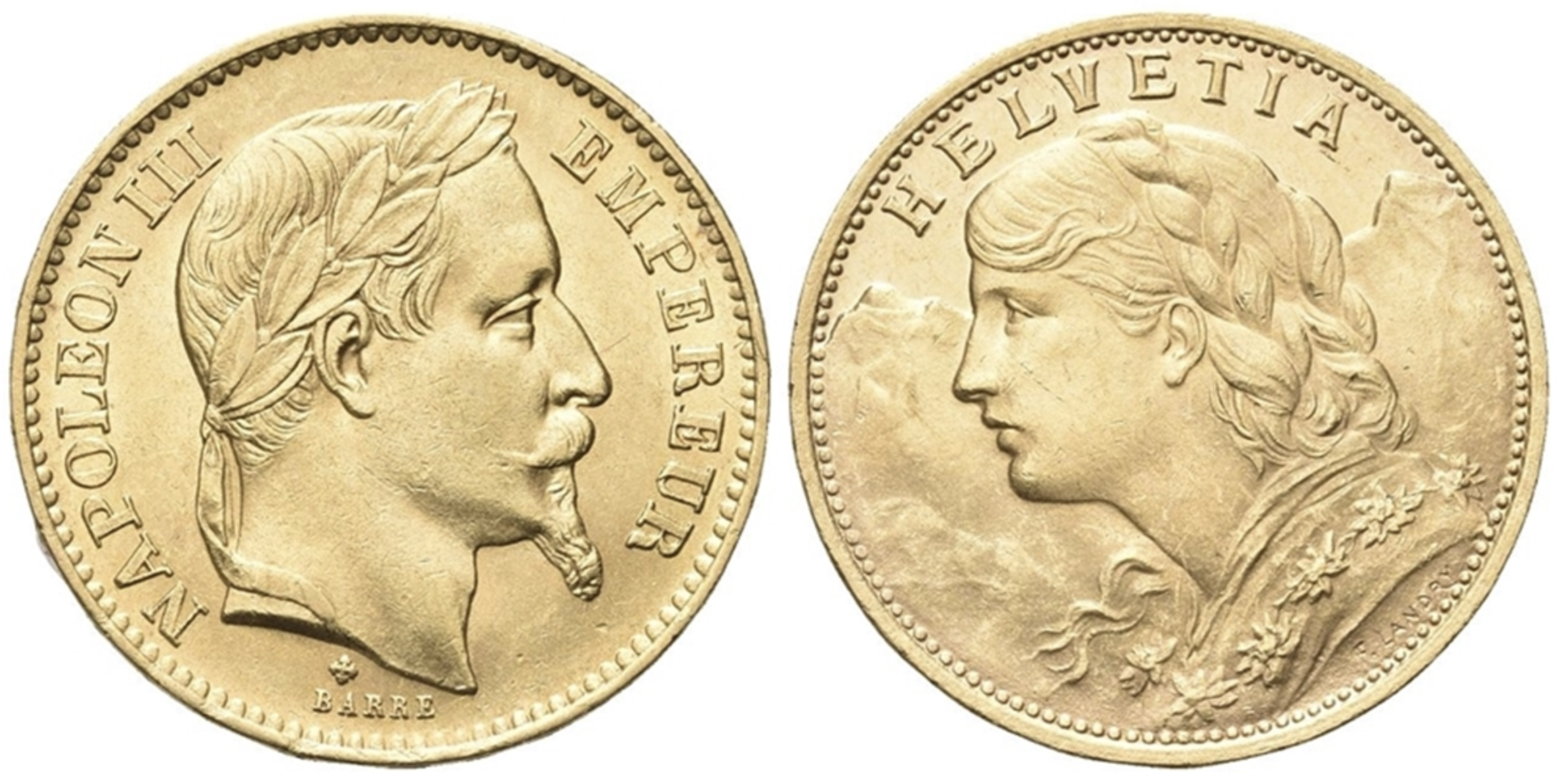
We close finally, with the Marengo swiss for several reasons: 1-Switzerland was the last to leave the Union formally; 2 - did not sovereign depicted on the obverse, but the “Verena” the woman personification of the swiss Confederation; 3 - last but perhaps most important, the Marenghi minted between 1897 and 1949 (1927, still in the framework of the Union from 1927 to 1949, however, remained, however, with the same standard metallic) are still considered coins of the bag.
MARENGO FRENCH NAPOLEON I
MARENGO FRENCH LOUIS XVIII
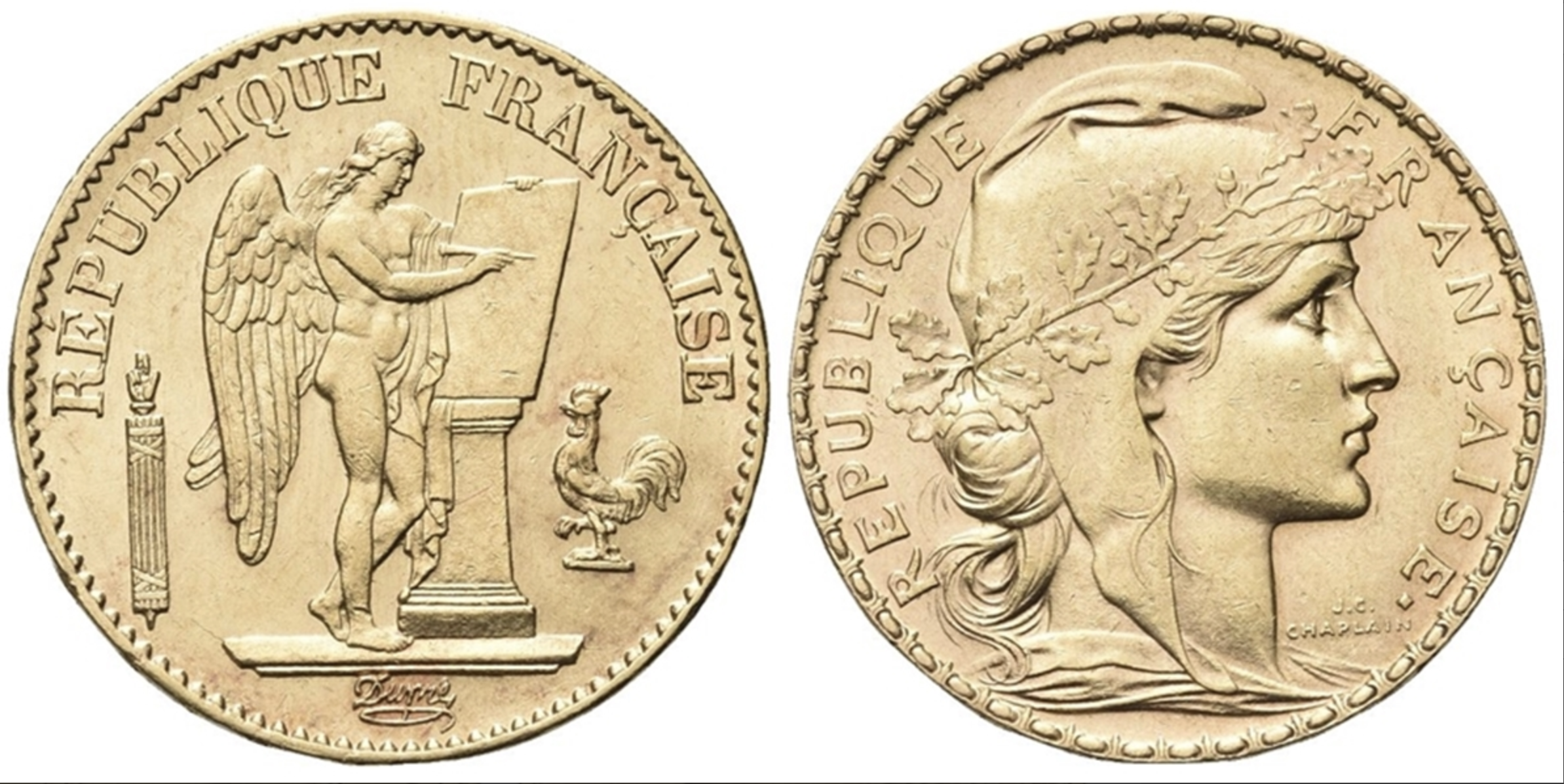
MARENGO FRENCH REPUBLIC, ANGEL WRITER
MARENGO FRENCH COCK
MARENGO FRENCH NAPOLEON IIII GRADUATED HEAD
MARENGO BELGIAN LEOPOLD II
MARENGO SWISS VRENELLI