

Description
Description
Type: 500 Lire silver
• Material: Silver
• Mint: Rome
• Actual weight: gr. 11
• Weight of the pure gold content: gr. 9,18
• Pure gold: 835 %
• Diameter: 29mm
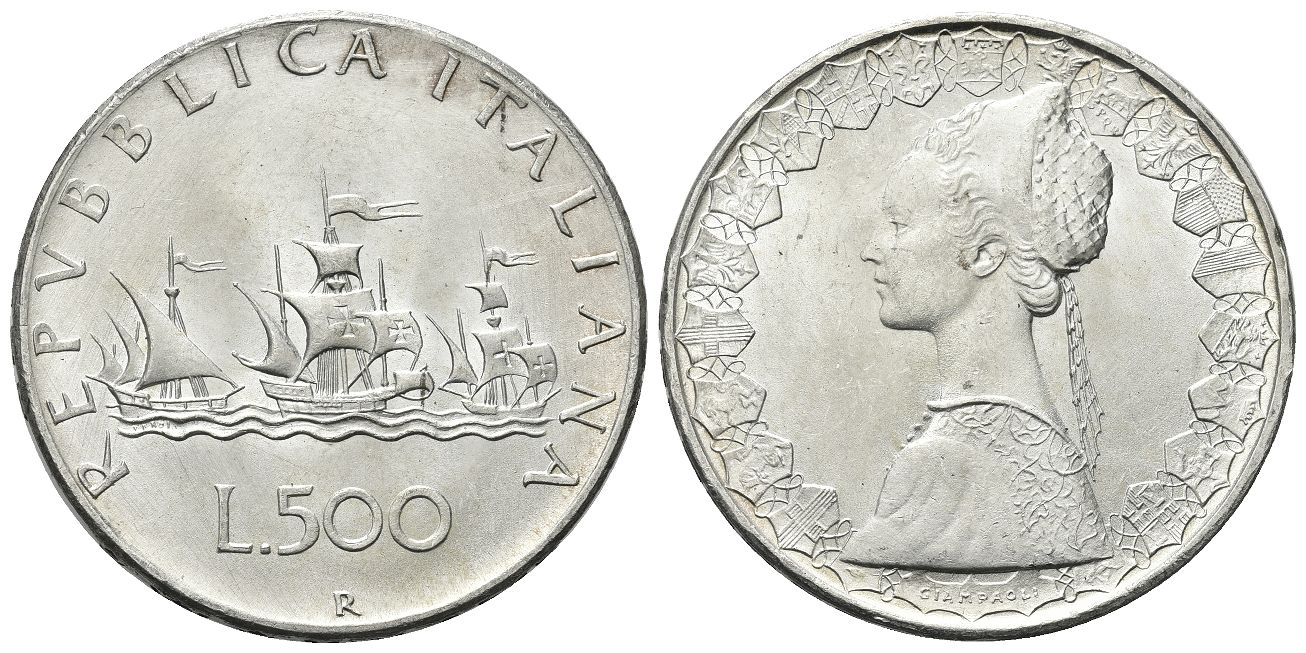
• The period of coinage: from 1854 to 1915. from 1958 to 2001. The name derives from the design of the straight developed by the engraver, Guido Veroi: three ships that ply the seas. Not to be confused with the version of test where there is a written TEST as well as the date, which is visible on the edge, is 1957.
HISTORY
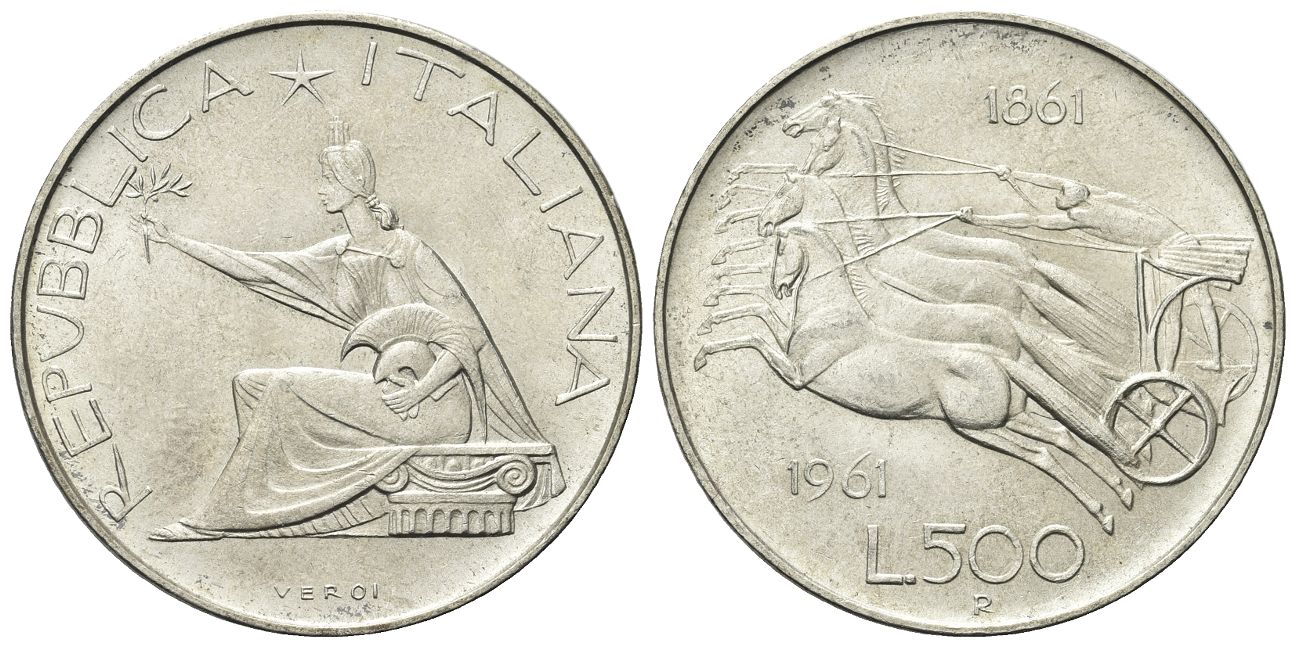
During its existence, the Italian Republic has issued so far only two rated silver for the movement: the 1,000 lire, Rome the Capital and 500 lire. The latter value were issued two commemorative (100 anniversary of the unification of Italy in 1961, and the 700 anniversary of the birth of Dante Alighieri, 1965), which coincided with the ordinary type. This ulti During its existence, the Italian Republic has issued so far only two rated silver for the movement: the 1,000 lire, Rome the Capital and 500 lire. The latter value were issued two commemorative (100 anniversary of the unification of Italy in 1961, and the 700 anniversary of the birth of Dante Alighieri, 1965), which coincided with the ordinary type. The latter, coined since 1958, is called the “Caravelle” because of the drawing of the straight, and appears in three caravels. This coin is silver 835 and weighs 11 grams: the result is that each coin contains 9,185 grams of silver up. The diameter is 29 mm, while the axes are to the French.
On the obverse, as already said, is a representation of three caravels with the bow facing to the right, and the tips of the flags toward the bow. Around this design is the legend REPVBBLICA ITALIANA. Under the caravelle vi is the value indication (L. 500) and, below, the sign of the brand (R). The coinage of this side was engraved by Guido Veroi, even if the original task had been entrusted to Pietro Giampaoli (the author of the reverse), who chose to think of a pink, but the flower did not fit to the style and the message you wanted to entrust to the currency. So the task went to Guido Veroi, which chose the three caravels to symbolize the economic rebirth of Italy of those years. The reverse, however, you can admire the bust of a woman in the clothing of the renaissance; the model is Joy Savonitto, wife of the engraver Pietro Giampaoli, author of this side of the coin. The bust of the woman is surrounded by the coats of arms of the nineteen between regions or towns of the region (the bust covers some of the coats-of-arms, which then are unrecognizable). In low indication of the author (GIAMPAOLI). The coat of arms refer to the following regions, or the capitals of the region (starting from the bottom to the left): Genova, Torino, Aosta, Milano, Trento, Venezia, Trieste, Udine, Bologna, Firenze, Ancona, Perugia, Roma, L'aquila, Napoli, Bari, Potenza, Catanzaro, Sicilia, Cagliari. It is absent in the Molise region because this region was established in 1963.
This coin is particularly famous in the trial version that had the flags upside down, which is directed towards the tail of the caravelle. The coins of the test were given in tribute to the prominent figures of the era, and to the members of parliament: not circulated. They are dated 1957, and, in addition to the orientation of the flags, there are several crosses on the sails and the height of the tree mezzana; in addition, the inscription on the boundary, is a REPUBLIC rather than REPVBBLICA.
After some controversy, it was decided to change the orientation of the flags on the coins intended for circulation. Below are the runs of 500 lire Caravelle produced in each of the years. The total amount of coins intended for circulation was 97.840.000 pieces.
This coin was minted also from 1968 to 1970, and then from 1980 to 2001, but only for the packaging of the brand. From 1985 to 2001 was produced version for the bottom of the mirror (proof), for the packaging, only to collectors; the runs vary from 8,000 17.500 pieces.
mo, coined since 1958, is called the “Caravelle” because of the drawing of the straight, and appears in three caravels. This coin is silver 835 and weighs 11 grams: the result is that each coin contains 9,185 grams of silver up. The diameter is 29 mm, while the axes are to the French.
On the obverse, as already said, is a representation of three caravels with the bow facing to the right, and the tips of the flags toward the bow. Around this design is the legend REPVBBLICA ITALIANA. Under the caravelle vi is the value indication (L. 500) and, below, the sign of the brand (R). The coinage of this side was engraved by Guido Veroi, even if the original task had been entrusted to Pietro Giampaoli (the author of the reverse), who chose to think of a pink, but the flower did not fit to the style and the message you wanted to entrust to the currency. So the task went to Guido Veroi, which chose the three caravels to symbolize the economic rebirth of Italy of those years. The reverse, however, you can admire the bust of a woman in the clothing of the renaissance; the model is Joy Savonitto, wife of the engraver Pietro Giampaoli, author of this side of the coin. The bust of the woman is surrounded by the coats of arms of the nineteen between regions or towns of the region (the bust covers some of the coats-of-arms, which then are unrecognizable). In low indication of the author (GIAMPAOLI). The coat of arms refer to the following regions, or the capitals of the region (starting from the bottom to the left): Genova, Torino, Aosta, Milano, Trento, Venezia, Trieste, Udine, Bologna, Firenze, Ancona, Perugia, Roma, L'aquila, Napoli, Bari, Potenza, Catanzaro, Sicilia, Cagliari. It is absent in the Molise region because this region was established in 1963.
This coin is particularly famous in the trial version that had the flags upside down, which is directed towards the tail of the caravelle. The coins of the test were given in tribute to the prominent figures of the era, and to the members of parliament: not circulated. They are dated 1957, and, in addition to the orientation of the flags, there are several crosses on the sails and the height of the tree mezzana; in addition, the inscription on the boundary, is a REPUBLIC rather than REPVBBLICA.
After some controversy, it was decided to change the orientation of the flags on the coins intended for circulation. Below are the runs of 500 lire Caravelle produced in each of the years. The total amount of coins intended for circulation was 97.840.000 pieces.
CURIOSITY
THE REPUBLIC OF ITALY, 500 LIRE “TEST” 1957
Ag gr. 11 Gig. P2 q. FDC Rare
The 500 Lire “Test” in 1957, is a rarity of great value to collectors of numismatic Italian. Coined in just 1.070 specimens and donated to members of parliament, senators and high officials of the State, stands out from the final version for the representation of the flags on the ships, put “wind”.
Wanted by the Minister of the Treasury, Giuseppe Medici, the coin was designed by Pietro Giampaoli (right) and Guido Veroi (ws). The right has a female bust renaissance with the coats of arms of cities and regions in italy while The reverse depicts the three caravels of Columbus with the flags “the wind”.
The cut bears the year “1957” in relief, surrounded by 3 star hotel. Only, in fact, the currency of the test may have on the board the date 1957 as the coins intended for circulation were coined only in 1958.
The coins of the Test called “the wind” should have on the board the date 1957.
Navy captain Giusco of Calabria raised doubts about the correct position of the flags. It sparked a heated debate among experts, and the local press-bringing to the fact that for the issuing official, which is dated 1958, the flags were changed in the traditional way.
The 1.070 specimens with flags “the wind,” they have become a unique piece and is coveted by collectors and their rarity and the unique story make them of great value numismatic: from € 2,000 to 11,000 euros.
The 500 Lire “Test” in 1957, is a coin that is full of charm and history.