

Description
Description
Type: 20 Lire Italy
- Material: Gold
- Mint: Rome
- Actual weight: gr. 6,45
- Weight of pure gold content: gr. 5,8
- Pure gold: 900% (21,6 carats)
- Diameter: mm 21
- The period of coinage: from 1861 to 1878 and from 1879 to 1897.
20 lire, or Marengo coined under Vittorio Emanuele II
The 20 lire gold in the name of the first king of Italy were minted between 1861 and 1878 were the first marenghi d'oro to be diffused in Italy commissioned by Vittorio Emanuele II.
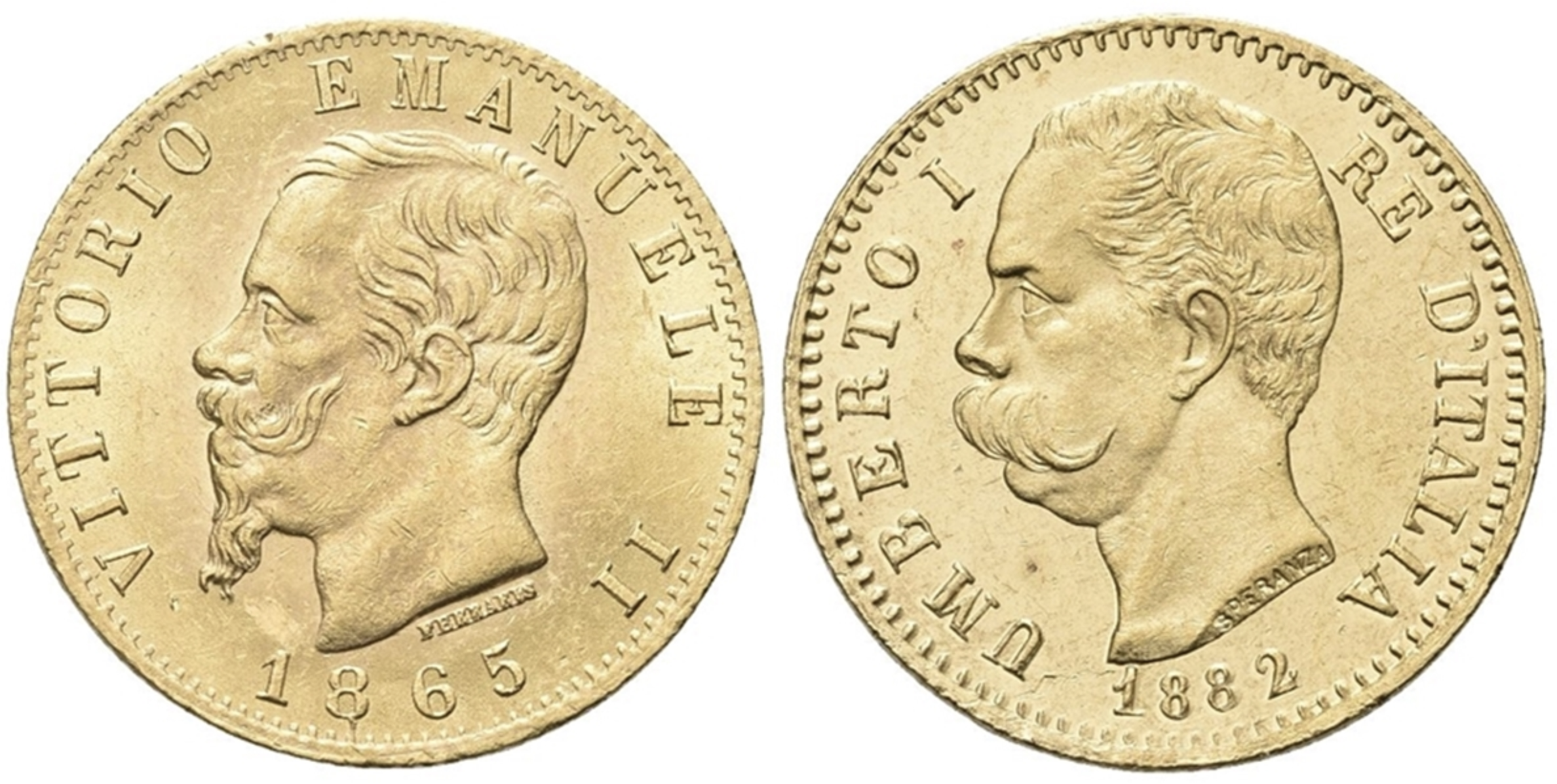
Author of the die axis or coin rotation was Giuseppe Ferraris which he portrayed on the obverse of the the king, Vittorio Emanuele II to the naked neck, facing to the left (the signature Ferraris is small, below the neck) and is surrounded by the name and the date of issue at the bottom. Just as the classic obverse, with the royal coat of arms, crowned and surrounded by the collar of the Annunziata, the whole between two branches of laurel; at the sides the words “Kingdom of Italy” and in the lower the value, and the signs of the mint (T to Turin, M Milano, R-Rome).
The Marenghi of Vittorio Emanuele II were produced continuously until the 1878the year of the death of the Sovereign. Because of the large number of pieces in circulation, except for a few dates, the value is equal to that of the gold content (5.80 gr.). Some of the dates, however, are of limited availability to the low number of parts produced, therefore, possess a value numismatic well beyond that of the gold content.
The Ticks responsible for the production of these coins were from the 1861 to 1870 the mint of Turin. From 1870 up to 1878 the mints of Rome and Milan. The mint marks are provided on the back next to the thousandth are: T (Turin), R (Rome) and M (Milan).
Considered to be extremely rare, in 1873 the mint of Rome (from 2,000 to over 10,000 € for a perfect exemplar) and very rare 1870, Rome (from 800 to over 3,000 € for a perfect exemplar).
20 lire, or Marengo coined under Umberto I
The Marengo gold 20 Lire Umberto I changed compared to that of the previous king and the official mint-enabled its production was only that of Rome.
Umberto I, nicknamed the “kind King” of the House of Savoy is in the picture to the right of the coin, while the reverse side, in the upper part, between the two branches, there is the Stella d'italia (the symbol “country”, that is, the allegorical representation of italy). Outside of the crown, down to the hour of seven close to the edge, you will find the sign of the mint of Rome “R”. More externally, as with the straight, is this the pattern formed by a series of small cones. The edge of the coin is milled, and the axes are to the French.
The Marenghi Italian Umberto I have been minted around 8.763.000 specimens over the years: from 1879 to 1886, 1888, 1889, 1890, 1891, 1893, 1897.
As often happens with any coin of value, even the Marenghi rare Umberto I have many fakes in circulation. They are basically identical copies, in terms of size, weight and fineness, to the original and put in circulation by the forgers of the time, and therefore devoid of value coin.
The most common of minting is the 1882, the year in which they did beat the gold coins, for a total of £. 139.523.000 (1.129 specimens from 100 lire, and the rest in “marenghi”) as there was a transformation of gold bars and coins in gold is not a decimal, the result of a loan of 644 million lire requested and received from the Italian government abroad, to cope with the conversion to the metallic currency of paper money, in the aftermath of the law (7.4.1881 nr. 133) that abolished the “circulation”. A circumstance that is certainly unusual, and that will not be repeated in the history of the country)
the justification for imposing the minting of gold coin from £ 20 with a specific one-thousandth, scrupulously reported in accordance with the article 11 of the Convention monetary latina.
The signing took place in London for work, especially of the lords of Baring Brothers & C., and C. J. Hambro & Sons (the Bank of Escompte of Paris vi figure for a small part) and Italy received the whole of the 644 million, of which 488 million in gold and 156 in silver scudi of the Latin League, yielding lire 36.487.250 income, 5 percent corresponding to the capital of lire 729.745.000.
20 Lire Marengo Vittorio Emanuele II
20 Lire Marengo Umberto I