

Description
Type: Kruggerrand
- Material: Gold
- Mint: South African Mint
- Actual weight: gr. 33,83
- Weight of pure gold content: gr. 31,1 (1 troy ounce)
- Pure gold: 916,66 % (22 carat)
- Diameter: mm 32,77
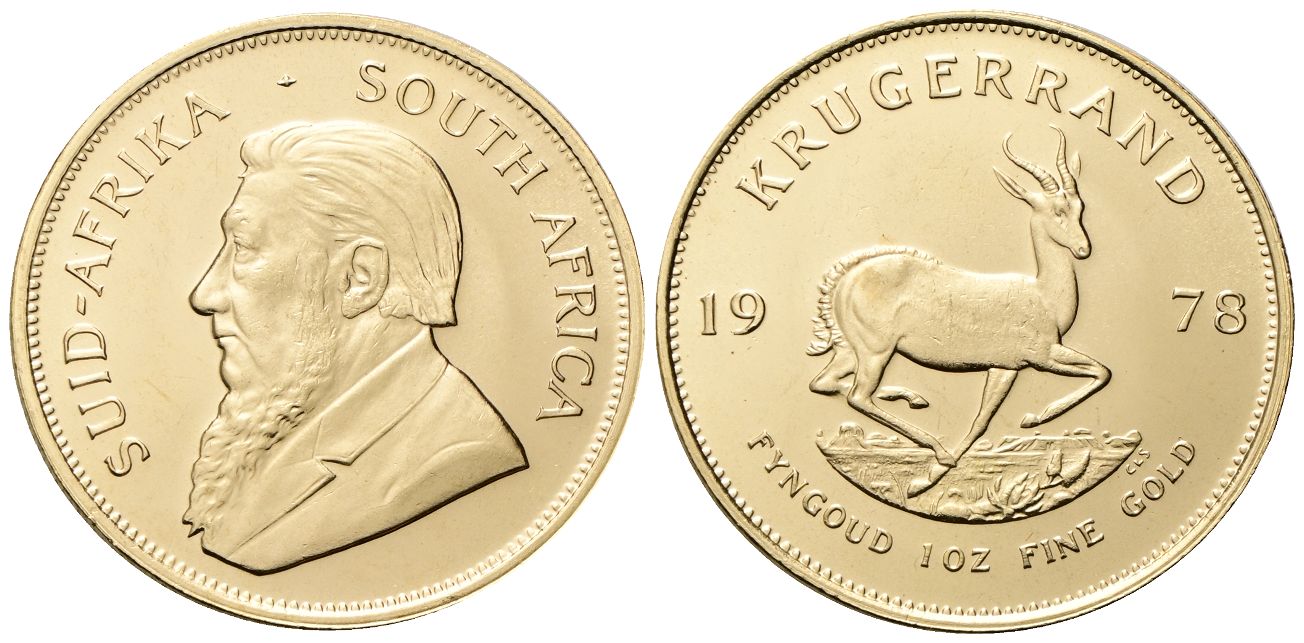
- The period of coinage: from 1967 to today, which presents to the dr., the portrait of Paul Kruger and the rv. the gazelle of south africa .
The Krugerrandminted by the South African Mint from 1967 to today, is recognized globally as a great choice for investing in gold. This coin, the first to be denominated in ounces of pure gold, has revolutionized the market of physical gold.
The Krugerrand is made of gold 22 carat (91,66% of pure gold), with a small percentage of copper (8,33%), which gives it the characteristic orange colour and increases the resistance to scratches compared to the other coins in silver alloy.
In 1980, to respond to a question of the market's most diversified, were introduced fractions 1/2, 1/4, and 1/10 of an ounce, each with their weight and diameter proportionate.
In that year, were produced gold coins from:
• 1 oz (33.93 g gross weight of which 31.10 g. of pure gold, with a diameter of mm 32.77)
• 1/2 oz (16,96 g gross weight of which 15,55 g of pure gold, with a diameter of mm 27,07),
• 1/4 oz (8,48 g gross weight of which 7.78 g of pure gold, with a diameter of mm 22,06),
• 1/10 oz (3,39 g gross weight of which 3,11 g of pure gold, with a diameter of mm 16,55).
In 2017, on the occasion of the fiftieth anniversary, it launched a version of pure silver.
The name “Krugerrand” is derived from the fusion of two elements significant for south Africa: Paul Krugerthe president of the Republic of Transvaal at the end of ‘800, for which a figure stands on the obverse of the coin), and Witwatersrandthe region's mining hub of gold mining in south africa.
On the front of the coin, the work of the German sculptor Otto Schultz, you can see the profile of Paul Kruger, surrounded by the inscription “SUID-AFRIKA” (afrikaans), and “SOUTH AFRICA” (English). The back, designed by the sculptor south african Coert Steynberg depicts an antelope Springbok, a national symbol of south Africa, with the engraving of “KRUGERRAND”, the year of minting and the value of the currency. Both sides have notches along the edge.
Coined initially to support the market of the gold south african Krugerrand quickly became a tool for the legal possession of gold by private citizens. In the United States, for example, prior to 1974, the prohibition of owning gold bars and coins, the u.s. made the Krugerrand a perfect option for investors.
Between the ’70s and ’80s, the success of the Krugerrand was brought to a standstill. Many western countries, including the United States and members of the European Community, and blocked imports of the coin as a sign of protest against the regime of Apartheid established in south Africa. Despite these sanctions, and the birth of coins competitors such as the Gold Maple Leaf canadian (1979), the Nugget of australia (1981), and the Gold Eagle of the united states (1986), the Krugerrand retained its prestige, returning protagonist on the international markets by the year two thousand.
Today, the Krugerrand is still a legal tender in south Africa, equal to that of the Rand, and is VAT exempt, in Italy. It is estimated that more than 54 million Krugerrand were placed on the market, making it the coin investment is most widespread in the world.
The gold is from millennia store of value universally recognized. In spite of its value may fluctuate, millions of people in the course of the centuries have benefited by possessing it at the right time, often as a form of insurance against the unexpected or to preserve wealth. Provide for the “right time” to invest in gold requires in-depth research and monitoring of the indicators of the market, and the final decision is always personal.
The Krugerrand is still one of the choices to a more solid for those who want to invest in physical gold. Its long history, the recognition at the global level and the ease of the swap make it a point of reference in the panorama of coins and bullion. It is appreciated not only for its intrinsic value, but also for its iconic design aesthetic and robustness of the technique of its own currency.