

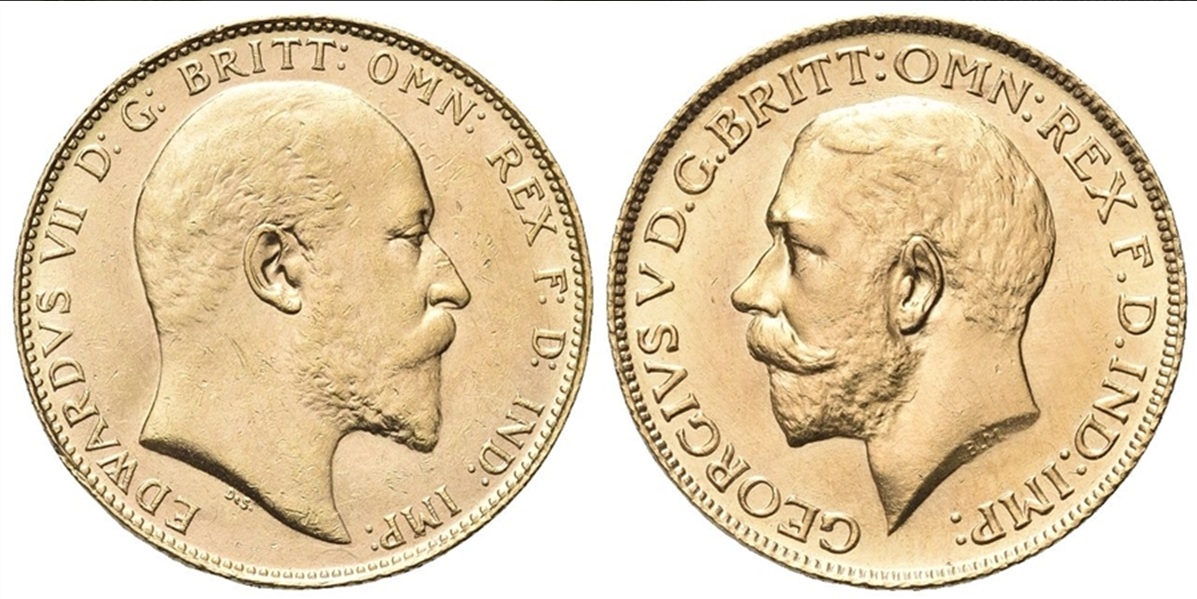
Descrizione
Type: British Pound
- Material: Gold
- Mint: Royal Mint
- Actual weight: 7.98805 gr
- Weight of pure gold content: 7.32 grams (0.2354 troy ounces)
- Pure gold: 917% (22 carats)
- Diameter: 22.05 mm
- Minting period: 1817 to present featuring the effigy of Queen Victoria, King George, King Edward VII, King George VI, Queen Elizabeth II.
For those looking for a specific year of issue for this coin, please contact us before placing your order so we can check if it is available in stock.
PHOTOGRAPHS ARE ALWAYS TO BE CONSIDERED AS EXAMPLES: COINS WITH DEFECTS OR COMING FROM MOUNTINGS ARE NEVER SHIPPED.
HISTORY
The gold sovereign is undoubtedly the best-known and most popular investment coin.
In modern times, the Sovereign was produced as a bullion coin from 1957 to 1968 (first portrait of Elizabeth II) and from 1976 to 1984 (second portrait of Elizabeth II). From 1983 to 1999, only proof coins were minted. Since 2000, the previous minting has resumed. From 1817, the year in which the modern gold sovereign was minted, to today the coin has retained the same characteristics: official weight 7.988g, gold fineness 916.66 ‰ (22 carats), pure gold content 7.322g, diameter 22.05mm, thickness 1.52mm.
The first Gold Sovereign (for the English Gold Sovereign) was minted on 28 October 1489 by Henry VII (1457-1509).
The King ordered officials at the Royal Mint to create a new gold coin, even though England had already had one in circulation for nearly a century and a half. The new coin was to be the largest ever seen, both in size and value, and was to be called the Sovereign. Such a magnificent name, however, must have been well deserved; that is why the obverse shows an enthroned portrait of the crowned King in full pomp, and the reverse features the Royal Arms and a double Rose, symbolizing the union of York and Lancaster after the Wars of the Roses. The name “Sovereign” was clearly intended to enhance the king’s dignity and convey a political message of stability and prestige, and was not intended to satisfy domestic or international commercial needs. The coin had a face value of 1 pound, with no face value. Under the reign of Henry VII, Sovereigns were made of 23-carat (96%) gold and weighed half a troy ounce (15.55 g). His successor, his son Henry VIII (1491–1547), reduced his purity to 22 carats (92%); since then, the 22-carat purity became (and remains) the standard for gold coins in both the United Kingdom and the United States. Minting of the sovereign was discontinued in 1604 after the death of Queen Elizabeth I (1533–1603), daughter of Henry VIII and Anne Boleyn, and was replaced first by the Unite, then the Laurel, and finally the Guinea.
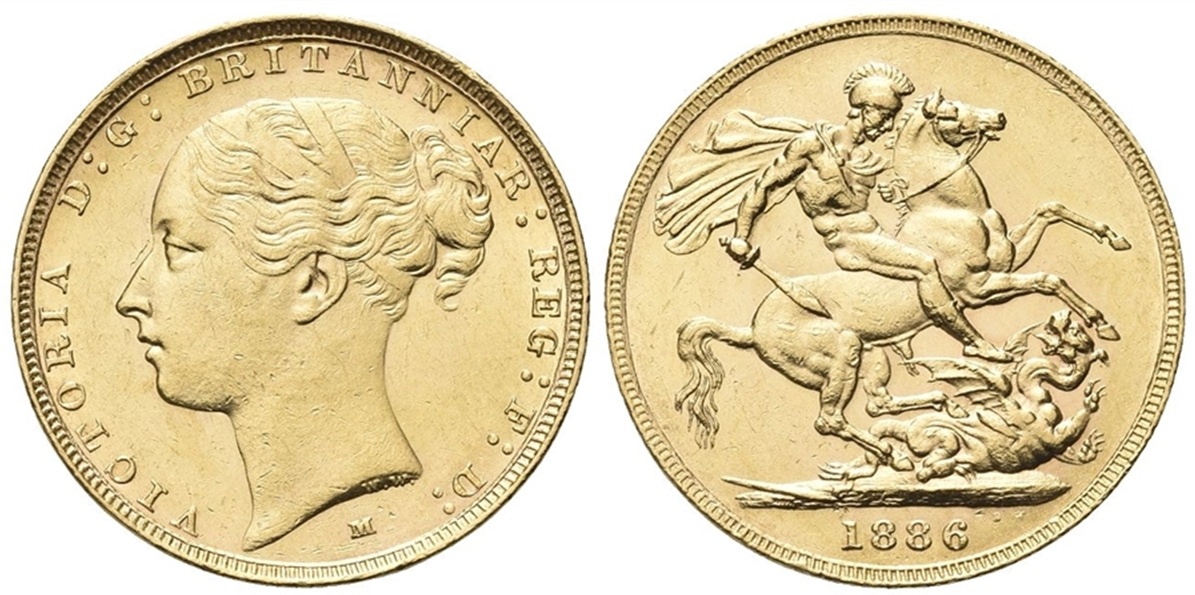
On June 22, 1816, during the reign of King George III, the English Parliament voted to abandon silver as the basis of the monetary system in favor of the gold standard. In 1817, the 21-shilling gold guinea was replaced by a new 20-shilling sovereign. The image of Saint George slaying the dragon appeared on the coins for the first time, created by the young Roman engraver Benedetto Pistrucci (1783-1855). Pistrucci, who had traveled to London in 1815 to work at the Royal Mint, was commissioned to create the reverse design, the famous Saint George slaying the dragon. Although it has been modified several times over the years and other reverse designs have been created, especially during the reigns of George IV, William IV, Victoria, and Elizabeth II, Pistrucci’s design remains the favorite, while the traditional depiction of the reigning sovereign on the coin’s obverse has always been respected. The stability of this monetary system was one of the keys to British commercial success in the 19th century, also thanks to the engraving of the young Pistrucci, proving to be the most popular and versatile coin in foreign lands.
In 1919, after the First World War, the gold standard was abandoned, only to be reintroduced in 1926, leading to the definitive abandonment of the convertibility of gold coins on 21 September 1931 (the last year of minting was at the South African Mint in Pretoria in 1932). Coins for circulation resumed from 1957 to 1982, but they circulated mainly among collectors and investors. Then, between 1983 and 1999, only proof coins were minted , while from 2000, in addition to proofs, brilliant coins, or brilliant uncirculated (BU), were issued.
At the behest of Queen Elizabeth II, the Royal Mint resumed minting them in 1957, both to satisfy the enormous demand and to curb counterfeiting from Italy and Syria, a thriving business after production ceased in 1917. In addition to the Sovereign, also known as the Full Sovereign, the Royal Mint also minted the Half Sovereign, the £2 (Double Sovereign), and the £5 (Quintuple Sovereign). Only the Sovereign and Half Sovereign were normally minted for circulation, while the Double and Quintuple Sovereigns were minted in limited quantities (primarily for collectors) because, given their size, they were susceptible to clipping. It was easier to remove gold by filing them or drilling microscopic holes and then hiding them by hammering. Even today, the gold sovereign is considered one of the most beautiful coins in Europe, if not the entire world, and since the 1930s and 1940s it has been the most sought-after and best-known. It has always been highly prized by savers, collectors, and numismatists, and has also been used as an “emergency currency” for decades. As mentioned, Allied pilots during the Second World War carried gold sovereigns in their survival kits, mostly 1925 King George V sovereigns, London Mint. Even in Desert Storm, American pilots and British SAS troops carried these historic coins as emergency cash in case they were shot down over Iraqi territory, proving that the British currency is synonymous with instant liquidity everywhere. Further proof of this is Timothy Green’s famous account in his book “The Gold Story.” Before the German invasion, in the winter of 1941, the family of a wealthy industrialist had converted their entire fortune into approximately 3,000 gold pounds, which they hid behind door frames: “When the Germans arrived and occupied the factory, without these savings we would have stared. We often dismantled doors to get the money that allowed us to live. Although we didn’t realize it immediately, most of our relatives had done the same thing. But my grandfather, who had faith in the Greek currency, found himself with a bundle of worthless notes and lost his entire fortune.”
The gold sovereign was made of 916.66‰ gold (22 carats) and had a diameter of 22 millimeters; these characteristics are still valid today. The official weight is 7.98805 grams, so the fineness content is 7.322325913 grams.
The gold pound is one of the most iconic and historically significant coins in the world. Its history is closely intertwined with that of England and, more generally, with the evolution of the international monetary system.
The table summarizes the minting periods of gold sovereigns, from 1817 to the present day, by portrait, main characteristics and variants:
Minting dates and variants of the pound
| Monarch | Design of the law | Reverse design | Date |
| George III | Laureate Head | Saint George and the Dragon | 1817 – 1820 |
| George IV | Laureate Head | Saint George and the Dragon | 1821 – 1825 |
| George IV | Bare Head | Coat of arms | 1825 – 1830 |
| William IV | Bare Head | Coat of arms | 1831-1833, 1835-1837 |
| Victory | Young Head | Coat of arms | 1838, 1839, 1841-1866, 1868-1887 |
| Victory | Young Head | Saint George and the Dragon | 1871-1887 |
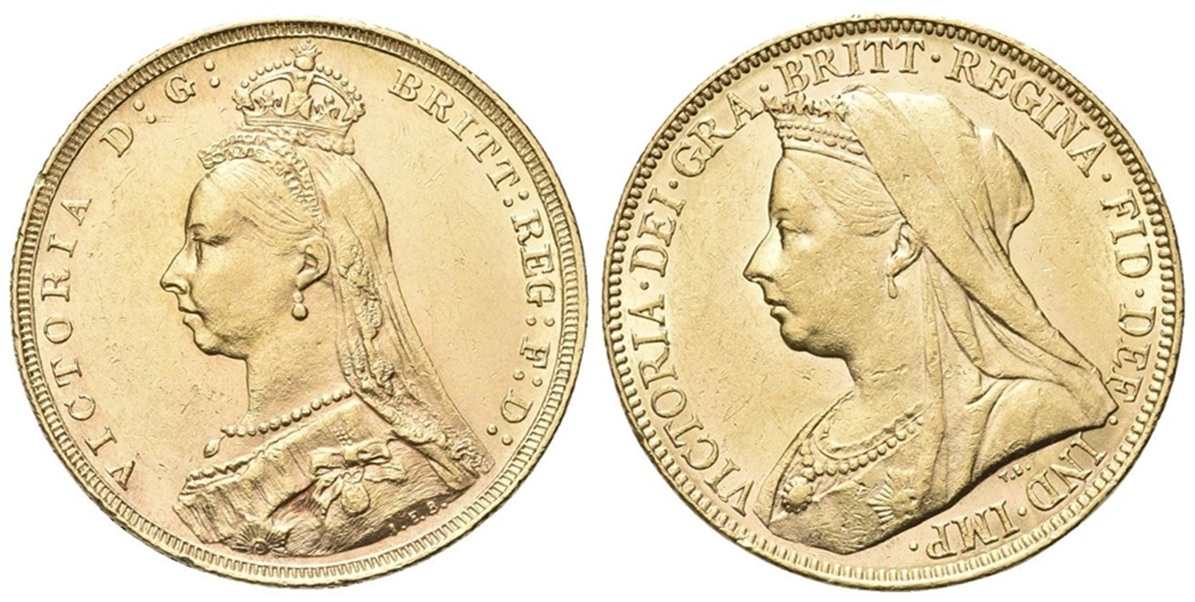
| Victory | Head of the Jubilee | Saint George and the Dragon | 1887-1893 |
| Victory | Veiled Head | Saint George and the Dragon | 1893-1901 |
| Edward IV | Bare Head | Saint George and the Dragon | 1902-1910 |
| George V | Bare Head (1st type) | Saint George and the Dragon | 1911-1928 |
| George V | Bare Head (2nd type) | Saint George and the Dragon | 1929-1932 |
| George VI | Bare Head | Saint George and the Dragon | 1937 |
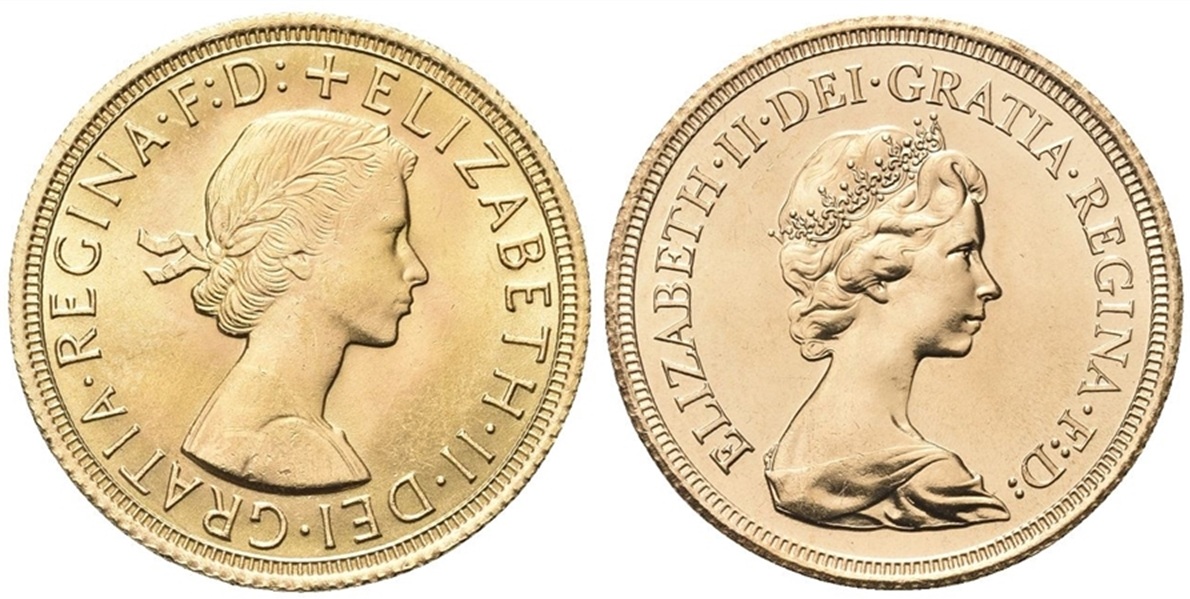
| Elizabeth II | First portrait (ribbon) | Saint George and the Dragon | 1957-1959, 1962-1968 |
| Elizabeth II (Proof only) | Second Portrait (diadem) | Saint George and the Dragon | 1974-1976, 1978-1984 |
| Elizabeth II (proof only) | Third Portrait (Gothic crown) | Saint George and the Dragon | 1985-1988, 1990-1997 |
| Elizabeth II (proof only) | Queen on the Throne | Tudor Coat of Arms | 1989 |
| Elizabeth II (proof only) | Fourth Portrait | Saint George and the Dragon | 1998-1999 |
| Elizabeth II | Fourth Portrait | Saint George and the Dragon | 2000, 2001, 2003, 2004, 2006-2011, 2013-2015 |
| Elizabeth II | Fourth Portrait | Coat of arms | 2002 |
| Elizabeth II | Fourth Portrait | Saint George and the Dragon (modern drawing) | 2005 |
| Elizabeth II | Fourth Portrait | St. George and the Dragon (Diamond Jubilee) | 2012 |
| Elizabeth II | Fifth Portrait | Saint George and the Dragon | 2016, 2018, 2019, 2020, 2021 |
| Elizabeth II | Fifth Portrait | St. George and the Dragon (bicentenary coat of arms) | 2017 |
| Elizabeth II | Fifth Portrait | Coat of Arms, Platinum Jubilee | 2022 |
| Charles III | First portrait, commemorative coin | Coat of Arms, Platinum Jubilee | 2022 |
| Charles III | Charles crowned | Saint George and the Dragon | 2023 |
| Charles III | First portrait | Saint George and the Dragon | 2024 |
| Charles III | First portrait | Saint George and the Dragon | 2025 |
STERLING BOW
STERLING CROWN
VICTORIA STERLING COAT OF ARMS
VICTORY DRAGON POUND
POUND VICTORY JUBILEE
Veiled Victoria Sterling
EDWARD VII POUND
GEORGE V POUND